


Peach Growing In The Cold North
Description
This section is from the book "The American Garden Vol. XI", by L. H. Bailey. Also available from Amazon: American Horticultural Society A to Z Encyclopedia of Garden Plants.
Peach Growing In The Cold North
The peach and apricot must be protected here in northern Vermont. No method of protection that I have ever known is practicable, and at the same time cheap and easy to manage, except the one I shall here describe.
The tree must first be rightly trained, to do which you should procure a tree not more than one year old. A June-budded tree would be good, or better, one in bud. It should be planted where it is wanted to grow, and all branches must be cut off, leaving the central shoot, upon which allow only one bud to grow. The tree should be visited every week or two, and all branches that have started out on the new shoot should be broken off, taking care not to injure the leaf below it. These little branches should not be allowed to get more than an inch or two long. The object is to get a long, slender cane without branches. Fig. 1 shows a tree in training; a a, are the little branches near the top that should be broken off. All the others below them have been removed. About four or five weeks before frost may be expected, you should stop breaking off the branches so as to allow the wood to ripen enough to stand the winter. On the approach of freezing weather, place a round block wood on the ground at the root of the tree, and slowly bend the cane down over it and fasten it there with a hooked stick driven into the ground. Then cover the cane with a couple of boards, nailed together at their edges to form a trough. This is all the protection it will need.
When the frost is out of the ground in spring, remove the covering and straighten up the tree. After it has begun to grow, cut or rub off all the branches and allow but one bud to grow, and treat the tree just as you did the previous season. At the end of the third season you will probably have a cane long enough for your purpose. Now the tree should not be lifted up in the spring but is kept in a horizontal position and allowed to grow up at the end and form a head, which should be trained fan-shaped and parallel with the horizontal trunk. Fig 2 shows a tree trained ready for bearing.
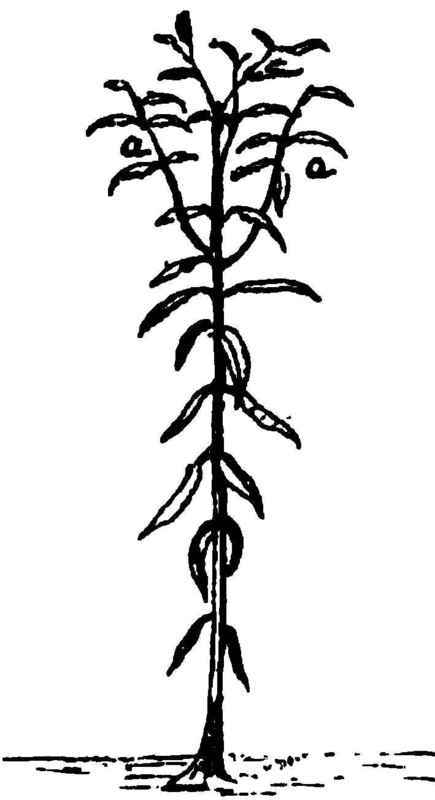
Fig. 1.
There should be a soft pad of straw or cloth between the tree trunk and the block. On the approach of freezing weather loosen the tree from the supporting stake, and after having placed some evergreen boughs or boards on the ground to keep the twigs off the earth, bend the head of the tree down side wise to the ground, and weight it if necessary ; then cover the whole head with boards. I have tried covering with evergreen boughs, covering some trees a good deal and some but a little. Those that had the most covering were killed by the snow drifting in and over the covering, and then turning to ice around the twigs during thaws. Those that were covered the least did better, while some that were laid on the ground without any covering bore some fruit the next season, but there is danger of their being injured by the sun in winter. I now cover with boards, and find it to be the easiest; cheapest and best method.
The object of the horizontal trunk is to have a portion of the tree that can be easily twisted to allow the head to lie fiat on the ground, and this trunk meets the requirement perfectly. When I first began this method some told me that the horizontal trunk would soon get too large to be twisted, but this is not the case if the trunk is long enough, for a trunk so trained and supported does not increase in size nearly so fast as a short, upright one does. This trunk should not be less than ten feet long : twenty feet would be better, but it would take longer to get it. I omitted to say that this low trunk should he protected from the sun during the entire year. Two boards, six inches wide and a little longer than the trunk, nailed together at their edges like a trough and turned over the trunk, will be sufficient.
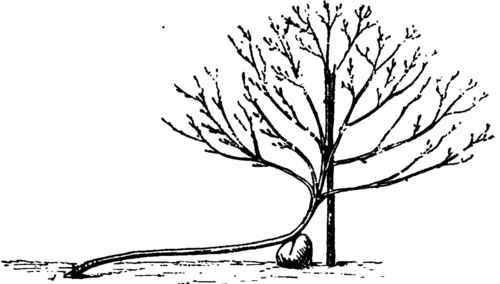
Fig. 2.
I began my experiment with about fifty trees which I raised from pits and budded, but during the process of learning my lesson, I have lost all but seven. The covering with boards saved these. They have been in bearing three years, and most of them are fine thrifty trees. I am so elated and confident that I intend next spring to plant out a lot of young trees, which I budded this season.
Besides the peach and apricot, the plum and the cherry can be grown in this way where they will not otherwise succeed. It requires some patience to get the trees into bearing, but when the training is finished it is not so much work to cover one of these trees as it is to prune and cover a grape vine; and who would go without grapes because of the trouble of taking care of the vines ?
Vermont. J. T. Macomber.
Continue to:


My Books

