


Automatic Ventilation
Description
This section is from the book "The American Garden Vol. XI", by L. H. Bailey. Also available from Amazon: American Horticultural Society A to Z Encyclopedia of Garden Plants.
Automatic Ventilation
NUMBER of letters have been sent to the editor of The American Garden asking for more information concerning the automatic greenhouse erected by Mr. Charles Barnard, of Stamford, Conn., and in an interview Mr. Barnard gave further particulars of his experiments.
"We first took out one of the lights of the middle sash, and over this opening placed the wooden trunk and chimney described in the October number of The American Garden. At first we had no valve as seen in the illustration on page 611, and in place of this we had a metal valve, taken from the top of an old incubator. The first experiments were with apparatus already used to ventilate the incubator. We took the entire apparatus - thermostat, cranks, rods, valve and connections - from the incubator, and by turning them around in another position fitted them to the underside of our ventilator. The thermostat was of the rod type, the rod being covered with rubber. We made a new frame for the rod, and then hung it just under the glass at one side of the ventilator. It was then an easy job to connect the bar with the arm that operated the valve, and once set up, the apparatus worked to perfection for many weeks without a single failure.
"The whole thing was simply an automatic ventilator taken out of an incubator and fitted to a greenhouse. Of course, the house was many times larger than the incubator, and it would seem impossible to use it to advantage. Practical, daily experience through many weeks showed that it would do the business. It can be explained in this way. The thermostat (as in all incubator thermostats) could be adjusted to various temperatures, and we set it to operate in the full sun at the very top of the house at 8o° Fahr. It proved to be very sensitive, and the valve began to open very soon after the sun shone upon the thermostat. At 850 the ventilator was wide open. At 830 it would begin to close, and at 790 it was closed tight.
"The result was that the heat was released the instant the house became too warm, and the warm air went out in a swift and steady stream all the time the ventilator was open. The smoke from a lighted match held at one end of the house would travel along under the glass and curl up into the ventilator, while a candle flame held near the ventilator would be bent out of shape and lay horizontal with the point to the ventilator. The secret of the successful working of such a small ventilator seemed to be in the tall chimney over the valve. No cold air could get down into the house, and the hot air was swept out as fast as it gathered. A passing cloud would cause the ventilator to close, and it , would open again within two minutes of the return of the sunshine. The thing was a real and practical automatic ventilator, and kept the house at an even temperature for many weeks without attention. If two or, perhaps, three such ventilators had been put in we would have bad no further trouble. In February the sun became so powerful that the heat would accumulate faster than the ventilator could carry it off.
We then made a larger opening in the glass and put in a larger chimney with the valve shown on page 611. To operate this valve we made a thermostat according to the following description taken from the Scientific American" (See Figure 1).
"The instrument depends for its operation on the difference between the expansion of braes and steel. The linear expansion of brass is nearly double that of steel, so that when a curved bar of brass is confined at the ends by a straight bar of steel, the brass bar will elongate more than the steel bar when both are heated, and will, in consequence, become more convex.
"At 2 are shown two bars, the straight one being of steel, the curved one of brass. The steel bar is slit for a short distance in two places at each end, and the ears thus formed are bent in opposite directions to form abutments for the ends of the curved brass bars, two brass bars being held by a single steel bar, thus forming a compound bar as shown at 3. Each compound bar is drilled through at the center. Ten or more such compound bars are strung together loosely upon a rod, which is secured to a fixed support. A stirrup formed of two rods and two cross-pieces rests upon the upper compound bar and passes upward through the support. Above the support it is connected by a link with a sector lever which engages a pinion on the pivot of the index. The use to which the thermostat is to be applied will determine its size and construction. It may be used in connection with kilns and ovens and for operating dampers, valves and electric switches.
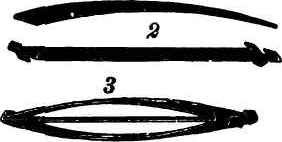
Fig. x. Details of the Thermostat.
' We made our thermostat with three springs only and hun'g it on the outside of the sash in front of the ventilator at a cost less than one dollar for the material. By means of bell-cranks and rods it was connected with the valve and caused it to open and close.
"From our experience last winter it would seem that a thermostat and ventilator taken from the top of an ordinary incubator can be made to ventilate about 100 square feet of glass through December and January and about 50 square feet in more sunny months up to April 1st. Two sash ventilators in an 18-foot house would be sufficient, one for dark months and one for lighter months. The large valve we used in March was too large for December, January and February. There seems to be no reason why such ventilators cannot be procured from the makers of incubators, and be used in greenhouses, giving one ventilator to carry 100 square feet of glass. Of course, the makers of incubators could supply larger ones by simply making new patterns for their ventilators and valves, and using the same thermostat and fittings".
Following up Mr. Barnard's most interesting achievements, the editor of the Garden is also experimenting with automatic ventilation, and some account of the results may be expected next month.
Continue to:


My Books

