


![next page: Grasses And Forage Plants, And Catalogue Of Plants [Of Nebraska]](../../images/nav/page_next.gif)
About Grass
Description
This section is from the book "The American Garden Vol. XI", by L. H. Bailey. Also available from Amazon: American Horticultural Society A to Z Encyclopedia of Garden Plants.
About Grass
Mrs. Tarryer Goes To The Connecticut Farmer's Meeting With Her Knitting-Work And Gets Some New-Old Matter To Tell Her Boys.
RE is now a growing curiosity about grass-seeds. They do not reproduce individual plants precisely and radically as roots do. Seeds vary a little b y degeneration year by year according to their environment, but that gives opportunity for selection and makes life more interesting and hopeful for the vigilant cultivator. If we care for the exact roots of a grass it is only necessary to see what we want in the broad page of the world's surface, and propagate that. Though seeds are lighter, nicer and easier of transportation than grass-roots, it is easier also to be mistaken and get cheated with seeds. This liability increases the chances of variation beyond what is pleasant sometimes; so Mrs. Tarryer believes that people should save their own grass-seeds, when they have any right good ones.
She went down to the Annual Farmers' Meeting of the Connecticut Board of Agriculture at Birmingham, in December. It is a sort of a feast of the passover for her. Having been born in the Nutmeg state, and living several years while she was young, in Rhode Island, she meets many old friends and acquaintances among those antique board-around teachers, and she likes nothing better in the whole year than to take her knitting-work and sit among a parcel of grey headed old farmers and hear them talk.
Since young scientists, fertilizer-men, grangers and their wives have begun tomuster strong at these meetings along youthwhatever local gardeners and rural politicians are attracted to the annually changing base of operations, these grand yearly gatherings have become doubly interesting.
Secretary Gold is a veteran caterer for the intellectual farm life in the new theology to be called the mother of gardening. He devoted a whole forenoon to roses, to the great astonishment of bystanders. He always manages to have a fast and lively programme, which he drives through like a valuable steer team bound home along a rocky and bushy road. There is plenty of time for discussions, and a free question-box to invite them. The talk gets pretty hot sometimes, but farmers have a native dignity and love of order (each being a little king in his own right), so there are never any rows, such as we hear of in almost every other sort of meeting. Latterly Mrs. Gold brings in music after each act; this empties our minds of deleterious matter, furnishes a soft packing for what is best worth saving, and a fresh basis for storage. So we go on through a protracted jam of mental fodder, which completely turns our livers over, so to speak, and sends us home with enough to think of for a year.
When Mrs. Tarryer found Charley Potter, the grass seed grower of Prudence island, was given a choice place in the bill of fare for showing how he cleans his fine grass-seed for market, she was bound to be there and see him do it, so as to be able to tell her boys how it is done.
Her fixed idea is that women are the mothers of industry and that nothing goes right which they don't have a thoughtful hand in. More women are of the same opinion than are always willing to own it, which is just as well as long as they think so, for we are often moved to best advantage by powers we are least conscious of.
Mr. Potter is a bright, plain farmer, tilling his 400 acres of rented land according to ancient recipes, with cattle, horses, sheep and hogs. He has a number of specialties besides that of growing the fine "peasant" agrostis seed, known by the trade name of " Rhode Island Bent," and counterfeited by common tall "Red-top" - now coming to be more of a grain than a forage-plant.
Fine agrostis is nearly "as old as the hills." Varieties of it are scattered in thousands throughout the north and probably in the south temperate zone. "British" botanists, in sorry league with city seedsman, the rack-rent landlord and the skinning plow declare these various forms of agrostis ** no use to agriculture." But yeoman and "statesmen," farmers, graziers, gardeners and the conservators of the land among all free races of men for ages, know the finer varieties of agrostis, under one name or another, as famous bottom-grasses for green meadows, solid sward for pastures and the sunniest fine verdure in open door-yards and lawns. "R. I. Bent" is "a good mixer," as they say out west, and so it lives in spite of neglect. But Mr. Potter is about the "last of the Mohicans" to grow this seed - singularly clean of others - for sale.
This island seedsman needs no naturalist to tell him that the turfing habit in a grass (like many other precious habits in vegetable and animal life), though fixed, still needs perpetuating in the conditions which produced its virtues, to preserve them. Hence he keeps sheep to trim, tread, manure and weed the green sward of his seed-pastures and meadows, as a long line of " Bent" growing ancestors did before him. Mr. Potter is that rare kind of a fine grass-seedsman whose exact science is inherited and traditional. He is actually living in the pastoral age whereof devoted city lawn-makers desire to preserve lovely turf emblems ! He made a very pretty appearance on the little opera-house stage; seemed as much at home there as if it had been his own barn-floor; and as he was wise enough to bring Mrs. Potter with him, so as to satisfy all reasonable social curiosity, the thousand questions fired at him by the audience only spoke the interest growing everywhere respecting grass-seed. The staff-writer of an eminent metropolitan journal (which gave an excellent report of the meeting) was so warmed up by the excitement of the occasion, as to confess, in private, that he wasn't aware before that grass comes from seed.
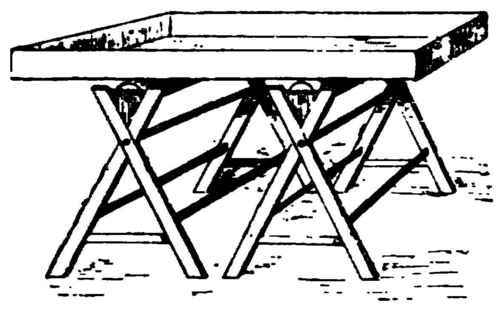
Such are the victories of peace! Mrs. Tarryer thought the whole scene worthy of a great historical painting, but our dabsters are not yet up to such a radical renaissance of agriculture and gardening. She finally begged a willing young woman of her acquaintance to make the accompanying sketch of one of the sieves, and the stand (a simple frame with four legs would bold the rollers just as well), used by Mr. Potter on the platform. His bags of seed, in the chaff, looked like the dust of home lot hay-mows. Passed through two sieves - 4 by 2½ feet - the first wth a mesh of 24, the second with 28 spaces to the linear inch, a product of golden-yellow agrostis seed - fine, light and silky - was the result. "Heavy Bent seed means dirt and foreign seed," said Charley Potter. *' That last sieve will take out white clover".
So much unclean seed is grown that trade is forced, at present, to advocate "mixtures," even for the choicest artificial grass-plats. Every observing seedsman knows better, but is helpless in the general stupidity. Till the public awakens to the folly of its ordinary practices, small lots of choice seed in the hands of great seedsmen will only be lost in their "mixtures," like nice cream in cooperative dairying. Mixed seed for weedy meadows and pastures is not so entirely reprehensible, but to mingle "Potter's Bent" with anything else for pure domestic purposes would be to waste it. "Sow my seed alone," he said. The finest sward for lawns everywhere is the purest one of whatever grass composes it. Mixtures of seed render a perfectly uniform sward as nearly impossible as the seedsman can make it.
The little rig pictured does not represent the complete horse-power thresher and separator Mr. Potter has adapted to his considerable business at home, but the sketch gives a sufficiently accurate notion of the simple contrivances used on the stage, and all that is needed by beginners in saving small lots of seed. Out of careful experiments widely extended, we may hope to grow an American grass-seed production for use and trade in the near future, whereof we shall not be ashamed.
Mrs. Tarryer was delighted with every feature of the meeting, but she was seen asking a grey-beard, if we were not "rather previous in paying so much attention to microscopic things - fungi, bacteria and so forth - while not a man of you could have crossed the street into Birmingham Green and give the right names to one of our common grasses!" Her idea is that instead of sowing seed for sward of whose sward-making qualities we know nothing, we should save seed from the grass that has shown itself able to produce precisely the sward we approve. There is a world of "service-reform " in it.
Continue to:


My Books

