


A Little Place In The Country
Description
This section is from the book "The American Garden Vol. XI", by L. H. Bailey. Also available from Amazon: American Horticultural Society A to Z Encyclopedia of Garden Plants.
A Little Place In The Country
WATER AS A SUBSTITUTE FOR TIME AND FERTILIZERS - GETTING A HELPER - WHAT TO PLANT - CONVERTING OUR LABOR INTO MONEY.
Sixth Paper.
MAXIMUM of pleasure and profit is to be obtained from the possession of our country home, only when it has been brought to the highest state of fertility, and consequent productiveness. It will take time, and the acquirement of a practical knowledge of the methods of practical men, to accomplish this result.
In the meantime we mu9t look about for the best substitute for these that we can find, to the end that we may keep the lawn green, have an unfailing variety of fine vegetables for the table, and that our strawberries may not become mere clusters of unpalatable seeds from an untimely drought, just as they should be ripening.
The best substitute that we can find for time, experience, and costly fertilizing will be WATER. If we can have plenty of that, and have it under our control, we may hope for success to crown our horticultural efforts, even on lands and in seasons that might otherwise afford but a poor return for our labors. It is true that water is not manure. But as all plants absorb their food only in a soluble form, it is of the highest importance as a medium for carrying the food. And even where soils are deficient in plant food, if water is applied regularly, it will render soluble, and consequently available, such supplies as the soil does hold ; and as it is less often the lack of plant food in the soil, than it is the inability of the plant to use such as there is, it will be easily understood that the results from poor soil richly treated may often be greater than from good soil wrongly treated.
The efficacy of water in the work of "making a crop" under unfavorable conditions was illustrated in my own case this summer. The overflow from a hydrant watered every day a poor ridge, which was crossed by some rows of cabbage, and by some cucumber hills. The cabbage headed much larger and earlier there than in other parts of the rows, and the cucumbers gave more fruit, and of course withstood a drought (which came in mid-season) much better.
There can be nothing more annoying to the amateur, or more productive of loss to the professional gardener, than to have the labor and hope of the early summer wrecked by a drought coming, as it so often does, just as we are about to reap the reward of our patient care. No one, until he has engaged in the making of a garden, can realize the poignant anxiety with which the forecastings of the weather prophet may be read, nor how anxiously the heavens may be scanned for a sign of rain.
The only feasible way, under ordinary circumstances, of providing an adequate water supply, will be by putting in,a wind pump, and connecting it with a system of tanks, pipes and hose. Where there are facilities for irrigation, this is, of course, unnecessary. But while the first cost of the plant will be considerable, it will be vastly better than a dependence upon a corporation water supply - even if that be available - where the recurring annual tax would soon amount to the entire cost of the individual plant.
In locating the pump there are other matters to be considered beside that of striking water easily. While that should have due weight, we must also endeavor to locate the pump as centrally as pos sible so that the various portions of the place may be reached without undue expense. And elevation must be considered, if it is the intention to use the water upon the more elevated portions of the grounds, or if it is intended to supply the upper stories of the dwelling from this source.
The elaborateness of the plant will depend upon the amount of ground that it is desired to cover. Thus if only the stable and a small garden are to be supplied, a single tank by the pump and a coil of hose will suffice. But to get the best use and money return from the outlay, tanks should be built upon various elevations, and kept supplied by means of iron pipes running from the central one.
The method by which the water is distributed to the plants must depend somewhat upon the formation of the ground. If it can be easily gotten to the head of slopes, it may be discharged there and allowed to find its way down by means of small irrigation channels, or it may be distributed by hose, as upon the lawns ; or in applying to young plants, where only a limited amount is wanted, it may be done with large sprinkling cans.
The vegetable garden will be the most directly benefitted by the water supply, and after that the strawberry beds. So, especial care should be taken to have tank's so located that these may be easily reached.
We have now progressed far enough, and reached that season of the year, when we must determine upon our plans of work for the spring and summer. That we shall have a garden, and a good garden, is a foregone conclusion. But just what its extent shall be, and whether it shall be solely for supplying our own table, or whether we shall make its scope sufficient to afford a surplus for sale, may be yet an open question. In suggesting the location which was outlined in the first of these papers, the idea was not only to select a place where the first outlay will not be large, but where the subsequent income from our labors might reimburse us, in part at least, for our expense in maintaining a country home.
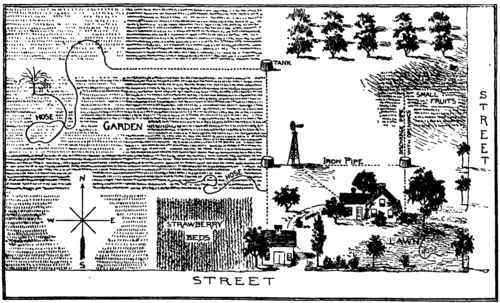
To have a good garden, such an one as will be satisfactory throughout the season, and competent to meet all demands upon it, even for the home table, from lettuce to late celery, will entail no small amount of labor and expense. I do not mean an amount that the product will not repay for a good garden does always pay. But so long as the care, the labor and the expense must attend the venture, if we are to get anything worth having, it will be wise to increase the quantity of each of these somewhat, and endeavor to get a money product that will leave as clear profit whatever we may use in home consumption.
To do this will require the services of a good vegetable gardener as a helper, and here it will not pay to be "penny wise and pound foolish." A good gardener, one who can use his eye and his brain, is worth incomparably more, especially to the beginner, than the man who can only hoe and dig; a knowledge of the "short cut" in planting and in cultivating, and in preparing vegetables for market, may save more than the difference in wages. While the more proficient a man is, the more wholesome pride will he have in his occupation, the greater desire to prove his value. But for the price which it will be wise to limit ourselves to, this first season of superintending, we must not expect too much. Do not look for an experienced fruit grower, a competent florist, and half a dozen other things in connection. If he is a good gardener, that must suffice.
Having found such an one, and become satisfied as to his habits of industry and sobriety, employ him at once. His services will be needed as early as the first of February in hot-bed work, preparing cold-frames, getting manure and composts ready, etc., and it will be well to make a contract for a term of nine months, as the last of the vegetable work will not be out of the way before the first of November.
A garden two acres in extent, if worked to its fullest capacity, will afford ample opportunity for the complete exercise of one man's powers. A greater mistake cannot be made than to suppose that chances for profit will be enhanced in proportion as his territory is extended. "A little ground, well tilled," is an old song; but it cannot be sung too often while its moral is so universally disregarded.
By a proper succession of crops, keeping the ground occupied the season throughout, the two acres will become five, at least.
The questions of what shall be planted, and when, and why, should all be canvassed and decided, as far as practicable, before the work is begun. Nothing should be left to chance. Our own tastes will be a pretty safe guide. In the early spring we want lettuce, and young onions, and beets, and radishes ; and we want them early - the earliest. So we may know that those who buy do likewise. And then we want green peas, and early cabbage, and cauliflower, and beans, and cucumbers. We know about what proportion we want of each (if not, our wives do), and that may guide us in planting.
After these, which are mainly for immediate use, come the crops which supply green vegetables for the table and for canning and pickling, as well. Such are late cucumbers and tomatoes. And those which are put away for winter use, such as potatoes, beets, onions, cabbage, turnips, celery, etc. The good garden - that which is directed by "sound mind and a sound body " - will fail in none of these.
Although a crop which is not yet planted is a long way from market, it is not too early now to be considering the method by which the surplus of the garden shall be disposed of. As we are not (at least as yet) professional market gardeners, we will not care either to sell them about town from a wagon, or to take a stall in the city market.
There are as yet comparatively few country or suburban towns in which one cannot find a grocery-man who would be glad to arrange for a steady supply of vegetables, grown close by, and sent fresh to his stand every morning. If such an one can be found, who will take the product and sell it on commission, it will be the most satisfactory arrangement that could be had. Failing in this, the the product may be shipped to commission dealers in the city, or it may be sold at home (and better prices obtained) by employing a man or boy for that purpose and giving him a percentage of the sales. The best buyers will always be glad to obtain their supplies direct from the garden of the farmer, rather than from the city, or even from the stand of the local grocer.
Even those who have gardens will be our customers, for the average amateur's garden begins late and ends early. By the time the hot suns of July begin to shine upon the garden, the amateur loses interest and gives up the battle with the weeds. So that just when he should be enjoying the profits of his labor, the garden yields nothing and its owner is compelled to buy from his wiser neighbor whose seed time and harvest have been planned to run through the season.
But to sit by a comfortable fire in this breezy month of January, and plan our garden, or even to walk abroad when spring winds blow, and say, "It shall be thus and thus," is a very different thing from that "four o'clock in the morning" courage that takes us upon the same ground with hoe and spade in hand. To plan is not to do; and success in gardening can only be had by the presence, supervision and personal work of the one who is chiefly interested in the great and mostly definitive question of profit and loss.
Continue to:


My Books

