


How To Cook Rice
Description
This section is from the book "The Pure Food Cook Book: The Good Housekeeping Recipes, Just How To Buy, Just How To Cook", by Harvey W. Wiley. Also available from Amazon: The Pure Food Cookbook.
How To Cook Rice

NOW comes a time when potatoes are high in price and may soar higher; why wouldn't it be a good plan to use rice sometimes instead of potatoes - rice which is not only a good cereal, vegetable, and dessert, but an unexcelled "left-over"?
Rice is most valuable as a starchy food. It has more starch than potatoes, although it has less tissue building material. It has a very slight mineral content and practically no fat. In fact it has less fat than any cereal that we use. It furnishes heat and energy, and is well adapted as a food for those engaged in hard physical labor, or extreme exertion. Rice is not adapted on account of the lack of proteid and fat, for a sole article of diet, but it is an admirable carrier for eggs, milk, and cheese, which impart to rice a valuable position in our dietary. In this way, strange to say, rice has come to be called an exclusive food in some Oriental nations, where it is used in combination with condiments to stimulate digestion, and with eggs, tomatoes, curries, cheese, for their added food value.
The Eastern rice has more nitrogenous value than most of the rice grown in America. The rice that we use in America is often highly polished - for appearance' sake - and is often coated with talc, to render the brownish kernels white and attractive. The public should demand either the unpolished rice, which has more nutritive value, or insist upon a digestible coating. This should not only be a nutritive saving but a money one, as the polishing process is an added cost to the production of American rice. At present, however, unpolished rice is more expensive because of the small demand for it.
" It is a disgrace that the most intelligent nation in the world should be so ignorant of the food value of the crops on which more people live than on any other, that they should insist on having their rice made as shiny as polished glass beads, although in so doing they are throwing away the best part of it. No rice eating people treat their rice as we do, and it is to be hoped that the small markets that have been started for the unpolished rice will lead to a general propaganda," so said the late Ellen H. Richards, the home economics' leader.
Most of the rice used and grown in Louisiana and Texas is Kiusha, - from Japan originally, - a short kernel which does not break as readily in the polishing process as the long grain, golden Carolinian rice. Buy the best quality of rice whose kernels are not mashed and broken. This is the first step in cooking rice successfully. Although there are numerous methods employed, yet everyone seems to agree that rice should be dry, and each kernel separate and distinct. All the Eastern nations like their rice harder than we, even as the Italians think that we cook our macaroni until it is too soft. Perhaps the rice eating people unconsciously feel that if their rice is hard, they are forced to masticate it more thoroughly, and thereby digest it more completely.
Cook the polished rice in the following way in order to remove practically all the talc coating. Do not wash first, but place directly into plenty of rapidly boiling salted water. Boil hard twenty minutes, then pour all through a colander and wash the rice in plenty of hot water. When washed, place all in the oven to steam and dry. If washed before being cooked, the talc is not entirely removed as it has a tendency to stick on. It is not advisable to use the water in which this rice was boiled for other cooking. . A rice ball is now made in which the rice is placed raw and the whole put into boiling water. When cooked, the water is drained through the perforations. This rice ball is illustrated.
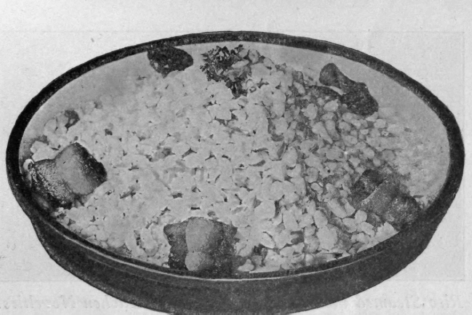
Hulled Corn with Crisp Bacon Curls. Recipe on Page 335.
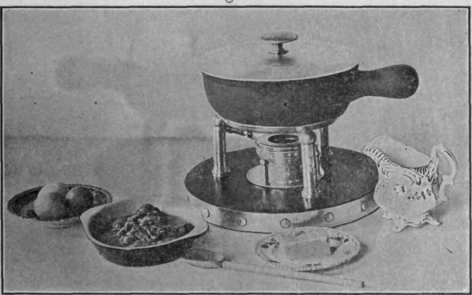
A Chafing Dish and Alcohol Lamp. The Casserole is an Attractive Novelty.
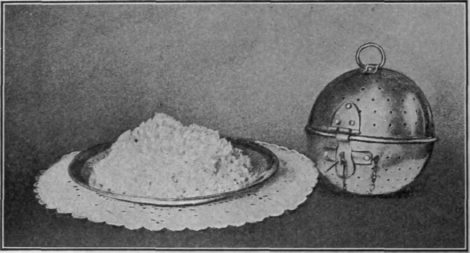
Rice Steamed in One of the Newest of Kitchen Novelties: a Rice Ball. Recipe on Page pp.
Raised Muffins. Recipe on Page 84.
Rice increases from two and a half to five times its bulk in the cooking process, its swelling depending upon the variety of the rice and its age. The older the rice the more water it will absorb. In boiling unpolished rice it must be remembered that it should be washed thoroughly in at least three waters, or put in a strainer and washed until the water from the rice is quite clear; rubbed briskly between the hands; boiled rapidly, so that the kernels do not adhere to the pot or to each other; and not stirred, else the rice will stick to the bottom of the pot and burn. Do. not cook rice with a cover on the pot.
Rice, like other cereals, must be thoroughly cooked, as it takes an appreciable length of time, at least twenty minutes, to render its starch content digestible. The Indian method, after the rice is cooked, is to put it in the oven for about five minutes, with the door open, and allow the moisture to evaporate.
Steaming is the best method of cooking unpolished rice, as in this way its scant proteid and mineral content is not lost in the water. If this rice is boiled, the water may be used for soup or sauce, in order to save the nutritive elements which escaped in the boiling process.
Continue to:


My Books

