


How To Buy Meats
Description
This section is from the book "The Pure Food Cook Book: The Good Housekeeping Recipes, Just How To Buy, Just How To Cook", by Harvey W. Wiley. Also available from Amazon: The Pure Food Cookbook.
How To Buy Meats
Tests For Fresh Wholesome Meat
FRESH, sound, sweet meat is, of course, the only kind to be considered. It is, as a rule, almost odorless, but has a slight fleshy smell that is pleasant to a normal person. The olfactory nerves usually may be depended upon to detect a tainted condition contracted by contact with fish, vegetables, or unclean vessels, cutting-block, or scales; decomposition due to exposure or undue delay in selling the meat; a strong natural odor such as is sometimes found in the flesh of old animals, especially males; or a rancid state as in stale cured bacon and ham.
There are those who relish meat, especially beef, that has " ripened " by remaining several weeks in cold storage at about 38 degrees Fahrenheit, the degree of ripeness varying from fresh to near-decay according to the time and conditions of storage and the quality of cut or carcass, and the objects being to improve both the flavor and tenderness of the meat. Only fat, mature beef, and mutton usually are subjected to this treatment, and, as a rule, only for such customers as city hotels, clubs, and the commissaries of other large establishments. The dark and sometimes quite moldy surface, high (not to say strong) odor, and the unattractive general appearance of such meats makes it unsuitable for regular retail trade because many patrons would consider it unsound; but when properly handled it is quite as wholesome as other foods which are artificially ripened, such as cheese or fruit. For ordinary use, two days to a week in the chill-room is sufficient. Meat used less than thirty-six to forty-eight hours after slaughter is likely to be tough, due to a set condition of the muscles called " rigor mortis."
Considerable quantities of frozen meat, also, are sold in retail market from late winter to summer, having been stored at about 15 degrees Fahrenheit since the preceding fall. If sold immediately after careful thawing, it is difficult to distinguish frozen meats from fresh, but as handled in some retail markets they sometimes become soft, flabby, and slimy. When from animals too young to be sufficiently developed for food, veal and spring lamb cuts have gluey or gelatinous flesh and abnormally soft, cartilage-like bone. Such meats should be carefully avoided. Although not necessarily dangerous it is at best repulsive and unwholesome.
Judging The Color
Perhaps the first characteristic that catches the eye is the color of the steak or chop under consideration. Good beef, when first cut, is a rich, bluish red, which turns bright cherry or pale red when exposed a few minutes. The blue or purplish shade frequently remains until the steak is unwrapped in the kitchen, and is not, as sometimes suspected, an indication of poor or old meat. Veal varies from almost white to light red, but should be a dull pink to be at its best. Lamb cuts range from light pink to grayish red, according to the age and quality of the lamb; and mutton is a dull brick red. Pork from young pigs is nearly white and that from older animals is dull pink or rose color. The fat of all meat should be as nearly white as possible, free from clots and spots, and of a firm, clear consistency.
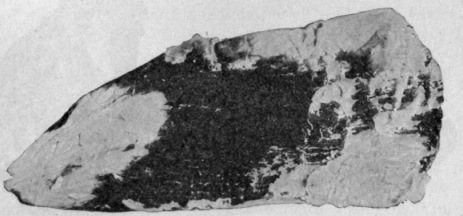
Flank Steak. A Juicy Beefsteak - Tender and Appetizing if Carefully Cooked.
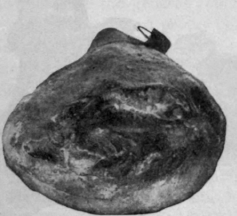
Inferior Ham.
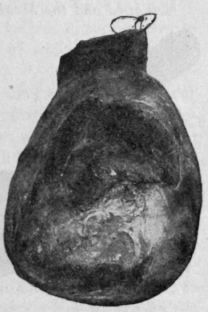
Choice Ham.
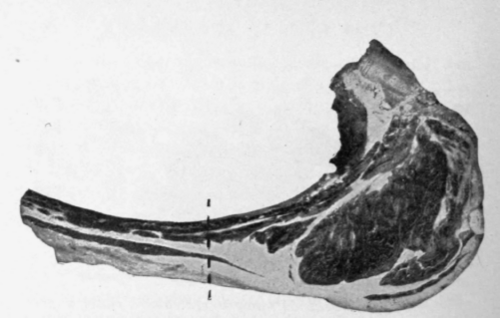
Standing Rib Roast. This Cat may be Roasted as it is, or made into a Short Rib Roast by Cutting Off the End at the Left; or the Bone Removed and the Meat Rolled Up.
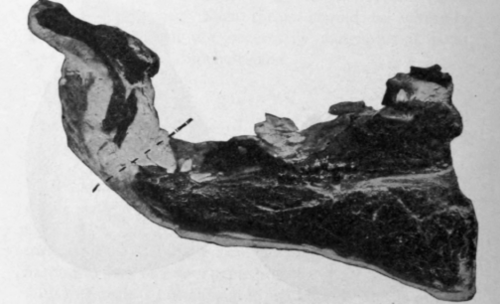
Common Porterhouse Steak from Stripper Loin. Represents Steaks used in Many Districts where Small Markets are Patronized.
Dark colored flesh, in general, is characteristic of older animals; is usually more pronounced in males than in females; and is sometimes due to incomplete bleeding. Generally, therefore, it is not of the best grade. But be not deceived by color, for it sometimes " happens," in violation of pure food regulations, that meat wears an artificial complexion, purchased at the drug store. Occasionally, too, a cut that is abnormally dark in color proves to be all one can desire as to its " eating qualities." The latter statement applies especially to the outer fat which, in beef cuts, is sometimes quite yellow, it applies also to dried and smoked meats, some of which can be appreciated only by tasting.
Now a few words which will serve to guide the reader to recognize the general appearance of good beef. Besides soundness and proper color, a tempting appearance in meat requires good shape - full, thick, and plump according to the kind of cut - even, smoothly cut surfaces, firm condition and absence of all indications of coarseness in the flesh and bone. Words can scarcely describe that subtle something called general quality; it must be impressed by actual observation of the details we are attempting to define; by careful attention, for example, to the size and shape of the " eye" of a rib-roast; the amount, character, and color of bone, as well as meat in a pork chop, the smoothness, thinness, and quality or rind on a strip of breakfast bacon.
As an exception to the rule, the unfavorable influence of the ripening process upon external appearance has already been mentioned. Certain kinds of cured meat, as for example Virginia hams, which hang for a year or two before being used, are most shrunken and unsightly; but the price commanded by such meats (fifty cents a pound for Smithfield hams) testifies to their inner goodness.
Continue to:


My Books

