


How To Buy Meats. Part 3
Description
This section is from the book "The Pure Food Cook Book: The Good Housekeeping Recipes, Just How To Buy, Just How To Cook", by Harvey W. Wiley. Also available from Amazon: The Pure Food Cookbook.
How To Buy Meats. Part 3
Choose Meat That Is Fat
Although most meat is used primarily for the sake of the protein, or lean tissue that it provides, the purchaser makes a serious mistake who objects to the so-called " waste fat" that choice meat must have, or who chooses unfinished lean cuts in order to avoid it. In the first place, the best quality of lean meat requires a sufficient outer layer of fat to give it good keeping qualities and a sightly appearance, and at least a moderate " marbling " of the cut to make it rich and tender. A roast, steak, or chop of good size should carry, usually, one-fourth to one-half inch of outside fat, and other cuts may have more or less, according to their class and size. Some of those who insist on the leanest bacon would find the thicker, fatter grades equally palatable and cheaper.
In the second place, fat meat is two and one-fourth times as nutritious from an energy standpoint as lean, and although a limited amount of it is sufficient for direct use, the remainder need not be wasted, but may be utilized in such forms as gravies and drippings, for which it is as good, or better, than butter. Finally proper cooking, particularly broiling and roasting, is impossible with extremely lean meat, and the percentage of shrinkage in cooking is high. If, from choice or for economy's sake, lean steak is ordered, it is well to get with it a piece of suet so that it may be made savory and served with its own gravy. The trouble is that our fancied economy is false; we would better save by selecting a cheaper class of cut, but looking well to its quality.
Cuts Of Meat Are Not Difficult To Learn
Notwithstanding a prevalent impression that the different cuts are difficult to distinguish, the truth is that they can be learned readily by anyone; for the structure of the bones and muscles is a guide that seldom leaves room for doubt as to the identity of any cut in the carcass. By referring to the diagrams and photographs that accompany these articles, and then closely observing actual cuts that the reader may venture to order from the lists given here, it will be found quite easy, after a little experience, to recognize at a glance any of the cuts that are commonly used.
Cuts of the quick cooking kind, given in the following list, may be either broiled or sauted. Steaks and chops, for best results, should be broiled (either grilled or pan-broiled) ; and for that purpose steaks should be cut three-fourths to one inch thick - thicker if desired - and chops one-half to three-fourths of an inch. Thin-cut chuck and round steaks, " drop tenderloins," and pork or mutton chops may be sauted if hard, overdone meat is preferred, as it is by some people with perverted tastes. Ham, bacon, salt pork, and breaded cutlets also are cooked by this method. None of the meats in this list ever should be actually fried, that is covered completely with hot fat.

Sheep or Lamb, Marked to Show the Retail Cuts.
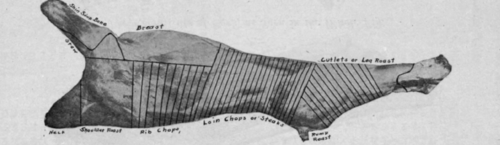
Showing where the Chops and Cutlets of Veal come in the Carcass.
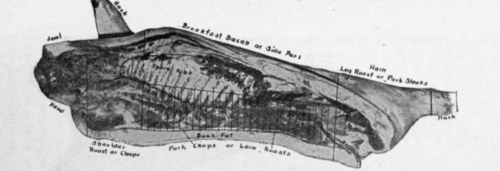
The Retail Cuts of Pork, as Seen in the Whole Pig.

The "Beef Creature," Marked Off to Show the Retail Cuts.
Continue to:


My Books

