


Bread
Description
This section is from the book "The Pure Food Cook Book: The Good Housekeeping Recipes, Just How To Buy, Just How To Cook", by Harvey W. Wiley. Also available from Amazon: The Pure Food Cookbook.
Bread
By Harvey W. Wiley, M. D.

THE term bread to the American means a product made of white flour. I am not an enemy of white flour, but I am a friend of whole wheat flour. There are many brands of white flour. For practical purposes in the kitchen we need only consider flour for bread making and for pastry making. The difference between these two classes of flours is chemical and correspondingly physical. Bread making flours are those which have a high content of very sticky gluten. This characteristic favors the entangling of bubbles of gas produced in the leavening process and their subsequent expansion held in the meshes of the gluten to make a porous bread. In pastry the leavening process is of less importance and hence a flour with a smaller content of gluten, a less sticky kind, may be employed. Or, again, a flour of second grade containing a great deal of what is known as middlings may be very useful for pastry making, especially when the whiteness of the finished product is not a matter of very great importance. White flour is the typical product for bread making in the United States. In Germany and Russia rye is the principal source of bread, and rye is used among our own foreign-born citizens to a large extent. Indian corn ranks next to wheat as a source of bread supply in the United States. This is especially true in the border and southern states, where a meal without corn bread is considered incomplete. There is no very great difference in the nutritive properties of the different cereals. Indian corn has less protein and the protein is less suitable for very young children. Oat flour has the largest amount of protein, and it is quite suitable for nutritive purposes, though it does not rank high as a bread maker. Barley, rye, and buckwheat occupy intermediate positions.
So important is bread that it is a synonym for all food. It is called by the poet " the staff of life." Bread making should be an art which every cook should learn. With the same raw materials two cooks will turn out products so different in character as to be hardly recognized as kin. The French and Austrians make the best bread among the nations of the earth. The characteristics of the loaf are largely brought about by the amount of manipulation, the kind and setting of the yeast, and the speed and completeness of cooking. Most of us like a bread which is largely crust. The long, so-called French loaf may very properly be called the " staff of life " as it might be used for a walking stick. Bread, that is to say cereals, is the ideal food. It is ideal both by reason of its economy and because of its nutritive properties. The cook should learn especially to make the so-called brown breads, which are not only palatable but highly wholesome. It is a mistake to feed a family nothing but white flour bread. It is both a dietetic and a nutritional mistake. Nevertheless white flour bread will continue to be, perhaps for many years, the principal kind of bread used by large numbers of people, hence the methods of making it in the right way are of supreme importance.
In connection with the subject of bread, it is well that attention should be called to leavening agents. There are three methods for leavening bread. First, the mechanical method, which consists in the admixture of air or carbon dioxid in the kneading of the dough. This method has been highly praised because of the fact that it introduces no foreign substances into the loaf. It requires, however, machinery and as a rule is not available for family purposes. The second method of aeration consists in the use of yeast. Yeast-made breads are generally the best, whether eaten cold, as is advisable in most cases, or in hot rolls, which are perhaps the most delicious of the bread products. Good yeast, skillfully employed, produces from the sugar of the flour equal quantities of carbon dioxid and alcohol. Both of these are in a gaseous form when the bread is baked and are active in the aeration process. Only small quantities of these bodies are formed and the alcohol is rapidly dissipated during the process of baking and on standing. Even the strictest prohibitionist may not refuse to eat yeast-raised bread because it may contain a mere trace of alcohol! Good yeasts also add a distinctive and desirable flavor to the loaf.
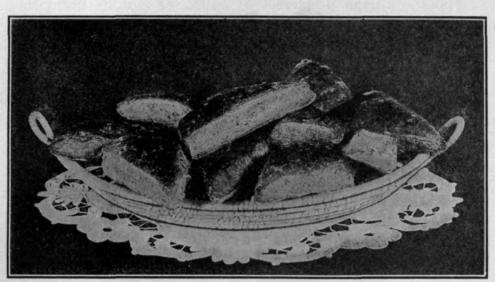
Cream Scones. Recipe on Page 90.
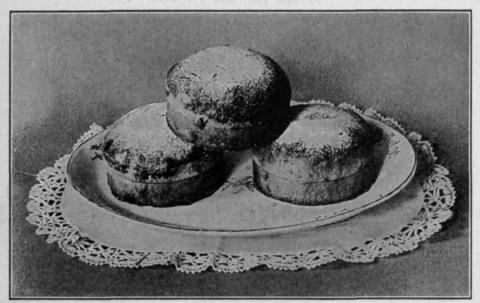
Sally Limns. Recipe on Page 89.
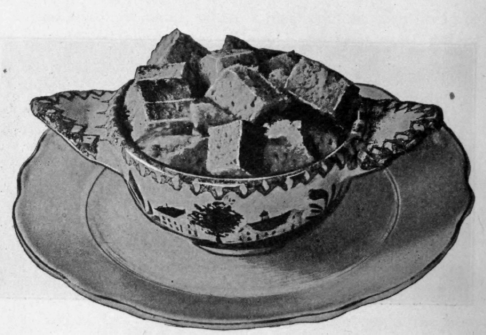
Rusk Squares in an Attractive Porringer are an Acceptable Dish for the Invalid.
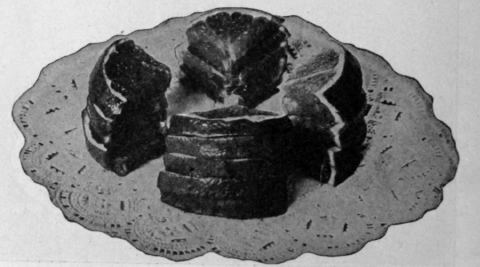
A Service for the Breakfast Orange that is Most Popular where the Fruit is Grown.
The third method of aeration is all too common because of its cheapness and speed, namely, the use of leavening powders. These " baking powders," so-called, are of three general classes; first, those made with cream of tartar, as the acid constituent of the powder; second, those made with phosphoric acid, or acid calcium phosphate, as the acid reagent, and third, those in which alum furnishes the acid ingredient. There is a great difference of opinion respecting the excellence and wholesome-ness of these classes of powder. We all have our individual preferences and as all of these powders are on the market, and usually correctly labeled, there is no reason why everyone should not be able to secure the one he wants. All of these leavening agents leave mineral residues in the finished loaf. The cream of tartar powders leave a residue of rochelle salts, that is, a double tartrate of sodium and potassium. The phosphate powders leave a residue of sodium phosphate and the alum powders leave a residue consisting of aluminum hydrate and sulphate of soda (glauber's salts). In my opinion, the ingestion of any considerable quantities of any of these ingredients is objectionable. Personally, I prefer the cream of tartar powders; others prefer the phosphate powders, and some believe the alum powders to be no more objectionable than the others. " You pays your money and you takes your choice."
Continue to:


My Books

