


How To Fold Napkins. Folding Serviettes. Part 4
Description
This section is from the book "The Steward's Handbook And Guide To Party Catering", by Jessup Whitehead. Also available from Amazon: Larousse Gastronomique.
How To Fold Napkins. Folding Serviettes. Part 4
Another Boat

The Boat is exceedingly pretty, especially if freighted with a few flowers. The serviette should be well starched to sit firm and sharp, and must be an exact square. First fold it in half like a shawl. Next take the corner A (fig. 1), and bring it to C. Turn over the serviette on the other side. Take the corner B, and bring it to C in the same way, but on the other side: this forms fig. 2. Fold fig. 2 in half by the line in the centre, bringing D to E, and forming fig. 3. Fold the point F to H. Turn over the serviette and fold G to H, on the other side: this produces fig. 4. Fold the half of the end J to K, producing fig. 5. Fold L to K, on the other side. These folds must be so made as to leave the upper part of the serviette, which will now again open and look like fig. 3, from F to G.

Fig. 1.

Fig. 2.

Fig. 3.

Fig. 4.

Fig. 5.

Fig. 6.

Fig. 7.
Slip the hand inside here, round it open a little, and so bring F to meet G, making it flat the reverse way: this is represented by fig. 6. Turn down the whole point M to N, on the thinnest side, like fig. 7. Slip in the thumbs at the opening at O in fig. 7, and holding the last fold firmly down; dexterously turning the Boat inside out: the inside fold resembles a capital A. Pinch the sides of the A the other way, making it an A again; and drawing out the Boat lengthways. Shape it a little with the hand. The bread may be slipped under the centre, A, or cabin of the Boat, provided it is not too large. A pretty addition to this would be to attach the carte de menu, by the means of a Chinese ribbon, to a chip, spill, or slender stick, and fix it in the Boat as a sail. The name card may also be attached to resemble an additonal sail.
The Hamburg Drum

The first three folds are made like those of the Mitre; namely, fold the serviette in half lengthways. Turn down the corners like fig. 1, fold it in half across the centre, inwards, from A to B, keeping the corners inside. It will now resemble fig. 2. Fold it again from C to D, into the shape of fig. 3. Let down the point E; turn down the corners F and G, to make a triangle uniform with the others: thus you have fig. 4. Let down the corner H, as shown in fig. 5: this corner must be the one that has the selvage on the lower corner. Make the fold by the dotted line in fig. 5: this produces fig. 6. Take the upper fold at A and B in the same diagram, open it back and crease it down to resemble fig. 7; turn the napkin over. You now have fig. 8. Fold over the edges C and D to E, to match the folds on the other side. Turn up the napkin again; turn up the point C, and bring the corners, E and F, together likewise. Slip the hand into the hollow at the base, as you did for the Mitre; and place over the bread.

Fig. 2.

Fig. 3.

Fig. 4.

Fig. 5.

Fig. 5.
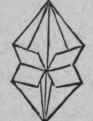
Fig. 7.

Fig. 8.
Continue to:


My Books

