


Method Of Packing The Box
Description
This section is from the "The Fireless Cook Book" book, by Margaret J. Mitchell. Also see Amazon: The Fireless Cook Book.
Method Of Packing The Box
This will vary somewhat with the different insulating materials used. These may be classified as:
Those into which the cooking utensil may be set without any intervening covering, among which are hay, excelsior, and paper.
Those requiring a covering material to keep them in place and to protect them from contact with the utensil, among which are wool, mineral wool, cork, sawdust, and cotton.
Boxes to be filled with the first class of insulating materials are packed in the following manner:
Line the box and cover, smoothly, with one thickness of heavy paper, or several thicknesses of newspaper. This will prevent cold air from finding its way through the cracks, and dust and pieces from sifting out. Asbestos sheeting also makes a good lining. Pack in the bottom of the box a firm layer of insulating material not less than three or four inches in depth. This must raise the cooking pail to within from three to five inches of the top of the box. Set the utensil in the middle of the space allowed for it on this layer, and pack around it, very tightly, until level with the top of the kettle. When this is removed it will be found to have left a hole just large enough for it to slip into again. A little manipulation will make the rim of this pocket less ragged than at first. The cushion for boxes packed with excelsior or hay should be at least four inches thick. In packing with paper, lay first an even layer three or more inches thick of folded papers, filling the space around the kettle with soft, crumpled papers. In place of the top cushion, make a bundle of papers folded to just the right size. This can only be done when perfectly flat pail covers are used, unless a supplementary soft cushion be first laid over the pail.
The box is now ready for cooking, but if, after considerable use, the material shrinks so that the whole space is not firmly filled, a little more may be added. There should always be at least a slight pressure when the cover is closed. The paper lining described on page 20, while not necessary to this class of boxes, is an improvement.
Boxes to be filled with the second class of material are packed in the following manner:
Line the box with a smooth covering of paper or asbestos, tacked into place. Pack a layer of insulating material, three inches or more in thickness, in the bottom, laying a piece of heavy paper on this. Sew two or three thicknesses of pliable cardboard into the form of a cylinder that will fit around the utensil loosely. (Fig. No. 1.)
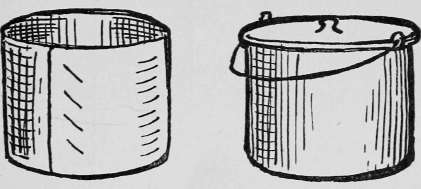
Figure No. 1. Pasteboard cylinder to fit the pail.
It must be of the same height as the kettle. Set this cooker-pail, surrounded by the cylinder, on the layer in the box. Holding the kettle in place with one hand, pack tightly around it, to the level of the top of the pail. (See page 12.) The efficiency of the box depends largely upon this packing. Cut a round hole, the size of the cooker nest, in a piece of heavy pasteboard, to fit the top of the box. Lay this over the packing, so that it will cover it completely. The box is now ready for its cloth lining. To make this, cut three pieces of cloth; one to be one-inch or more larger than the top of the box, with a round hole cut in its centre, one inch smaller than the diameter of the cooker-pail (Fig. No.2:1); another to be a round piece one-inch larger than the diameter of the pail (Fig. No. 2:2); and the third to be a strip one-inch wider than the height of the pail, and long enough to go around it with an inch to spare (Fig. No. 2:3). Sew the ends of this strip together to make a cylinder. Into one end of this cylinder sew the round piece. The other end is to be sewed into the large piece, taking in each case a half-inch seam. When this is put into the box it will line the nest for the kettle, and cover the pasteboard which rests on top. (Fig. No. 3.) Remove the pail and tack this cloth lining in place, turning in the edges where it is tacked to the box. A paper lining may be substituted for cloth in the following manner: Take a sheet of very heavy paper, at least one inch larger in every dimension than the top of the box. Draw a circle in the centre of it the size of the pail. In the centre of this circle cut a small hole large enough to insert the blade of a pair of scissors. From this hole, cut to the circle, so as to strike it at intervals of about one and one-half inches. (Fig. No. 4.) Fit the paper over the top of the packing in the box so that this circle will come just over the nest for the pail. Put the cooker-pail into the nest and it will crease the points down at exactly the right place.
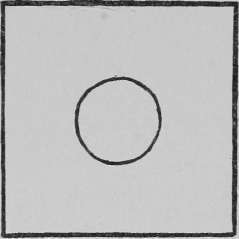
1.
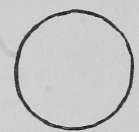
2.
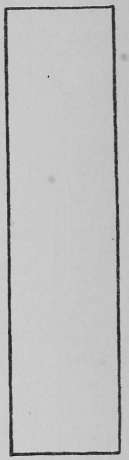
3.
Figure No. 2. Showing how to cut the cloth pieces for lining a home-made cooker.
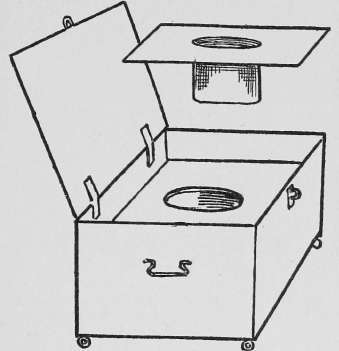
Figure No. 3. Showing the cloth lining just about to be placed in the box.
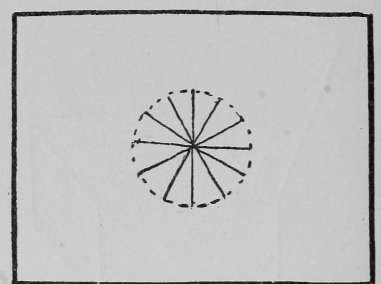
Figure No. 4. Showing the manner of cutting the paper covering for a fireless cooker.
Figure No. 5 shows the cooker completed. A paper lining is in some respects to be preferred to cloth. It is easy and quick to make and can be readily replaced if it becomes soiled.
With either class of cooker more than one nest may be made. It is well, in that case, to have a wooden partition put into the box before packing it, although this is not strictly necessary. Each portion of the box can then be packed independently and for utensils of different sizes if desired. If possible, when packing a box with mineral wool, do the work out of doors, wearing a pair of gloves, as particles from it fly into the air and are extremely irritating to the throat and skin. Twenty-five pounds of mineral wool will pack a nine-quart pail in a box fifteen by fifteen inches and eleven inches high. Five pounds of wool will pack the same box for using a nine-quart pail. If a smaller pail is used, more wool or mineral wool will be required.
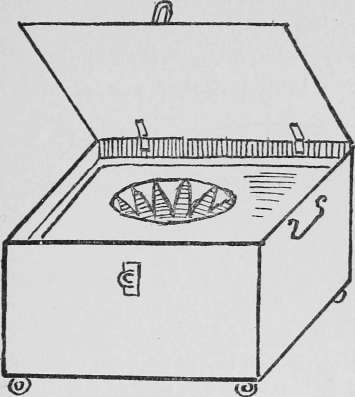
Figure No. 5. Showing the paper lining of a fireless cooker in place.
Continue to:


My Books

