


The Well-Equipped Kitchen
Description
This section is from "Every Woman's Encyclopaedia". Also available from Amazon: Every Woman's Encyclopaedia.
The Well-Equipped Kitchen
Choppers and Knives - Cherry-stoner-weights and Scales - Sieves-pastry-making Requisitesgriller - Chafing-dish - Spice-box - Fireproof China Utensils
Among absolute essentials must be in-cluded a meat chopper, a good assortment of cook's knives - among them being two or three good chopping knives - a long larding knife, some root knives, which are used for peeling and trimming vegetables, and some palette knives, which, among other things, are useful for spreading icing on cakes. Then we must not forget the meat-saw, and also a larding and a trussing needle. A potato-peeler is an excellent little contrivance, and soon repays its original cost by what it saves. The potatoes are also more evenly peeled than if done with a knife.
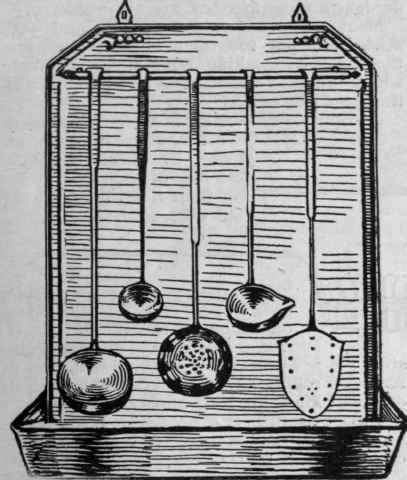
A case in which basting spoons, ladles, and slice can be hung ensures their being to hand when wanted. The case should be fixed to the wall near the stove
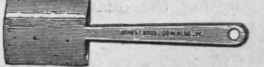
Cutlet-bat for flattening steaks and cutlets
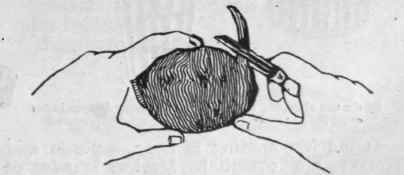
A potato-peeler removes the peel more neatly and evenly than an ordinary knife
A cherry-stoner is somewhat of a novelty. It is a great improvement in preparing tarts, fruit salads and the like to have the fruit stoned, but it is an almost endless piece of work if it is done by hand.
A cutlet-bat is useful for flattening cutlets or steaks, but a heavy cook's knife answers the purpose very well.
When beating more than two or three eggs at a time it is best to use an egg-whisk, either one having a wooden handle or one made entirely of wire. It is well to have two or three" of different sizes as they are not expensive.
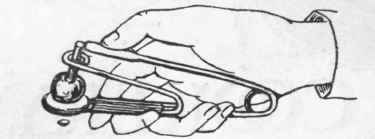
It is a great improvement to fruit salads and tarts it the stones are removed from cherries. This can be quickly dons by using a cherry-stoner
A round metal grater is invaluable, and one with graters of different coarseness is the best kind to buy. It is then possible to grate either nutmegs, cheese, lemons, or bread on it.
The "potato ribbon" cutter is an excellent device which saves time and wastes no potato. Potatoes cut with it make a pretty garnish besides being delicious when served as a vegetable.
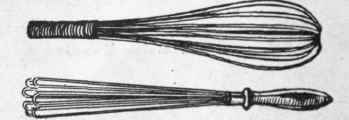
Egg-whisks are a great convenience when beating more than two or three eggs
If by any means possible, weights and scales should be found in every kitchen. Much good food is spoilt and wasted through the popular but often fatal practice of guessing the quantities of the various ingredients required - in other words, by cooking by "rule of thumb," as it is called. If through lack of space or money a large set of scales are out of the question, then procure a good "spring balance."
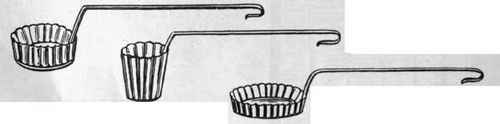
By the use of copper fritter-moulds in varying designs, battel cases for sweets and entrees can be quickly prepared
If much pounding is done, a pestle and mortar are essential. Mortars made of marble are the best as they are more durable, heavier, and consequently more steady, but naturally they are the" most expensive. In a small kitchen, mortars made of composition do very well.
Pestles made of hard wood are very good, and last practically for ever; while those of composition with wooden handles are apt to come apart and sometimes even to break.
Needless to say, hair and wire sieves should be found in every kitchen. If both cannot be obtained, a fine wire one is the best to have. It is, of course, convenient to keep some of different kinds both as regards the fineness of the mesh and the size of the sieve. One measuring ten inches across is a useful and convenient size.
Sieves are used for a number of purposes, for passing various soups to form a puree, such as puree of artichokes, potato soup ; for making breadcrumbs, when they are far superior to a grater, as all the crumbs are bound to be of the same size ; for sieving flour so as to get the air entangled in it and thus lighten it; and for many other purposes.
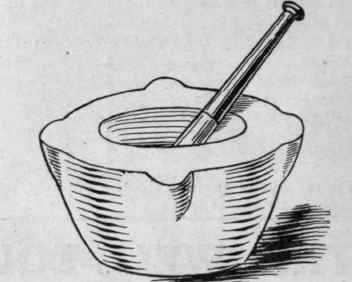
A pestle and mortar is useful not only for pounding mixtures, but for crushing dried breadcrumbs
Colanders are required for straining vegetables out of the water after they have been cooked. They are made either of tin or enamelled iron, the latter being more easily kept clean as they require no polishing. A metal flour-dredger, a castor sugar-dredger and pepper-box are all necessary.
Meat skewers should be strong and well made, but not too thick or they disfigure the meat by making large holes, through which much of the flavour and goodness of the meat can escape.
A copper sugar-boiler is very desirable if sweet-making is done at home, as there is much less risk of the sugar burning than if a tin or enamel pan were used.
Continue to:


My Books

