


The Garland Design
Description
This section is from "Every Woman's Encyclopaedia". Also available from Amazon: Every Woman's Encyclopaedia.
The Garland Design
An Emblem of Rejoicing - Nature's Garlands - The Garland in Needlework - Methods of Working Embroidery on Net - Ribbon Work in Garland Designs
There is a beauty in the garland which has come down to us from Greek and Roman times. Ever since the Appian Way was decorated with laurel wreaths worked on strings or ropes of flowers to celebrate the homecoming of a conquering emperor or successful general, this special form of ornament has been associated with rejoicing. So that through the sheer weight of tradition, besides its own beauty, the garland appears as a gladsome thing.
The garland is a form beloved of Nature, who weaves one with every vine tendril, and trains the young shoots of hop and briony, wild clematis and eglantine into the most delightful wreath forms to decorate the triumphal march of springtide and summer. It is impossible to pass along the wild hedgerows without finding inspiration for our needle pictures, whether we note the strongly growing sprays of the wild rose in spring, with clustering leaves half unfolded to reveal promise of pink buds, or in summer, when honeysuckle makes a garland with intertwining stems and creamy-pink bell flowers distilling subtlest perfume. Even in autumn, the green leaves and fairy down of "old man's beard," or traveller's joy, waves a lovely silvery decoration round the red-berried holly, and orange and crimson-tinted blackberry leaves give more colour to the garland.
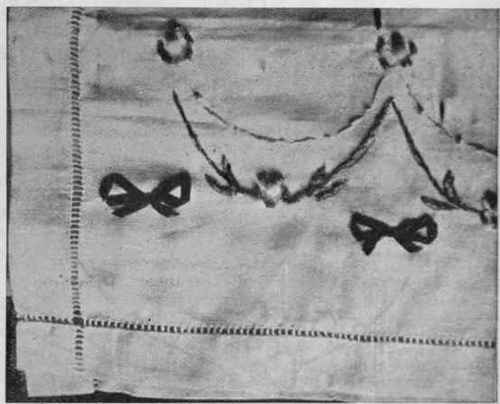
Beads can be used most effectively in garland designs as here shown, where garnet beads are used to outline the bosses, in the centre of each of which is a large yellow bead
Such riot of colour belongs to nature, and is chiefly expressed in art at those times when conventions are set on one side and restraint is unheeded. Before the Renaissance the garland was little used in painting or the decoration of textiles; geometric forms and the feeling for the Gothic were too strong.
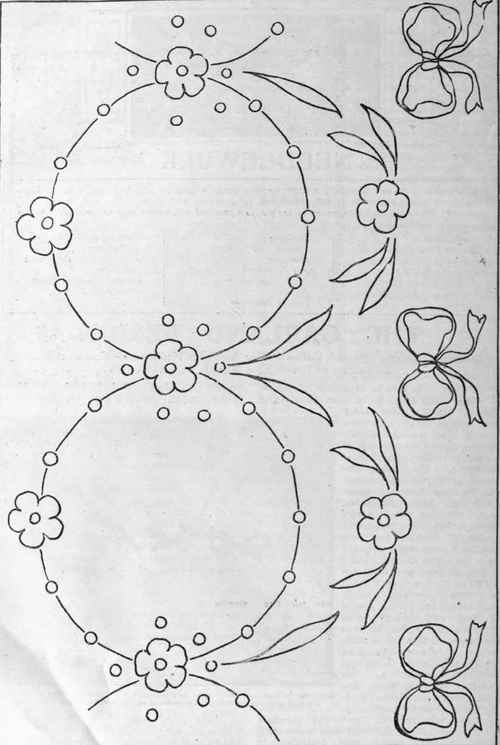
A beautiful garland design, which can be transferred to tracing paper or tracing cloth. By the aid of carbon paper and a moderately sharp-pointed instrument, such as a knitting-needle or blunt stiletto, the design may then be transferred from the tracing to the material to be embroidered
The garland had its fullest expression during the eighteenth century, and we can scarcely find a design or pattern of that period which has not its swag of fruit or flowers, or its garland of ribbon. These are usually held up with ornamental bosses or by fat cupids, who appear in drawings and paintings, on the walls of houses and the lintels of doors; even the ceilings of our churches are not free from them, especially if built by Sir Christopher Wren and his school, and they cluster on the tombs of our ancestors.
Garlands In Needlework
The pattern we give is one well adapted to any decorative needlework. It should be traced on to transparent paper or tracing cloth.
It is best to fix the muslin, silk, satin, linen, velvet, or whatever the material which is to be embroidered, with drawing-pins on to a board or table; then place the carbon paper, dark side down. After this, pin the tracing of the pattern firmly to the material which is to be decorated, and trace with a knitting-needle, a blunt stiletto, or any other moderately sharp-pointed instrument.
The point must not be too blunt, or the carbon line marked on the stuff will be too broad for covering with the stitches, nor must it be too sharp, or the pattern will be cut when traced over. It is for this reason that we always advise tracing a pattern on to tracing cloth rather than paper, as one nearly always requires a repeat for the completion of a piece of work, and a ragged pattern cut through where the lines have been run over is apt to give incorrect results.
Modes Of Working
With regard to the working of the pattern the choice is very varied, the bosses may be considered as flowers, when the forget-me-not shape naturally suggests pale blue petals, with a French knot in the centre of yellow. The leaves would be in green silk, and we suggest the upper line of the garland should also have green as the connecting links and pale blue or pink for the dots, the pink which one sees in the buds of a forget-me-not. The upper line of the pattern may be left out, if desired, examples being shown of both methods of arrangement.
Another variety is given in one illustration in which the use of beads make a pleasing mode of carrying out the pattern. The lovely colours of a garnet are shown in the small beads outlining the bosses, and a large yellow bead is sewn on in the centre. In this case olive green mallard floss is used for the leaves and yellow thick silk for the line and dot of the upper garland. The effect is extremely good. If more beads were thought desirable, the whole of the garland might be expressed in beads, or the dots of the upper garland only.
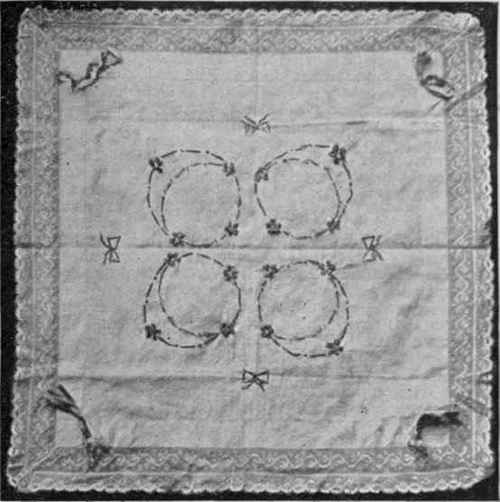
A cushion cover edged with Valenciennes lace, and worked in a garland design in net shadow embroidery upon a gentleman's fine cambric handkerchief
Such a method, with gold beads in differing sizes, would make a very handsome edging to a black tunic over gold satin underdress. The gold-bead garland embroidery would be also needed at the edge of the transparent sleeve, and in a straight line across the corsage, which should be slightly pulled over the gold satin.
Milk-white beads might replace the gold for a debutante's dress and tunic of white ninon, or steel and silver beads would be graceful with, perhaps, wee pink rose buds for the bosses from which the garlands hang.
Net Shadow Embroidery
If net is chosen for the dress, there is a delightfully quick and easy way of decorating this material, but the worker should practise a little before beginning on the main fabric.
After making the tracing, paste it on to a fairly stiff piece of cardboard, or a piece of tailor's canvas, just the width of the pattern, tack the net or muslin over where the section of pattern shows through, then, taking a long thread of coarse silk, darn over the net wherever the pattern shows. This work is very quick, half a yard of it can be completed in an hour, and the effect is really handsome. If a wide piece is desirable for the edging of a tablier or panels, the rounds at the top can be worked above again and again until the border is wide enough. The hanging floral garland should be at the edge only, as a garland suspended in the air with its pendant sprigs upright is against all rules of Nature Pale heliotropes, blues, and greens could be used instead of the white silk for the darning.
A Cushion Cover
In our cushion cover, which is edged with Valenciennes lace, only sections of the pattern are used and are arranged as a centre ornament with good effect. This is worked entirely in green silk, the circles with lines and dots in French knots are simply repeated, the little Louis Quinze bows serve to fill up the spaces below, and these are repeated in green and rose ribbons at the corner. This cushion cover is no more or less than a fine cambric handkerchief, gentleman's size, which, of course, was bought hemstitched and ready for working. A second handkerchief forms the back, so that the down-stuffed pad is slipped in between. Giant ribbon of a pale myrtle green is used for the leaves in the garland on white mull muslin, which is to form the corsage trimming for a girl's dinner dress. The flowers are worked in forget-me-not blue embroidery silk. They could be in ribbon, if desired, or in rose silk, which would be a more commonplace but very desirable alliance.
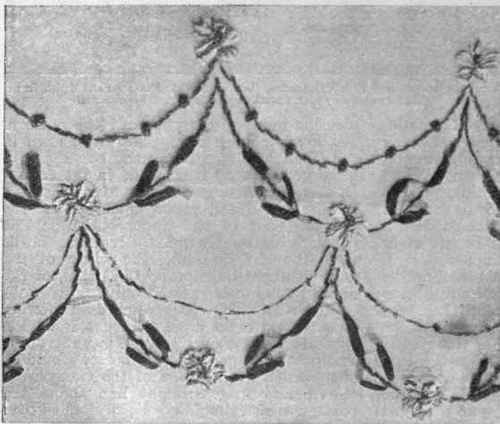
An adaptation of the garland design in ribbon work upon white mull muslin, which would form a pretty corsage trimming for a girl's dinner dress
Such a pattern on muslin or net could be carried out with one of the tinted ribbons which are to be had at the best needlework shops which show dainty goods from Paris. These ribbons of the miniature type are sometimes in faint colours, such as vieux rose, blue, or green, and are woven with gold and silver threads, so that a shot effect is obtained. The whole pattern could be worked with such a ribbon, sequins of gold or silver forming the dots in the circle and the bosses.
Flounce Edgings
The garland form is always suitable for flounce edging. We can imagine a shot taffeta dress of grey and rose in faintest sunrise hues, with three flounces three inches wide set at intervals on the skirt of a girl's graceful dinner-gown. The lowest flounce would be at the hem, the other two nearer the waist at nine-inch intervals. Rose and grey silk, one shade darker than the pale tones in the taffeta, should outline the garland embroidery pattern at the edge of each flounce.
The silk might be hemmed in festoon-shaped edge, or the edge of the silk might be cut and left raw ; but in any case it must be in scalloped form, following the lines of the embroidery.
Such flounce edging might be used with exquisite effect on the book-muslin drapery of a baby's cot. The muslin should be hemmed first, and the scallop edge is not necessary. After the flounce is hemmed, tack it on to the design traced on cardboard as described above under shadow embroidery, and darn the pattern in white crochet cotton or linen thread. The canopy curtains would look charming with the garland pattern darned in white thread.
If colour in soft blue or pink is required, it may make its appearance as bows of ribbon, but the embroidery should be in pure white.
The needlewoman will find it a good plan to cu' out the flouncing, first joining it with run and fell stitch until it is the right length. To join completely so that it is in the oval shape required is best when embroidery is contemplated, for this obviates an unseemly join. Now hem the entire length, then roll up and cover the roll with a cambric handkerchief, leaving uncovered only the half-yard or yard length which is to be ornamented.
When this length is embroidered, rem< the cover and roll the piece finished in the cambric covering.
Continue to:


My Books

