


Great Houses And Their Chatelaines - Chatsworth And The Duchess Of Devonshire. Continued
Description
This section is from "Every Woman's Encyclopaedia". Also available from Amazon: Every Woman's Encyclopaedia.
Great Houses And Their Chatelaines - Chatsworth And The Duchess Of Devonshire. Continued
The state rooms at Chatsworth are magnificent, and the wood-carving with which they are decorated is justly famous. Many people say that Grinling Gibbons himself was the artist.
The most wonderful designs of dead game, flowers and fish, adorn the rooms, and especially beautiful is the design known as "Grinling's Masterpiece."
This is generally considered the finest piece of wood-carving ever executed, and includes a point lace cravat, as delicate in its tracery as the finest lace itself, a woodcook, some foliage, and a medal with the then Duke of Devonshire's head carved upon it.
Tradition says the great wood-carver gave this to his patron after he had finished his work at Chatsworth.
The Sabine Room
Several of the state rooms are hung with richly embossed and gilded leather, and in one is preserved an ancient embroidered canopy and state chair worked by the wife of the first Earl of Devonshire.
The intricate workmanship of this makes it very apparent that in those days a lady of leisure was indeed a lady who had time and enough to spare for her needle.
In one of these rooms also are preserved the chairs and footstools used at the coronation of George III. and Queen Charlotte.
Mary Queen of Scots was three times a prisoner at Chatsworth under the Earl of Shrewsbury, who, "for her safe keeping took to himself forty extra servants chosen from his tenantry to watch day and night."
The actual rooms the ill-fated Queen used are not now in existence, but the east wing built upon their site is still called Queen Mary's wing.
Another interesting relic of this sorely tried lady is "Queen Mary's Bower," a little mound by the river in the grounds, where tradition says Mary Stuart would sit with her maids and sew away the lagging hours of her captivity.
The Sabine Room at Chatsworth is famous. When its doors are closed a curious effect is obtained, for the whole surface, including the doors and ceiling, make parts of one huge painting, the subject being the rape of the Sabines.
The Paintings At Chatsworth
The paintings at Chatsworth are unique Among the more modern are Landseer's original paintings of "Bolton Abbey in the Olden Time," and a number of family portraits by Reynolds, Lawrence, and others.
In the Grand Drawing-room are some priceless full-length portraits, including Philip II. by Titian, Mary Queen of Scots
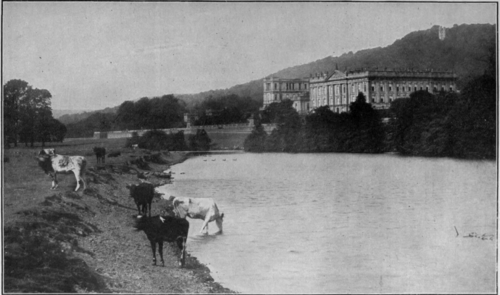
A beautiful view of Chatsworth House, the stately manston of the great ducal house of Cavendish. Here the reigning Duke of Devonshire and his Duchess reside in almost feudal magnificence and receive as guests the greatest personages of their day photochrom by Zucchero, and the famous Henry VIII. by Holbein.
The walls of this room are hung with tapestries from Raphael's cartoons, and these and the carved ceiling have many a time and oft made the softest and most effective background for the brilliant entertainments that have, in recent years, been given at Chats-worth.
Everyone has heard of the Chatsworth library, and one of the most interesting relics preserved there is the famous Anglo-saxon M.s. of Caedmon.
Another pathetic relic is the prayer-book given by Henry VII. to his daughter Margaret, Queen of Scotland, who, in her turn, gave it to the then Bishop of St. Andrews.
This book contains the following quaint gift lines:
"Remember yr kynde and louying fader in yor good prayers Henry R.
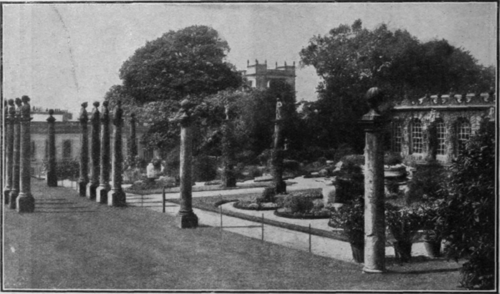
The beautiful French gardens at Chatsworth. The grounds of this great mansion represent many of the most famous schools of landscape gardening, and are a constant source of wonder and pleasure to those who visit them Photochrom
"Pray for your loving father that gave you this booke and gave you God's blessing and mine. "My good Lorde of St. Andrews I pray you pray for me that gave you thys bouk.
"Yours to my powr Margaret." These lines are interesting, if only for their quaint and varied spelling, and the book is most carefully preserved.
The sculpture gallery is another of the glories of Chatsworth, and there, amongst other works, frowns a colossal bust of the great Napoleon.
By the kindness of the Duke of Devonshire, Chatsworth is open to the public, and thousands avail themselves of this privilege yearly.
There is one rather curious joke often worked off on the sightseer, a relic of a practical-joking Duke of Devonshire.
In one of the galleries the visitor sees a half-opened door, revealing a little sitting-room beyond, and is naturally anxious to inspect this apparently private room.
But the steward warns him that this is a private room, and that the Duke does not like his privacy disturbed. However, after some humming and hawing, this worthy says confidentially, "You may go inside."
Feeling privileged, the visitor essays to do so, but to his astonishment is confronted by a wall, the mysterious door and the room being but a realistic painting.
The only possible thing to do is to retire as gracefully and in as dignified a manner as circumstances will permit.
During the lifetime of the late Duchess of Devonshire entertaining at Chatsworth was on a gorgeous scale.
Every year a large New Year's house party was given, and King Edward and
Queen Alexandra were invariably guests. Invitations were eagerly sought for by members of society, and a brilliant party of the noblest families in England gathered under the hospitable roof.
The Chatsworth theatricals have become historical; at this annual party special pains were taken to obtain the best amateur talent in society.
It is expected that the present Duchess will entertain on a more elaborate scale when her children are older, and Chatsworth once more will be the scene of many a splendid masque and brilliant entertainment.
The amazing theft of "La Gioconda" from the Louvre recalls the similar fate which befell the Chatsworth picture of the beautiful Duchess of Devonshire, painted by Reynolds.
This portrait was stolen under mysterious circumstances, and only recovered after twenty years had passed. It now hangs, a treasured possession, on the walls of Devonshire House. It is to be hoped that an equal good fortune will befal the luckless guardians of Lionardo da Vinci's masterpiece, and that her immortal smile will continue to mystify and charm countless admirers as of yore.
The Pleasure Grounds
The gardens at Chatsworth are some of the most beautiful in Europe, and full of historical interest. They boast a famous avenue of limes, which were fine trees long ago, when Dr. Johnson walked beneath their shade. The avenue ends with three trees of particular interest, known as the Royal trees. One of these was planted by Queen Victoria, when she was Princess Victoria, in 1832; another, planted on the same day by the Duchess of Kent, is a fine Spanish chestnut; and the third, a sycamore, was planted eleven years later by Prince Albert, who had then been Consort for some years.
Perhaps King George, should he so *far honour his loyal liege, will add one more tree to this historic group.
Two of the most remarkable objects of interest at Chatsworth, apart from the house itself, are the great conservatory and the waterworks.
The conservatory is so large - being 276 feet long and 123 feet wide - that it has a carriage road through it, and covers an acre of ground. Six miles of hot-water pipes are used to heat this vast building, and the fuel is supplied by a sub-tramway half a mile in length. Through the centre is cut a drive, fringed on either side with bananas, planted, as is almost everything, in the ground, and not in pots. On all sides great palms and plants tower above the visitor, and the whole place has the air of a real tropical forest.
The waterworks are quite wonderful in their way, and were designed, by Grillet, after those at Versailles. They produce, when in full play, a wonderful effect of cascades and fountains. One quaint fountain is made like a willow-tree in copper, from each leaf of which, when a tap is turned, water springs, as well as from the ground beneath this aptly termed "weeping" willow.
The flower gardens of this beautiful domain are many and varied, representing as they do the chief schools of landscape gardening known to Europe. They include, of course, an Italian and a French garden. Wherever the eye can reach, one sees beauty; the level lawns and terraces are broken by sparkling fountains, with here and there a lake. In June the rhodendrons are a sight worth going miles to see. A sea of blossoms, varying in colour from richest crimson to purest white, is a feast of colour rarely seen under our grey northern skies.
A magnificent panoramic view of the gardens and surrounding country can be obtained from the Hunting Tower in the grounds.
Extensive alterations are being carried out at Chatsworth by the present Duke of Devonshire. Workmen are engaged in revolutionising the character of the interior, and the grand hall, with its painted ceilings, mentioned earlier in this article, is being greatly improved. An old balcony of wood and an old staircase, which have somewhat marred the architectural charm of the apartment, are to be removed to make way for more modern and ornamental contrivances, and many paintings, which have been partly hidden by old woodwork, will once more see the light of day.
A great improvement is in process of completion in the form of a new and gorgeous staircase, which will be truly consonant with the style of the mansion. This noble staircase of Stancliff stone will be the central feature of the hall.
Truly the owners of this stately house and its surroundings may exclaim that their lot has "fallen in a fair ground," and that they have indeed "a goodly heritage."
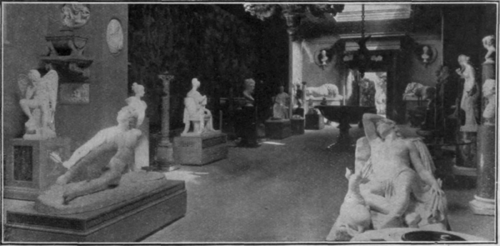
The sculpture gallery is one of the chief glories of Chatsworth. It possesses a colossal bust of the great Napoleon
Continue to:


My Books

