


Famous Lady Explorers
Description
This section is from "Every Woman's Encyclopaedia". Also available from Amazon: Every Woman's Encyclopaedia.
Famous Lady Explorers
Women Pioneers of Africa - Lady Baker's Great Achievement - Charles Kingsley's Niece among
Cannibals - Amazing Journeys from the Cape to Cairo - Through the Congo Regions - The First
Woman Appointed a Fellow of the Royal Geographical Society - Love Romances which Led to
Dangerous Expeditions - A Ten-thousand-mile Journey - Daring Lady Mountaineers
The remarkable achievements of women provide a chapter of absorbing interest in the story of modern exploration. Men have stood amazed at their daring. And, by scientific societies, no names are more honoured than those of these brave and strenuous women.
A tribute must be paid in the first place to those women pioneers of Africa - Mary Moffat, Lady Baker, and Miss Mary Kingsley, niece of Charles Kingsley. It was Mary Moffat who accompanied the famous missionary Robert Moffat on his remarkable journeys through Africa in the days when the white man was practically unknown in the interior of the Dark Continent.
And then there was Lady Baker, the wife of Sir Samuel White Baker, the famous African traveller. Lady Baker was a Hungarian lady of great talent and enterprise, and it was she who accompanied her husband when he undertook a journey of exploration at his own cost in 1861 for the discovery of the Nile sources. The daring couple, entirely alone, crossed the Nubian Desert in the glare of a scorching sun with the thermometer at 114 degrees.
Beyond Khartoum - which, they found " sacred to slavery and to every abomination that man can commit"- they pushed weariedly up-nile against adverse winds, fierce rapids, and tortuous streams. They both fell ill with fever, so that neither could rise to nurse the other. But at last they reached their goal, the magnificent lake which they named the Albert Nyanza.
Some years later, Miss Mary Kingsley, who fell ill nursing sick Boer prisoners during the South African campaign and died in hospital in Simon's Town, commenced her travels through Africa. And it is no exaggeration to say that in sheer daring no explorer has surpassed her.
During her last journey she paid a visit to a nation of the fiercest cannibals in Africa. She mixed fearlessly with them, although she was the only woman in the small party, and the bones of their victims were lying everywhere along her route. She even • inspected their larders, where human limbs were hanging like so many joints of mutton, and she taught them how to play cricket and other English games.
There was one occasion when she lay with her native escort in the thick grass, and wondered, as she quaintly put it,
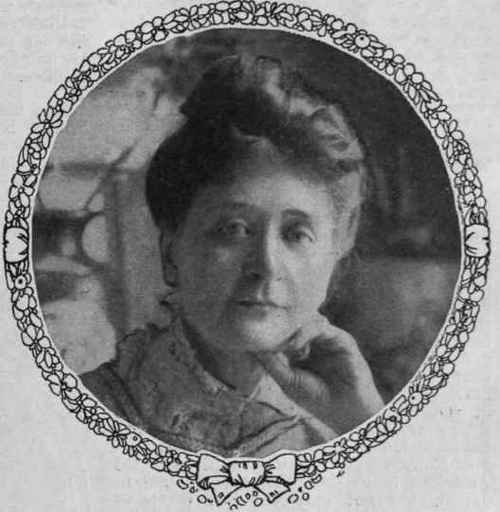
Mrs. French Sheldon, a most daring American lady explorer, arid the first woman to be appointed a Fellow of the Royal Geographical Society
Photo, E. H. Mills when some of the arrows that were being shot into the bush to try to discover their whereabouts would hit one of them. They escaped, however, and when the enemy had gone farther down the stream, and were testing another bit of bush, the fugitives went calmly on their way. And yet this fearless woman explorer was one of the most gentle and refined of women, whose natural sphere appeared to be her drawing-room rather than African wilds.
It is somewhat curious that African exploration seems to exercise the same fascination over women as it does over men, and since the expedition of Miss Kingsley a number of women have followed in her footsteps, and made many discoveries in the Dark Continent. Probably the journey of Miss Charlotte Mansfield is still fresh in the minds of many, for, unaccompanied by any other white person, she journeyed from the Cape to Cairo, covering 16,728 miles in seven months. She took only natives with her, and had to traverse many hundreds of miles on foot or in a hammock slung on a pole and carried by native bearers.
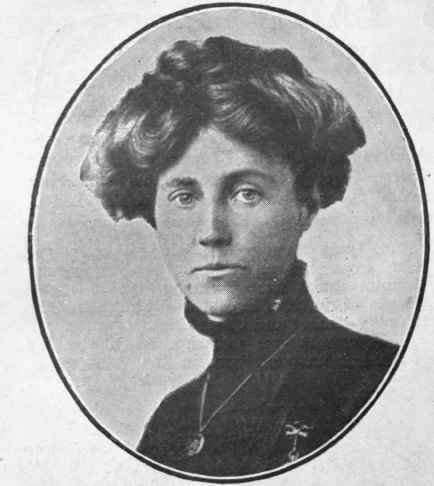
Miss Mcleod, who traversed four thousand miles of savage Africa.
During her travels she made a wonderful collection of curios, and of botanical and zoological specimens
Photo, L.n.a.
An equally remarkable trip was that made by Mrs. Marguerite Roby, one of the most travelled women of the world, who, at the beginning of 1911, returned from Africa after spending five months in the Congo region attended only by black porters. Mrs. Roby, who is the wife of a distinguished American brain specialist now residing in Japan, has not only explored much of Africa, but also many districts in China where no white woman had ever been before, and has been everywhere in Japan, Australia, and America. While in Africa she saw more than five hundred villages, traversed all the country in the neighbourhood of the great lakes, especially making a study of native conditions in the Congo State. Some idea of the perils of her journey may be gathered from her confessions to the writer during the course of an interview.
A Passage Perilous
" Frequently," she said, " my bearers became mutinous, and 1 had to deal with them unaided. One of my boys, however, named Thomas, was very faithful to me, and 1 owe my life to him, for when 1 had a bad attack of fever and my temperature was 107 degrees he saved me from death by persistently pouring cold water over my head after letting down my hair. I was quite unconscious, and had given myself a dose of morphia in the hope that if I was to die I might pass away easily. And I shall never forget the look of joy on Thomas's face when, after a sleep of five days, I opened my eyes. Altogether I had three attacks of fever, and the last was so bad that I had to make my way when I was convalescent from Lake Victoria Nyanza to Mombasa, and thence by steamer to Marseilles.
Continue to:


My Books

