


Elementary Wand Exercises
Description
This section is from "Every Woman's Encyclopaedia". Also available from Amazon: Every Woman's Encyclopaedia.
Elementary Wand Exercises
Exercise 1
Count I. Arms upward bend (wand across chest).
2. Arms upward stretch, head backwards bend (see Fig. 1).
3. Return to 1.
4. Recover (to starting position).
Special Effect. To deepen chest, straighten spine, and correct drooping head.
Explanation, and faults to be avoided. During this exercise the knees must be well braced back; the pupil will be inclined to bend at the knees when the wand is raised. Sometimes one end of the wand, when overhead, is higher than the other - due to the arms not being evenly stretched or to loosening the hold with one hand.
Exercise 2
Count 1. Raise wand forward, upward, and backward (wand is carried rather beyond the head).
2. Bend arms, bring wand across shoulders.
3. Rise on toes.
4. Lower heels. 5. As 3.
6. As 4.
7. Stretch arms
8. Recover.
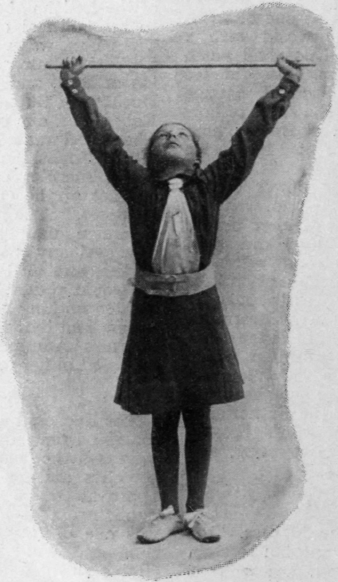
Fig. 1. Elementary wand exercises. Exercise I, position 2 Arms upward stretch, head backwards bend Photos, Stephanie Maud
Special Effect. To broaden chest and correct prominent shoulder-blades; to give balance, and strengthen feet and ankles.
Explanation, and faults to be avoided. Common faults are - ducking head forward when bringing wand on to shoulders; wand lower on one side than on another, due to arms not being evenly bent; separating of heels.
Exercise 3
Count 1. Raise wand forwards, up, and back.
2. Bend arms, wand across shoulders.
3, 4. Bend trunk slowly forward till horizontal.
5, 6. Stretch trunk slowly
7. Stretch arms up.
8. Recover.
Special effect. To stretch the spine and strengthen muscles of back. The position of wand across shoulders prevents chest from contracting when bending trunk forward.
Explanation, and faults to be avoided. Common faults are - allowing the head to droop or bending the knees when bending trunk.
Exercise 4
Count 1. Arms bend, wand across chest, point left toe forward, touching ground.
2. Bend left knee up.
3. As in 1.
4. Recover.
Repeat with right foot, then whole again.
Special effect. To exercise muscles of thigh and abdomen, and give balance and control.
Explanation, and faults to be avoided. The body should be kept steady throughout, and at 2 the foot must be directly under the knee and pointing to the ground. The knee should be level with the hip.
Exercise 5
Count 1. Raise wand forward, up, and back, and place left foot astride.
2. Lower wand obliquely across back, right arm bent and hand close to ear, left arm straight by side.
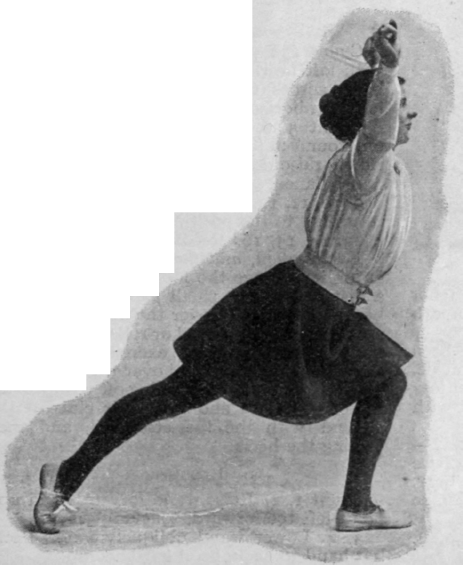
Fig. 3. Advanced wand exercises. Exercise 2, positions 3 and 4. Side view. Left leg extended back, right knee bent, arms stretched
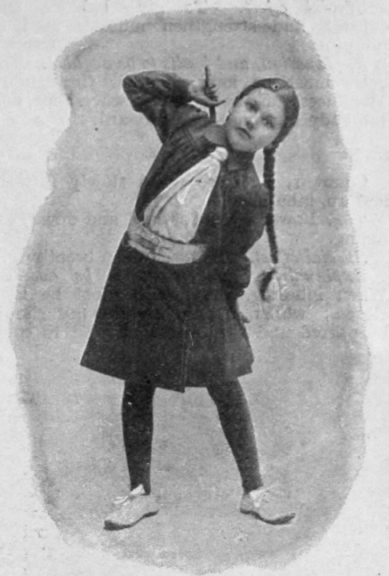
Fig. 2. Exercise 5, positions 3 and 4. Wand obliquely across the back. Left arm down. Bend trunk to left
3, 4. Bend trunk slowly to left (sec Fig. 2.)
5, 6. Stretch trunk slowly.
7. Stretch arms up.
8. Recover. Special effect. To deepen the chest and make it and the spine supple. To strengthen the muscles of the side of the trunk.
Explanation, and faults to be avoided. As the body is bent at 3, 4, it must not be turned. The head must not be allowed to droop or bend to one side.
Exercise 6
Count 1. Bend right knee up, wand to chest.
2. Hop on left foot.
3. Place right foot down on toe and bend left knee.
4. Hop on right foot. Repeat hopping alternately on left and right foot up to 15. and at 16 close the heels.
Special effect. To give agility, and strengthen feet and ankles.
Explanation, and faults to be avoided. The body must not sway from side to side during the hopping, and the toes should be pointed down.
Exercise 7
Count 1. Rise on toes, wand to chest.
2. Bend knees slightly.
3. Rise on toes.
4. Recover.
Special effect. To give balance and control, and strengthen muscles used in jumping.
Explanation, and faults to be avoided. The heels must be kept together throughout. The knees must be separated when bent, and the body must not lean forward.
Exercise 8
Count 1, 2. Raise wand slowly forward and up, inhaling.
3, 4. Lower wand forward and down, exhaling.
Special effect. To teach deep breathing.
Explanation, and faults to be avoided. When inhaling, the mouth must be kept closed; whilst in exhaling the lips should be parted and the breath allowed to come out gradually and audibly. The teacher can then judge if a sufficiently deep breath has been taken.
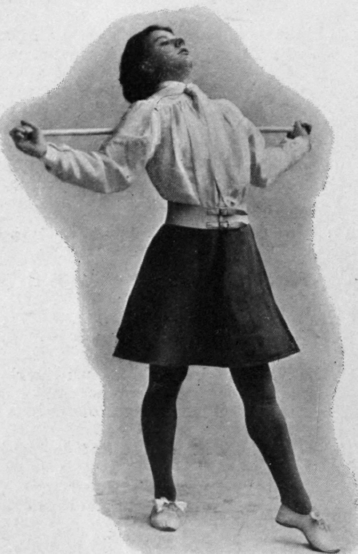
Fig. 4. Exercise 2, positions 6, 7, and 8. Left toe pointed forward, wand across shoulders. Bend the trunk back
These exercises, after they have been learnt carefully, should be done to music. This will give the rhythm, add to the enjoyment, and stimulate the child to work with greater energy.
Some crisp command, such as "Ready - Go!" should be given, and the exercise and music should start with the next beat. Two-four, six-eight, or waltz time may be used.
The child should work with precision, keeping each position for the full time, and changing to the next with sharpness and neatness.
Continue to:


My Books

