


Dress - Millinery Fruit
Description
This section is from "Every Woman's Encyclopaedia". Also available from Amazon: Every Woman's Encyclopaedia.
Dress - Millinery Fruit
How to Make Apples, Plums, Oranges, Grapes, and Cherries for Hat Decoration - Use of Velvet and Satin - Imitating Nature with a Needle - Colour - Suggestions
It is extremely useful to be able to give the right touch to a hat or toque without going out to buy the expensive accessories which always mount up in price when exact matching has to be done.
Does not every woman know that delightful cheap oddments are never to be procured of a special colour that will suit a coat and skirt or our new spring costume? The very thing may be found frequently, and if only it were another shade what a real treasure it would be!
The French modiste, with her handmade groups of fruit, has shown the way, not only towards a very chic and exclusive trimming, but also a means of matching our hats or toques with a precision that modern completeness in dress demands.
A hat of ranging tone can be used if a single dominant note in its trimming be just what is right for the tone of the dress. Thus, one of the faultless blue serge tailor suits which always recur during the early spring with the regularity of a uniform on many well-dressed women would be charming with one of the new dark blue satin straws wreathed with green foliage and brown stems, with here and there a carefully made blue plum of velvet, which seems to show exactly the bloom of the real fruit.
The idea that velvet flowers or fruit must necessarily mean rather a serious outlay need not deter the quick-fingered woman, for the making of the plums is quite a simple affair, and one that is really rather amusing to the artistic mind. Search your piece-boxes for a scrap of velvet of a blue which suggests the plum or damson skin, and at the same time is just right for a hat to be worn with a fine blue serge. Cut out of the velvet a round about 2 1/2 inches in diameter, run it close to the outer edge (but not too close so that the velvet will fray) with double blue sewing silk.
Now get some dark green millinery wire covered, cut off a four-inch length, turn down one end in the form of a button-hook. Round this hook wind an inch-wide strip of cotton wadding, about eight inches in length, winding it so that the knob at the top is rounded, and well shaped in the semblance of a plum.
Then place this knob in the centre of the round of velvet, draw up the run thread, and fasten off round the wire, so that only the wadding is covered, and the length of wire stands out like a stalk. Continue to make these plums until you have as many as you desire for your hat trimming. Now get your foliage and arrange it as nearly like the leaves of a plum as possible, fasten in the fruit here and there, following the lines of nature as well as you can, and a very uncommon and pretty hat garniture is. ready to give a note of distinction to your spring costume.
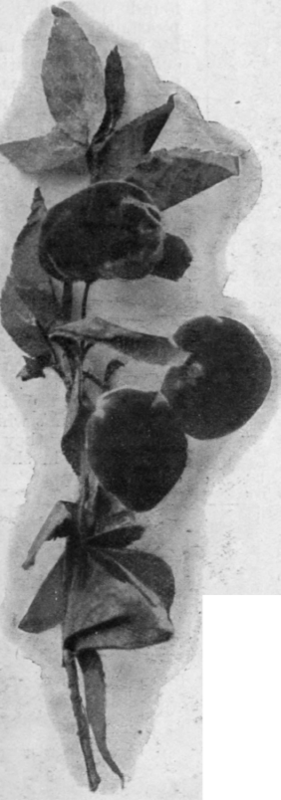
A deep purple velvet gives the effect of plums in millinery
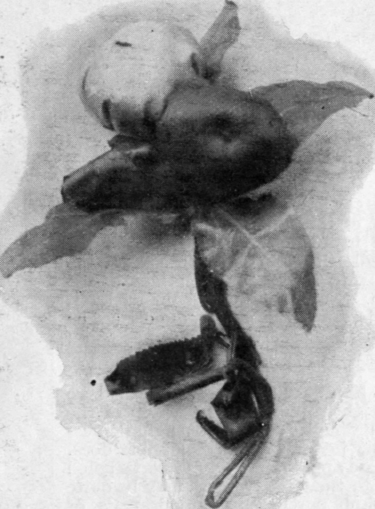
Pale green silk covered apples and foliage form a favourite millinery fruit
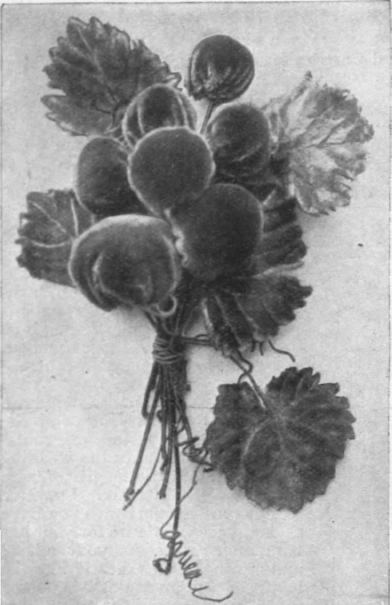
A realistic bunch of grapes in deep purple velvet; or light shot effects are also very attractive to represent this fruit
How to Make a Silk or Satin Apple
In making an apple, pear, orange, or any fruit that has a central core and bud centre showing at the top, an important addition has to be made in order to obtain the desirable semblance to nature.
The texture of an apple skin is nearer to that of glace silk or satin than of velvet, so the silk should be chosen. Proceed as described above, cutting the round of silk, drawing up and stutting with wadding secured on a hook of wire, which forms the stalk.
When this is done, and the drawing-up thread is fastened off, thread a darning needle with thick black silk of the embroidery variety, pierce the fruit from the back, bringing the die through from the base of the stalk to the centre of the fruit at the top. Now make a large French knot, and return the needle, almost at the same place, to the back of the fruit; and fasten off by means of tying the silk to the commencing knot.
The thread thus inserted should be tightly pulled that the top of the fruit dimples down into a slight depression, just as a natural apple does. These apples are ready to be fastened on to the foliage, which may be quite cheaply purchased at any draper's, or can be made with ribbon leaves, if desired.
To Make Oranges
This depression, by means of stitching through the fruit, when made, is also used when making oranges.
No one should attempt to make an orange for millinery purposes of the natural size, as such fruit would look rather comic; one of the size of a plum or small apple will be found quite large enough, and a very pleasant variety may be given to this fruit by making some of the deep, rich orange colour characteristic of the fully ripened fruit, some of a paler yellow, and one of a green that is only a shade lighter than the leaves of the orange-tree.
It is well known that the same branch of an orange-tree will bear ripe and unripe fruit, and not only this, but half-formed oranges and blossom as well, so that the courageous wearer may quite reasonably wear orange fruit mixed with the lovely waxen blossoms, though the flowers are generally thought to be the exclusive property of the bride on her wedding-day.
Grapes, purple red, translucent green, and of a ripe brown tone are very effective as millinery decoration, and tone with any of the brown-green or green straws which are so much used.
Grapes are especially useful to wear with any of the stuffs which show the fashionable shot effects, for they carry out several shades of the cloth in showing their own natural colours.
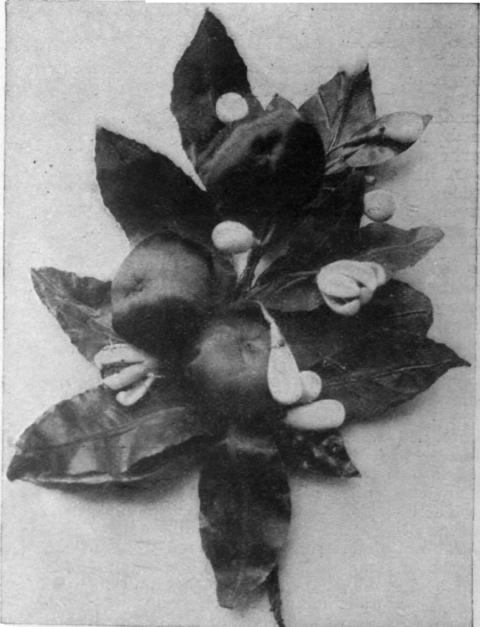
Small oranges may be used in millinery grouped with foliage and the buds and blossoms of the plant, the vivid colour of the fruit being enhanced by the contrast
In Making The Grapes
In making the grapes, rounds of velvet, not more than I 1/2 inches, must be cut, and wadding of four inch thickness will be found sufficient to make the right stuffing on the hooked wire. The fruit should be made in at least three different sizes, as a bunch of grapes is seldom found with the fruit of uniform size all over the bunch.
In our group illustrated the leaves are also of velvet and have been painted with a few splashes of ruddy autumnal tint. Tiny spirals of thin wire have also been added; these greatly enhance the realistic effect, and are made easily by winding a thin brown or green covered wire round a pencil or stiletto a dozen times lightly, and then pulling off and fastening amongst the leaves.
Though fruit making has been described above on realistic lines, it is often made in adhering to the shape, but in colours that Nature never intended. We do not always want cherries of black, rose, or deep red colour on our hats, yet the cherry group is a fashionable asset in the new millinery.
Some good cherries were made for wear with a brown heather mixture of brown velvet. The stalks, instead of being of wire, were limp, and of thick brown silk piping which was simply sewn on to the velvet-covered wadding which formed the fruit. Another variety in this group was still further from nature's design, yet no less useful and effective. Black velvet was used for the fruit, and a handsome twisted gold cord made the stalks. About two dozen of these cherries were needed for a handsome bunch; the fruit was made rather larger than nature.
In the same way apples can be made natural in shape, but in whatever colour is desired for the dress. An effective hat was of rose red straw, and its garniture of grey velvet apples, varied with grey satin and also grey silk ones; the varying points of light on the different stuffs, which were well matched in colour, made an agreeable result.
Apricots in yellow velvet, and in silk as well, are a decided success on the pale grey linen hat of a brunette; while grapes of blue and rose give a note of distinction to a toque of dark blue satin straw.
Some Forbidden Fruit
Though the adornment of millinery may be of flowers and fruit, yet the most daring should never attempt any sort of vegetable. Why this unwritten law should be as inexorable as those of the Medes and Persians we do not know, but the fact remains that a dainty little bunch of carrots, though quite pretty as apricots, would be absurd, and the carmine radish, as attractive when young as many a rosebud, is taboo. Cabbage roses we may wear in plenty, but not a handsome grey-green cabbage. Why? Not because they are edible, for grapes and plums are edibility and we may wear them. A cauliflower is as pretty as a market bunch of primroses, and gives very much the same effect; but a cauliflower cannot be worn as hat decoration.
In the realm of feather mounts and trimmings the rule against homely and edible birds being used as decorative plumage is being relaxed. As well as the birds of Paradise, ostrich plumes, and osprey feathers, we now see pigeons' breasts used in mounts, the homely and beautiful ducks' wings, and even the fluffy creaminess of the common barndoor fowl. Pheasant, partridge, and peacock plumage have always been favourites, so that it is not utility for food purposes that is a bar to the use of such gauds as hat decoration.
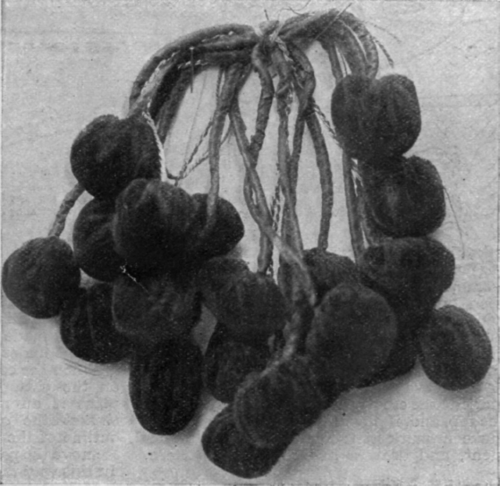
Brown velvet can be used with good results to fashion cherries, thick brown silk piping forming the stalks
It is often possible for the house worker to add silk or velvet fruit to help out the flower garniture which is not large or handsome enough for her requirements. Thus a single spray of wild roses may be augmented with half a dozen little bunches of the handsome scarlet hips of the wild rose seed pod. These should be of the oval stuffed form described for grapes, but the stitching at the top would be necessary with the wild rose fruit. If the apple-blossom is inadequate, add silken apples of varying sizes.
Continue to:


My Books

