


Brendon. Continued
Description
This section is from "Every Woman's Encyclopaedia". Also available from Amazon: Every Woman's Encyclopaedia.
Brendon. Continued
But that is all. There is no more to tell concerning Miss Lacey. War claimed her soldier lover. So he left her. And the following year saw him back again in London - this time an invalid. He had been wounded at the Battle of Laffeldt; not seriously, but seriously enough to disable him, and make him an interesting convalescent - interesting, at any rate, to Miss Elizabeth Lawson.
Now, Miss Lawson, the eldest daughter of Sir Wilfred Lawson, and a niece of General Sir John Mordaunt, was one of the Maids of Honour to the Princess of Wales, and, it would seem, one of the most fascinating of society butterflies. James Wolfe first met her at his parents' house in Old Burlington Street on the day when he celebrated his coming of age. And almost immediately a strong attachment sprang up between him and the fair enchantress.
"The winter we were in London together," he wrote from Glasgow, in 1749, to his friend, Captain Rickson, "I sometimes saw Miss Lawson, the Maid of Honour, G. Mordaunt's niece. She pleased me then; but the campaign in view, battledore and dangerous, left little thought for love. The last time I was in London, only three weeks, I was several times with her - sometimes in public, sometimes at her uncle's, and two or three times at her own house. She made a surprising progress in that short time, and won all my affections.
"Some people reckon her handsome; but I, that am her lover, don't think her a beauty. She has such sweetness of temper, sense enough, and is very civil and engaging in her behaviour. She refused a clergyman with £1,300 a year, and is at present addressed by a very rich knight; but, to your antagonist's advantage, he has that of being mad added, so that I hold him very cheap. In point of fortune she has no more than I have a right to expect - viz. £12,000. The maid is tall and thin, about my own age, and that's the only objection!
"I endeavoured, with the assistance of all the art I was master of, to find out how any serious proposal would be received by Mordaunt and her mother. It did not seem that they would be averse to such a scheme; but as I am but twenty-two and three months, it is rather early for that sort of project; and if I don't attempt her, somebody else will. If a company in the Guards is bought for me, I shall certainly ask the question; but if I'm kept long here, the fire will be extinguished. Young flames must be constantly fed, or they'll evaporate."
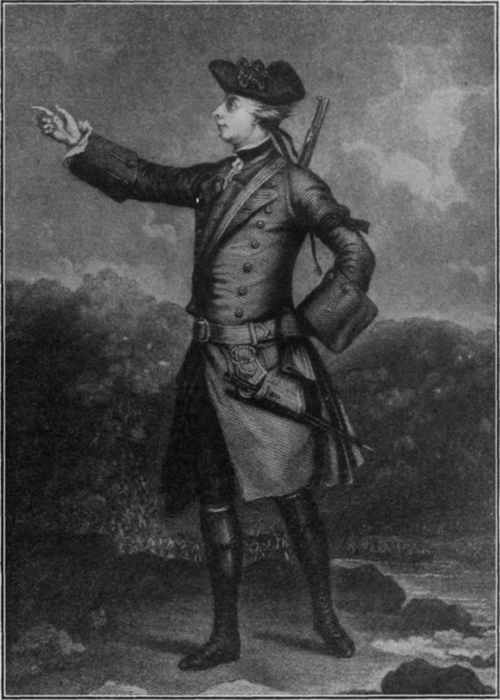
James Wolfe, the conqueror of Quebec - and ladies' hearts From a scarce contemporary print
But not so this flame. It continued to burn brightly. But, then, the fire did not lack fuel, and the fuel in question was opposition - the most effective of all known fuels. The truth is, the young soldier's father and Mrs. Wolfe - especially Mrs. Wolfe Love began to oppose his suit relentlessly. And why? Well, the good woman did not altogether approve of Miss Lawson as a wife for her beloved son. Gossips credited the girl's mother with what to-day is called a "past." And this alarmed Mrs. Wolfe. But she was shrewd enough to know that such an argument would hardly carry weight with James. Indeed, how many ladies in the Court of George II. could lay claim to stainless reputations?
No. Mrs. Wolfe acted much more tactfully. She gave her son to understand that she opposed his wishes "from other more interested views." And so, indeed, she did. Mrs. Wolfe, in fact, was intensely ambitious for her son. She wanted him to make a brilliant marriage, and, moreover, to marry money. Money, money, money! She regarded it as essential to his preferment. Of what use, to him, then, would be an extravagant wife and £12,000? None. Absolutely none.
Besides, during the boy's absence from England she had found, so she thought, the very wife for him - a certain Miss Hoskins, of Croydon, a lady possessed of £30,000 a year, and a romantic love for the soldier she had never met.
What more could he want? It was absurd, she maintained, for him to persist in his "senseless passion" for Miss Lawson.
But, unfortunately, so far as the plans of Mrs. Wolfe were concerned, James happened to be in love really with her. And he resented his mother's uncalled-for interference. What is more, he suspected the true reason of her opposition. He tried, therefore, to justify her conduct. Perhaps she did make somewhat liberal use of liberty. But what did that matter?
"The women of this country," he wrote to his mother from Scotland, "partake very much of society with men, and by that means gain a certain freedom of behaviour, uncommon in England, but which is, nevertheless, of great use to preserve them from the consequences of sudden surprise or novelty, and is a real protection to their virtue, though at times one would imagine that their easiness in some particulars lead directly to the contrary."
Old General Wolfe then took the field, and wrote his son a letter which certainly belied his reputation as a doting father. This was the boy's reply:
"Dear Sir, - Though I have frequently given you occasion to blame either my neglects or levity, I am not, however, conscious of our having intended to give you any uneasiness by obstinacy or perseverance in an error. The high opinion I have all along entertained of your just sense of things has always forced me to a proper submission to your will, and obliged me to be actually wrong, when you think them so."
How else could he reply? A soldier himself, the son of a soldier, he had been trained always to obey without questioning. But it was a stern test his father thus imposed upon his discipline. Obey he did, it is true. But still he could not forget Miss Lawson.
Poor soul! He had many disappointments to bear at this time. Thwarted in love, ignored by the War Office, life in his eyes was becoming rapidly a stale and unprofitable institution. Even his love-sickness might be bearable if only he could be sent on active service. But no! There he had to remain cramped and inactive in the North. It was intolerable.
"This fresh disappointment in love," he told his mother, "has changed my natural disposition to such a degree that I believe it is now possible I might prevail upon myself not to refuse twenty or thirty thousand pounds, if properly offered!"
As a matter of fact, he had no intention of marrying Miss Hoskins. He merely made this remark by way of extending the olive branch. The fact is leave was due to him, and he wished to arrive home popular if possible.
But, of course, when he did return to London, the old trouble began afresh. For in London again he met Miss Lawson. And his mother, encouraged, no doubt, by the letter quoted above, proceeded to urge him strongly to seek Miss Hoskins's hand. This he would not do. Miss Lawson still held his heart. And Mrs. Wolfe, by emphasising the delinquencies of that lady's mother, taxed his patience beyond endurance.
In short, he lost his temper. And one day, after an exchange of angry words, he picked up his hat and left the house, slamming the door behind him. And then for the first and only time in his career, James Wolfe plunged into the dissipations of gay London. For months he lived a life of utter reckless folly, not because he liked it - at heart he was never a rake; and no man ever held the fop in more healthy contempt than he did - but because he hoped, as many a man has done, thus to forget his troubles, and deaden his consciousness of misery.
Moreover, in his inmost self he was half-convinced of his mother's wisdom. Perhaps Miss Lawson might not prove an altogether perfect wife for him. But still he resented the way in which the truth had been brought home to him. Besides, he loved the girl. What else mattered? Disappointment, anger, shame - all surged within him. And vicious revels seemed to be the only antidote against the poison in his mind.
And here, Reader, at his revels, you must leave him for a while. How Fate unravelled the tangled threads of his affairs; how in the end he won a love which, like himself, was also great, and died a hero - this remains to be told; as also does the history of that love brought into being by the one bright spark of tender passion which fired the heart of Arthur Wellesley. This is a story very different from that of Wolfe. Nor, perhaps, will the comparison be found uninteresting.
Continue to:


My Books

