


Woman's Homz
Description
This section is from "Every Woman's Encyclopaedia". Also available from Amazon: Every Woman's Encyclopaedia.
Woman's Homz
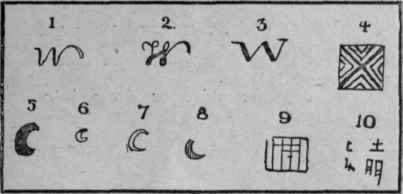
Some marks found upon blue-and-white Worcester poicelain. The mark most frequently found is the crescent, though the W in script form is considered the earlier
Another form of under-glaze decoration adopted by Dr. Wall is that known as "powder blue." Here, again, is an adaptation from the Chinese cleverly copied at Worcester. The groundwork is granular in appearance, and is steel blue in colour. It was produced by blowing a blue glaze on to the porcelain through a pipe covered at the end with silk gauze. The white panels which decorate this powder blue background are round, square, or more commonly fan-shaped, and are painted with landscapes, flowers, foliage and insects in blue under-glaze or in colours over the glaze. Pieces of this kind of Worcester porcelain are valuable, especially those which bear the square mark or, as is very rarely the case, an anchor or crescent in red.
The " Lily pattern," a conventional design in outline, wilh a border of dark blue, slightly gilt, is another somewhat well-known style of decoration in a pale shade of blue, and is one that was used alike in early days and as late as the Chamberlain period.
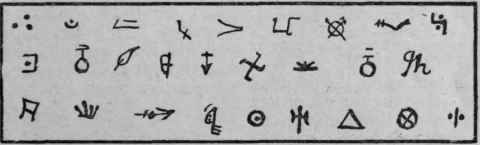
Some painters' marks that may be seen on Worcester china. These often occur in addition to or instead of the factory mark
A dragon pattern is found upon dinner, tea, and dessert services made by Thomas Grainger, who established a factory in Worcester in 1800. This formed the sole decoration upon porcelain of a superior quality. The colour, however, is not that which is generally associated with old Worcester blue-and-white, but is a light lavender shade.
The mark most frequently met with upon Worcester blue-and-white is the crescent, though the letter W in script form is considered to be earlier. The crescent varies in size from a very small open crescent to one of much larger size, filled in or lined in blue under-glaze. On rare pieces it may be found in red or gold over-glaze. The square mark copied from a Chinese seal in blue under-glaze is of rare occurrence upon blue-and-white porcelain, but disguised numerals in imitation of Chinese marks may sometimes be found. Upon many pieces a painter's mark occurs in addition to, or instead of, the mark of the factory. Further information aboutthe great Worcester factory, its products and marks, will be found in a following part.
Continue to:


My Books

