


True Love Stories Of Famous People. Lady Hamilton. Continued
Description
This section is from "Every Woman's Encyclopaedia". Also available from Amazon: Every Woman's Encyclopaedia.
True Love Stories Of Famous People. Lady Hamilton. Continued
Emma always had been popular among the Neapolitans, but now she became not only popular, but also important. As Lady Hamilton she was given the entree where previously it had been denied her. She was received officially in court circles, and soon became on terms of closest intimacy with the queen.
These were troublous times in Europe. The spirit of the French Revolution, which had pervaded every country, had made its influence to be felt very strongly in the kingdom of the two Sicilies.
Ferdinand was a faineant king. The preservation of the monarchy, therefore, was a task which devolved upon the queen, a brilliant, resourceful woman and a sister to the unfortunate Marie Antoinette.
England alone had had the courage to breathe defiance against the eagle of all-conquering France; but for Maria Caroline to appeal openly to England, or even to negotiate with the English embassy, would have spelt ruin, for French influence was strong in Naples.
Through the ambassador's wife, however, the queen was able to negotiate and to gauge exactly the feelings of the English Court towards Naples.
To what extent, however, Lady Hamilton contributed towards the salvation of Naples is impossible to determine, but undoubtedly she did much. Indeed, without her skill and help, Nelson has assured the world that never could he have effected the rescue*.
Nelson first met Lady Hamilton in 1793, when, as a young naval officer, he was sent to Naples, with despatches to the ambassador. The next meeting took place five years later, when wild - nay, mad - with excitement, Lady Hamilton greeted her hero after the glorious victory of the Nile.
Nelson has left on record a description of this meeting. "She fell," he wrote in a Letter to his wife, "into my arms more dead than alive." And from that moment he loved her.
In 1800 Sir William Hamilton was recalled, and Nelson, whose work in the Mediterranean was now completed, decided to travel in the company of his friends to England, and to the faithful wife who was there awaiting him.
The journey was a long, intoxicating triumph, and to Nelson it must have been particularly sweet, since all the many honours which were showered upon him he was able to share with the woman whom he loved.
Whatever may have been the nature of the relations between them during their residence at Naples, there can be no doubt but that, long before their arrival in England, Nelson and Lady Hamilton were deeply attached to each other. The evidence of reason, if not of fact, is indisputable.
Sir William must have been blind, but Lady Nelson was less easily deceived. No sooner had she met her husband than she saw written on his face the confirmation of her fears. Perhaps even then this honest little woman recognised as inevitable the separation which was consummated later.
Towards the end of the year 1800 Sir William, it is true, contemplated a separation from his "beloved Emma." This, however, he did from quite unselfish motives. In his old age he felt incapable of living in such a whirl of social gaiety as was necessitated by the friendship between his wife and Nelson. He did not take the step, however, because, as he himself remarked," I well know the purity of Lord Nelson's friendship for Emma and me. And I know how very uncomfortable it would make his lordship, our best friend, if such a separation should take place."
Moreover, in 1803, when he died, he was still without suspicion, and he died clasping in his the hands of his beloved wife. There was a pathos about the old man's blind devotion which was wasted neither on Emma nor on Nelson. To the end they loved and ministered to him as would have a daughter and a son.
Although basking in the sunshine of a brilliant and ardent love, Lady Hamilton now was burdened with remorse. She was conscious of having descended" the primrose path" which once she had found so difficult to climb. She resented finding herself once again the subject of malicious paragraphs in papers, gossipped about in clubs, and the centre of vulgar curiosity in every drawing-room.
She resorted to all manner of subterfuges to conceal her secret, and at the time of the birth of her daughter, Horatia - that much-discussed infant - Nelson in his letters always refers to himself and Emma as Mr. and Mrs. Thomson.
In the spring of 1801, however, he threw oft this feeble and transparent mask, and wrote:
"Now, my dear wife, for such you are in my eyes and in the face of heaven . there is nothing in this world I would not do for us to live together and to have our
Love dear little child with us. ... I love, never did love anyone else. I never gave a pledge of love until you gave me one, and you, thank my God, never gave one to anybody else ! "
"Never gave one to anybody else!" Either love had closed Nelson's eyes completely against all sight of facts, or Emma, with amazing cunning, had concealed from him all knowledge of the days which had gone by.
The former theory is the more probable. To the admiral England could afford only very little leisure, and during those few, short, peaceful hours Nelson may have been contene to enjoy unqucstioningly the society of the woman whom he loved.
It is true that, when the danger of imme-diate invasion was no longer imminent, he spent eighteen months at Merton at the house which Lady Hamilton had chosen for his home. But, with this as the sole exception, Nelson was allowed no leave save a fortnight now and a fortnight then. England was ever in need of the great admiral's genius.
During the long months when he was absent Lady Hamilton, for the most part, made her home at Merton. London, however, she visited frequently, and there was welcomed cordially. Her social charm, her beauty, and her fascination still were incomparable. She was a gorgeous woman, and the world loved her. Even at the house of Nelson's mother she was an honoured visitor, and Mrs. Nelson was the wife of a Norfolk clergyman and the personification of strict conventionality.
Nelson's infatuation, however, was insatiate. At sea, in times of danger, amid trouble and anxiety never for a moment did he forget Lady Hamilton.
Moreover, he longed for the day when he would be able to retire and proclaim as his wife the woman who was, and whom he declared to be, his Alpha and his Omega.
"I rejoice," he wrote on August 20th, 1803, "that you have had so pleasant a trip to Norfolk, and I hope one day to carry you there by a nearer tie in law, but not in love and affection, than the present."
So superb a romance, however, Fate deemed worthy of a more dramatic ending, and the finish it devised has justified the intention. It is at one and the same time as grand and as pathetic an incident as a biographer can chronicle.
In 1805 Nelson spent one happy fortnight with Lady Hamilton at Merton, and after that he saw her no more. His country called upon him, called upon him for the last time, to save her, and Nelson sailed to death and glory. Off Cape Trafalgar he established the supremacy of England; off Cape Trafalgar he died. His mission was accomplished; all was finished save the last and most beautiful of his letters to Lady Hamilton.
"My dearest, beloved Emma, and the dear friend of my bosom, - The signal has been made that the enemy's combined fleets are coming out of port. . . . May the God of Battles crown my endeavours with success! At all events, I shall take care that my name shall ever be most dear to you and to Horatia, both of whom I love as much as my own life, and as my last writing before the battle will be to you, so I hope in God that I shall live to finish my letter after the battle. . . ."
But Emma finished the letter:
"O, miserable and wretched Emma! O, glorious and happy Nelson."
On this day also died the Emma of romance. Henceforth she degenerated rapidly, and became a silly, extravagant, vain-glorious woman. In 1813 she was imprisoned for debt. On January 15th, 1815, she died at Calais, at the age of fifty-one, and there were but few to mourn beside her grave.
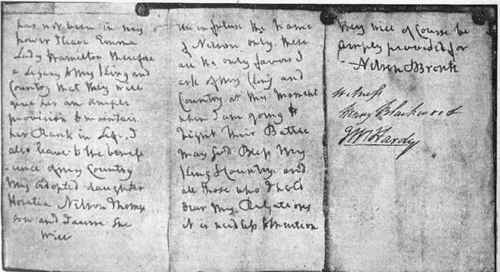
Lord Nelson's last wish As a legacy to his country he left his daughter Horatia and her mother
Continue to:


My Books

