


The Invailed Woman And Service. Part 3
Description
This section is from "Every Woman's Encyclopaedia". Also available from Amazon: Every Woman's Encyclopaedia.
The Invailed Woman And Service. Part 3
If the invalid is not personally known to the clergy or the minister of the church to which she belongs, as she ought to be, what a perfectly splendid introduction a letter offering help in this way would be ! Or if, again, the invalid is not a member of any religious body - a distinct loss to both - this need be no impediment. Philanthropy is not conditioned by church membership. So much help is needed that any offer of service would everywhere be welcomed; and, indeed, such an offer might easily lead on to something better.
Other Practical Services
But there are other methods of work than these. I have known an invalid wife of a rector who, in addition to being the daily inspiration of her husband in his arduous work, was also his constant helpmeet in raising funds both for home and foreign enterprises. I have known, also, an invalid lady whose life was a blessed ministry by means of letter-writing. I can imagine invalids learning typewriting, copying, etc., and by these and other means becoming of immense practical service in the various departments of church work.
But I have said enough to indicate the principles of a great revolution in the sad and solitary lives of the permanently sick. To all such I would say as a last word: Believe, or try to believe, that "all things work together for good to them that love God." Believe, or try to believe, that every soul has a service to render, every life has a ministry to fulfil. Believe, or try to believe, that guidance will not be withheld if you pray the prayer," Lord, what wilt Thou have me to do?" Believe, or try to believe, that when you are guided to service grace will be given you to serve. Try, for in trying we never really fail.
Never mind even though your faith is
"as a grain of mustard seed." It will, if cultivated, grow; and, growing, will bear fruit. The fruition of faith is strength for service, and by your good works for others you will best prove your faith in God. Only believe, and your invalid life will become a blessed and faithful ministry. Then, by suffering service, you will be prepared for the service without suffering, and when "sorrow and sighing shall flee away" you will enter upon the endless joy of perfect service.
"It is enough - earth's struggles soon shall cease, And Jesus call us to heaven's perfect peace."
The Beacomess Institute,O Bowrom House
The Story of the Foundation - Bowron House - The Staff, their Work and Aims - Tributes Paid to the Good Work of the Institution most interesting history is attached to the Deaconess Institute, Bowron House, and it illustrates how a woman's act as a "ministering angel" may bring about unexpected and far-reaching results. Some years ago a wealthy London business man, the late Mr. Bowron, when returning home from New Zealand, was taken ill. There was no trained nurse on board; and he was left to such ministrations as the steward or his deputy could give. Then a lady passenger took pity on the sick man, and. volunteering her services, nursed him to the end of the voyage. The patient was so grateful for her gentle, kindly care that he desired to start some project with the view of enlisting the work of women amongst the ailing and distressed and to provide openings of service for them in connection with evangelistic work. He did not live to carry out his wish; but after his death his sons founded to his memory the Deaconess Institute, Bowron House, as a training home for women in evangelistic and social work in connection with the United Methodist Free Churches.

The work was begun in 1891, in a house in Pimlico, with a lady superintendent, one deaconess, and one probationer. It prospered from the beginning, and owed much of its success to its secretary, the Rev. T. J. Cope, who organised and managed the whole movement.
Now there are forty deaconesses at work in various parts of the country, and there is always the full complement of probationers in training at the institute, which now has its headquarters at 25, Bolingbroke Grove, Wandsworth Common.
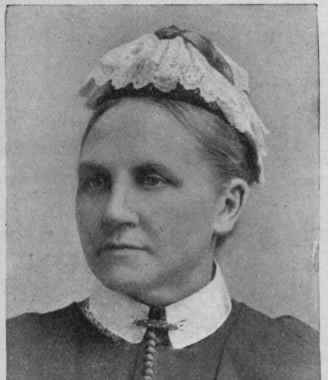
Miss Bushell, Lady Superintendent Deaconess Institute, Bowron House. Photo by Soper & Stedman
It is some time since the nightingales sang in Bolingbroke Grove, but the fine old trees, from which it derived its name, still remain, and impart a semi-rural look to the vicinity. Bowron House is pleasantly situated overlooking the common, and the highest compliment one can pay it is to say that it has nothing of an institute about it.
Under the benign management and dignified presence of Miss Bushell, who has presided over it for sixteen years, Bowron House is a refined and charming home, artistically furnished, and its many-windowed rooms command delightful views over the garden. Miss Bushell herself has one of those richly - endowed natures which inspire an atmosphere of love and harmony.
The Staff
Probationers are received at the institute from anv Christian church, and women who have gained a knowledge in the practical affairs of life by work in some occupation are specially welcome. The institute is not intended for women of leisure. No vows are taken by the sisters. The usual length of training is one year, beginning with probation. Board and lodging are provided, and an allowance given for incidental expenses after probation. Those who can are expected to contribute to
Continue to:


My Books

