


Fancy Rabbets As Pets
Description
This section is from "Every Woman's Encyclopaedia". Also available from Amazon: Every Woman's Encyclopaedia.
Fancy Rabbets As Pets
Written and Illustrated by F. J. S. Chatterton
Specialist Breeder and fuage of Poultry, Pigeons and Cage Birds; Judge at the " Grand International Show, Crystal Palace," Membre Societ-des Avicultenrs Francais; Vice-president Poultry Club; Hon. Sec. Yokohama Club; on the Committee of Middlesex Columbarian Society;
Indian Game Club, etc., etc.
Why the Dutch Rabbit is one of the Most Popular Breeds - Good Foster-mothers - Good Points The Markings - Most Popular Colours - Cost - Show Specimens
The Dutch rabbit, although the smallest fancy breed in this country, is one of the prettiest and most popular, on account of its exceedingly affectionate and docile nature.
It is quite unusual to find a specimen with a bad temper, though I have come across one or two which seemed to delight in trying to bite anyone who came near them. Such, however, I am pleased to say, are very seldom met with, for it is not pleasant for a judge to take one of these kinds of animals out of its pen to judge it with the others in its class. It is, as a rule, the buck (or male) rabbits that have this bad temper.
The does (or females) are excellent mothers. They not only show much affection for their own young, but will also rear and care for the young of other rabbits, and so make splendid nurses or foster-mothers when the does of other breeds of fancy rabbits prove variety of the breed is the most popular bad mothers or have too many of their own to bring up themselves.
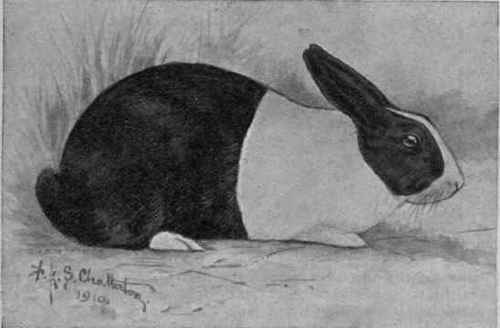
A typical black-and-white Dutch rabbit, correct in form and in colour-markings. This
The Dutch rabbit, of course, originally came to this country from Holland, and it reminds one of the black-and-white cattle one s e e s everywhere in Holland.
One great advantage in breeding this variety is that it is possible to tell at an earlier age - viz., three or four days - than almost any other variety of rabbit whether they will be good enough for exhibition purposes. The m i s-marked ones can then be taken away at once, that the others may receive more attention from their mother. Both the doe and her young will thrive all the better for the reduction in numbers, which will also reduce the corn bill and give more room for the good stock.
There are other points in favour of Dutch rabbits as pets. As they are small. they do not require so much room as other breeds, their varieties offer a choice of colours for selection, and, finally, they mature most quickly for exhibition, many animals having won high honours in the show-pen when only ten and twelve weeks old. he is not to be wondered at, therefore, that the Dutch rabbit is such a favourite.
All varieties of the Dutch rabbit should be marked in the same manner. The illustrations accompanying this article show a typical black-and-white Dutch and a typical blue-and-white Dutch rabbit, as well as a mis-marked black Dutch, and explain clearly the kind of marking required in good specimens.
The principal faults in the mismarked specimen illustrated are: (1) Marking on the face comes too low down; (2) there is marking on the neck, which should be white - this is generally termed "a drag on neck;" (3) a broken saddle - that is to say, the black marking comes too far forward, and is not clean cut. and there is marking on front leg: (4) the marking on hind feet is uneven and too far forward, technically described as "stops cut on the cross."
This animal is also too long in front legs, and too much like a Belgian hare-rabbit in shape. A Dutch should be short-bodied, or "cobby" and thick set.
The most popular colours are without doubt the black-and-white and the blue - and - white; t hen come greys, either steel greys or light greys, of which the former is the more popular. The tortoiseshell and yellows are next in order of popularity, and then come the fawns, blue fawns, blue greys, etc. None of these colours can approach the blacks and the blues for beauty. The appearance of a really good jet black and pure white coat is exceedingly pretty, a remark which also applies to a sound and even-coloured blue.
In breeding blacks the most satisfactory mating is that of a black doe to a blue buck, or a blue doe to a black buck. By this breeding you will get more depth of colour and lustre on the coat than mating two blacks together. Of course, there are exceptions, but this will be found the best rule to follow
In selecting your breeding stock be sure the marking is as near the ideal standard as possible; the sharp line of the marking on the saddle should continue right round, and not be broken or pale in colour on the stomach. The ears should be black and free from any ticking or spotting of another colour, eyes bright and in colour like the coat. Two of the most common faults in blues are light coloured ears or white tips to the ears. The ears should be of the same colour as on the body. Some blues are of good colour when young, and then go off in colour as they grow older.
Young Dutch rabbits can be bought from half-a-crown each and upwards, according as they possess good points for exhibition: while adults fetch from half a guinea upwards. Good does for breeding purposes can sometimes be bought for thirty shillings and two guineas each.
Do not breed from buck or doe until they are fully six months old. If you wish to breed show specimens from the first, be sure the buck and doe are of the same strain and slightly related to one another.
It is a common error amongst beginners in the fancy to think that if they purchase the first-prize male and the first-prize female at a show they will be sure to breed show specimens as good as the parents. In ninety-nine cases out of a hundred the offspring from such a mating will be a great disappointment to their owner.
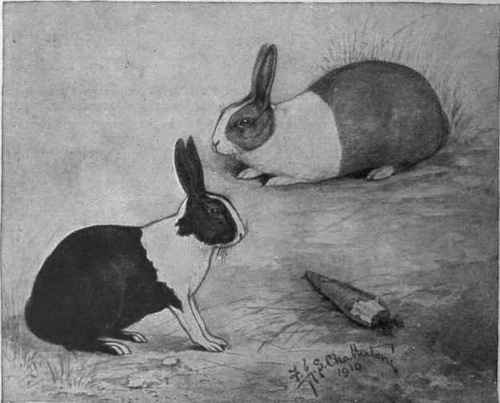
A good specimen of a blue-and-white Dutch rabbit and a mismarked specimen of the black-and-white variety, in which not only is the colour-marking unevenly distributed, but the shape is also incorrect
The correct weight for a Dutch rabbit should be about five or six pounds, but often good specimens weigh less. Some fanciers advocate breeding from young parents, but this is a mistake. It is better to breed from fully developed parents, and to feed the young with care and discretion. In this way the stock will become strong and healthy.
Continue to:


My Books

