


Children. How To Arrange A Children's Party
Description
This section is from "Every Woman's Encyclopaedia". Also available from Amazon: Every Woman's Encyclopaedia.
Children. How To Arrange A Children's Party
By Gladys Beattie Crozier
The Invitations - Decorating the Tea-table - Games and Dances - Presents to the Guests A Children's Dance Supper
There is no prettier or more popular form of entertainment than a well-managed children's party, and, in order to make it the merry, delightful affair it should be, the wise hostess secures the promises of one or two of her prettiest and gayest girl friends to come early and play games, pour out tea, lead Sir Roger de Coverley, and generally help to make things go with a swing from start to finish, before finally fixing the date and sending out invitations to the little guests.
The invitations, as a rule, are written by the children of the house - under grown-up supervision - on one or other of the pretty picture invitation-cards of which there are nowadays such a variety to choose from at any good stationer's. "We are giving a little party on -------, from o'clock to - . Will you come?" or some similar legend, is printed on them, and the spaces left are filled in with the hour, date, and name of the little guest. They should be sent out from ten days to three weeks beforehand, according to the size of the party, and, partly also, according to the time of year. The longer the invitation the better, when many juvenile entertainments of every sort are going on, as children have often more invitations than they can accept. The hours at which a children's party should begin and end depends upon the age of the children of the house and of their little friends. If under seven years old, they must be asked from 3.30 to 6 o'clock or 6.30; or, if ranging in age from seven to twelve, 4 o'clock to 8 o'clock are the usual hours.
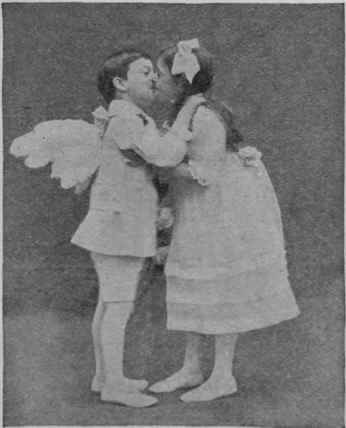
Forfeits - kissing the one you love the best
A party for bigger schoolboys and schoolgirls, from twelve to sixteen or seventeen, is often given from 5 o'clock to 10 o'clock, or from 6 o'clock to 11, when a more grown-up form of invitation would be used, and supper takes the place of tea.
Music is essential to. make a children's party a real success, and the services of a good pianist may be engaged from one of the many agencies at a cost of about a guinea.
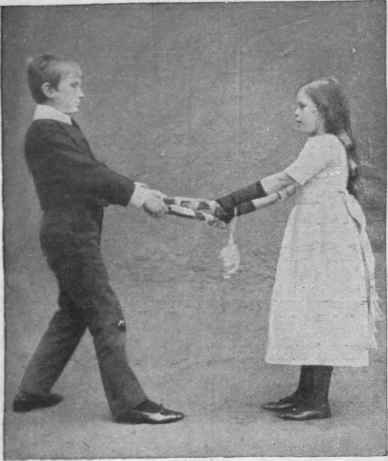
After tea cracker-pulling will be found a popular pastime. A proportion of the crackers should contain paper caps that can be worn and add colour to the scene
Rout seats cost very little to hire, and are a great convenience in seating a number of children at tea or supper, if space is a consideration, and they save much carrying about of heavy chairs; and, for a party of over twenty children, it will probably be necessary to hire cups, saucers, and plates - those made of white china are the best to choose, at a cost of 6d. a dozen.
For tea provide plenty of small pink and white iced cakes, made of sponge cake and jam, small chocolate cakes, sponge fingers - for the babies of the party - jam sandwich cut into slices, and rolls of brown and white bread-and-butter, jugs of milk, and pots of very weak tea. Cakes with fruit in them should be avoided.
Place two or three sugar-coated cakes - white walnut and chocolate cakes are excellent for a children's party - down the centre of the table, each one adorned with a dozen small flags of every colour and nationality, arranged in such a way that when the cakes are cut a flag goes with each slice, to the delight of the little recipient.
To further decorate the tea-table nothing is prettier than strings of silver tinsel, such as are used to decorate Christmas-trees, wound round the base of each cake, and in and out between the various dishes. Plenty of the gayest coloured crackers obtainable should also be provided, two being placed crosswise in front of each child's plate, and the remainder scattered about between the dishes on the table.
In choosing the crackers see that a proportion of them contain coloured paper caps, so that when tea is over, and, at a given signal, the cracker-pulling begins, the pretty paper head-dresses to be donned by the children may add a final touch of revelry to the gay scene.
It is a good plan to map out a programme of events before the guests arrive, in order that there may be no pause. The usual way, where small children are concerned, is to play games, such as Hunt the Slipper, Blind Man's Buff, Hide the Thimble, Oranges and Lemons, or Musical Chairs, beginning a game directly half a dozen' children have arrived, choosing one which everyone already knows, so that the shyer children amongst the little guests can at once be drawn into the fun. Dancing or an entertainment may begin after tea.
At 4.30 a gay air should be played on the piano, and the children, swiftly sorted into couples according to age and height, march round the room, out of the door, and downstairs to tea.
If the party is a small and more or less informal one, the hostess and her girl assistants pour out tea, and help the maids to wait upon the children, while any nurses present stand behind their small charges to attend to their wants.
At a bigger party, the hostess and her grown-up friends, having marshalled the children in to tea, retire to some other room, library, or boudoir, where tea and coffee and various dainty cakes and sandwiches are served, and they return to the dining-room in time for the cracker fusillade.
Entertainments and Presents
If a conjurer, magic lantern, cinematograph, troupe of performing dogs or birds, marionettes, or the time-honoured Punch and Judy has been provided, the children are marshalled into the room where the performance is to take place directly after tea.
Continue to:


My Books

