


Baby's Short Clothing
Description
This section is from "Every Woman's Encyclopaedia". Also available from Amazon: Every Woman's Encyclopaedia.
Baby's Short Clothing
Author of "Health and Home Nursing," "Hygiene and Temperance," "Home Nursing," etc.
General Principles - Specimen Short-clothing Sets - Binders - Stays - Petticoats - Drawers Socks and Shoes - Frocks
The time for "shortening," or " short-coating," baby is usually determined by the health of the child and the time of the year. If baby is thriving and healthy, and the weather is suitable, the long clothes may be replaced by shorter ones about the twelfth week.
Should baby be ailing, or the weather be cold, shortening had better be delayed for a week or two.
The principles which have been already laid down with reference to baby's clothing in previous articles must, of course, be adhered to in preparing or purchasing the short clothing.
The clothes should be warm, without being heavy, and the warmth and weight should be equally distributed over the body, care being taken to see that the extremities are kept warm. The sleeves should still be worn long and the necks high, on account of the position of the lungs, the apices, or points, of which rise above the collar-bone on each side, and also extend down under the armpits.
With the discontinuation of the long clothes, extra care must be taken that the lower part of the body, especially over the bowels, is kept protected against chills, or distressing diarrhoea may result.
The under garments should still be of wool, which is warm, light, soft, absorbent, and, if properly washed, porous; indeed, it is almost impossible to over-estimate the importance of warm woollen underclothing, more especially if any marked tendency, such as struma, rickets, anaemia, or any other constitutional delicacy has begun to show itself. Far better, should means be limited, to sacrifice some of the smartness in material or trimming of the outer garments, and have good underclothing for the young and growing baby. Illness, and even life itself, may be saved by the wearing of some sort of woollen garment next the skin.
Where circumstances permit, there is nothing better or more suitable than underclothing made of the natural wool, otherwise flannel or woven woollens should be used.
As already stated, flannelette should be avoided, as not affording enough protection from cold, and being so highly inflammable.
Shortening should be gradual, the first shortening clothes reaching about four inches below the feet, as baby should still be carried about mostly in the recumbent position. On this page are given details of two short-coating sets, one with prices, the other without, and intended to be a guide for making the little garments at home.
Short Coating Set I. | ||||
£ | s | d. | ||
6 | Shirts or vests at 1s 9d | o | 10 | 6 |
2 | Stays at 1s 3 1/2 d | o | 2 | 7 |
3 | Flannel petticoats at 2s. o|d. | o | 8 | 4 1/2 |
i | Best flannel petticoat | o | 4 | 9 |
3 | White petticoats at 2S. ii jd..... | o | 8 | io 1/2 |
1 | Best white petticoat | o | 5 | 6 |
3 | Nursery frocks at 5s. nd. | o | 17 | 9 |
2 | Nursery frocks at 5 s 11d | o | 17 | 10 |
1 | Best frock | I | 1 | 0 |
1 | Pelisse | I | 5 | 6 |
1 | Bonnet | o | 12 | 11 |
2 | Pinafores at 2s. 10 1/2d..... | o | 5 | 9 |
1 | Best pinafore .. .. .. .. | o | 5 | 8 |
£7 | 7 | 0 | ||
Short Coating Set II.
Can be home-made garments, about 23 inches long.
4 Large vests, with long sleeves and high neck. 2 Belts, knitted or woven.
2 Pairs of woollen stays.
4 Woollen petticoats, with bodice. 4 Upper petticoats. 4 Nightgowns.
3 Woollen dresses, or frocks.
1 Best frock (silk 0r cashmere).
4 Pairs of woollen socks, with long legs. 6 Pairs of flannel or knitted drawers.
6 Bibs. 24 Large diapers, or napkins, 24 inches by 27 inches.
Belts or Binders. The flannel binder should now be replaced by a knitted or woven one, to reach from the hips well up over the abdomen, and to which the napkin can be safely pinned. This will help to keep off diarrhoea, so often caused by chill to the bowels.
Stays. These are generally made of two layers of quilted flannel, which should be large enough to reach from the hips to the collar-bone. The armholes and edges should be bound with soft flannel binding.
The strings are placed at the edge on the right-hand side, and two inches in from the edge on the left-hand side. This allows for wrapping over. The shoulder straps are 4 1/2 inches long (see Fig. 1). Very comfortable stays for baby may be done in close double crochet, two ounces of three-ply fingering wool being needed, and a No. 9 hook. The crochet is bound with ribbon, and ribbon is used for the shoulder-straps.
Petticoats. These are usually of two kinds, a flannel or woollen one, and an upper, which is generally of longcloth or calico in summer, or some woollen material in winter. Flannel Petticoats. These can be made in two ways, either long or short.
With the short variety, the skirt of the garment is put into a calico band, to button on to the lower part of the stays (see Fig. 2). A better way, for winter wear, is to attach the skirt to a high-necked bodice, with sleeves reaching to trie elbow.

Fig. 1. Stays made of quilted flannel
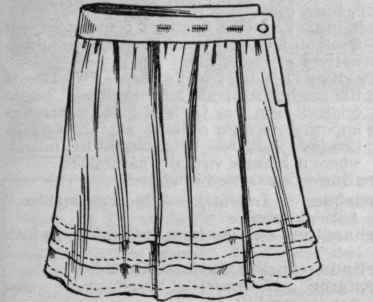
Fig. 2. The petticoat should be tucked to allow for shrinkage
The petticoats should be tucked, to allow of lengthening for growth of baby or shrinkage in washing, and the lower edge may be trimmed with embroidery or coarse washing lace.
Upper petticoats may be made of any material, but are generally of cambric, longcloth, or nainsook. The garment consists of a skirt gathered into a sleeved bodice. The skirt should measure about sixty inches round, and when made up should be about fourteen inches long. The skirt is often elaborately embroidered or profusely trimmed with lace.
Drawers are a much better protection for baby than petticoats, as when lying down the latter may be kicked back, and baby's legs be exposed to the cold.
If drawers are worn, a second petticoat may often be dispensed with. They may be made of soft flannel or hand-knitted or crocheted, and are generally worn over the diaper.
Flannel drawers are usually set into a band, which can be made to button on to the stays. The leg part, which is merely a curve, is finished with an ordinary hem, to which an edging is attached, or a row of feather-stitching looks neat and pretty.
Knitted drawers can be purchased quite reasonably or can be made at home.
Socks and Shoes. Socks should be long, those of three-quarter length being good, and in winter should always be worn.

Fig. 3. First little drawers
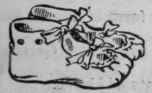
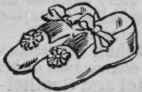
Figs. 4 and 5. Soft kid shoes can take the place of woollen bootees
Morocco or kid shoes take the place of the first wool bootees. (Figs. 4 and 5.)
Frock or Dress. With the passing of time, perhaps no article for baby's wear shows so much change as does baby's first short frock.
Some years ago it was made with a bodice and full skirt separately, these being then joined together at the waist, and always with low neck and short sleeves.
They have been wisely superseded by the "overall" type of dress - that is, a long skirt suspended from a yoke (see Fig. 6). This also makes for economy, as by this fashion the long and often expensive monthly gowns may be used up. This can be done by extra tucking, or a piece may be cut out just above the tucks, an extra one being made to hide the join. Even if the yoke be too small, or showing signs of wear, a new larger yoke may be added to the skirt. The little frocks may be made in nuns' veiling, fine wincey, or cashmere in winter, or cambric or nainsook in summer, with good washing silk for best.
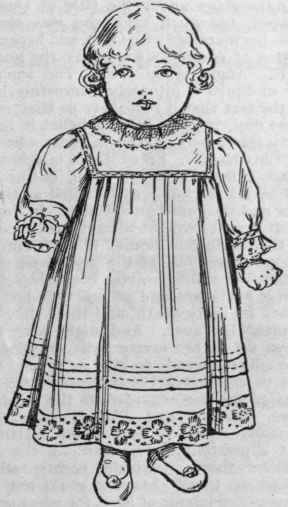
Fig. 6. Dresses of the "overall " type are easy to make, and comfortable in wear
To make a frock of the " overall " type. - There is the skirt part, which consists of front and back practically alike, except that the back has a slit for the placket.
The skirt should represent five-eighths of the length of the garment, which will vary with baby's age.
Measurements up to one year old are:
Back and front .. 18 by 27 inches Sleeve .. .. 12 by 14 ,,
Yoke .. .. 13 by 9 „
Chest measurement about 8 inches.
These garments are quite suitable for baby till creeping and toddling begin, when they should be made shorter, especially the petticoats and frock, which might otherwise interfere with the first attempts to stand and walk.
Continue to:


My Books

