


Animal Hospitals
Description
This section is from "Every Woman's Encyclopaedia". Also available from Amazon: Every Woman's Encyclopaedia.
Animal Hospitals
When pussy shows signs of a cold she ought to get instant attention, and be isolated, both for her own sake and because nothing spreads infection, particularly amongst children, so quickly as a cat. Pussy can be at once taken, when she shows signs of illness, to one of the many " private nursing homes." The cat will be received at the Sanatorium, Beddington Lane, Surrey, or at Althorpe Road, Bridge Road, West Battersea. Or the owner can apply by telephone to the Matron of the Animals' Hospital, who will give other addresses. Or, on the other hand, she can be attended, like any human mortal, at her own home by a specially trained cats' nurse, and be daily visited by the veterinary surgeon. The Animals' Hospital at No. 1, Hugh Street, Pimlico. S.w., owned by "Our Dumb Friends' League," has special wards for cats, where pussies suffering from every kind of disease are treated. This famous hospital, which is supported only by voluntary contributions, exists for the treatment of the animals of the poor, and has no paying department, but the matron can recommend homes for paying patients. If cats are to be " humanised," they must be frequently spoken to and noticed by their owners, and they must also have plenty of playthings, etc., to keep them bright and lively.
To train a cat never to leave the house, by no means injures it or makes it unhappy, providing that it is allowed plenty of fresh air and plenty of room. The making, in fact, of a perfect race of cats resembles closely the necessary proceedings for the making of a perfect race of babies.
Cat owners should remember that when it is absolutely necessary to punish pussy this ought to be done immediately after the fault is committed. Do not whip or strike to punish immediately an offence has been committed, but take the cat and press the hand on the back of the neck firmly enough to hold the animal with head down on the ground. Hold it steadily for some five minutes, talking to it and scolding it gently all the time. If the fault is repeated, bump the nose gently several times. « This is quite sufficient to teach any ordinary cat all that is necessary.
Cats are passionately fond of the taste and smell of aniseed, a fact that can be utilised in training them either to cleanly habits or to the performance of homely tricks. A cat that is taught by kindness to sit up and beg for some special dainty enjoys it all the more, and the education is good for it.

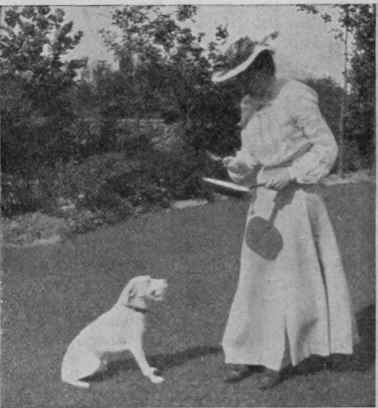
Tricks without number can be taught to a clever fox-terrier or any other dog if, from the day he comes into her possession, his mistress takes entire charge of his education, making him her constant companion, always feeding him herself, and teaching him prompt obedience to the word of command however gently spoken.
At six months old his training in tricks should begin. Already he will have shown all sorts of pretty ways and characteristics of his own, as every cheerful and well-

" Dying for his country" cared-for puppy does, and, by studying these ways, the basis can be found for all manner of tricks.
Perhaps he will run always to a lighted cigarette or burning match which has been dropped accidentally on the ground, and will swiftly stamp out the fire with his hard little paws; perhaps, after waiting patiently in the farmyard until a triumphant cackling from a nest-box announces the fact that an egg has been laid, he will pick up that treasure gingerly between his teeth, and take it as a present to his mistress; perhaps, if he is not hungry when given a biscuit, he will hide it with his paw, and play about with it before eating it; perhaps when excited he always springs on to a certain chair, and, putting his paws on the back of it, gives vent to his feelings by a series of short, sharp barks.
Bobs, the dog appearing in the illustrations, for example, learnt in half an hour to " make a speech" at the word of command, flying to the little chair, and barking over the back of it, directly it was produced and placed in the middle of the floor.
A trick box, containing a small frying-pan and spoon, a box of big wooden matches - wax ones would have stuck to his paws and burnt them - a tin of biscuits, and the little chair, were always kept behind the piano ready for a performance.
"I want to make an omelette - what can you do to help me ? " his mistress would ask, flourishing the frying-pan and spoon. Off Bobs would scamper down the kitchen stairs to cook, returning proudly, his head held high in the air, gently carrying an egg, which he would lay down in the frying-pan placed at his mistress's feet.
Next, his mistress would light a match and drop it on the stone verandah, exclaiming excitedly:
The house is on fire ! What would you do, Bobs ? " The dog would then promptly "put it out."
Smelling and tasting a biscuit, and, finally, hiding it with his paw at the word of command, before receiving the order to eat it, would wind up his entertaining little performance.
"Gently carrying an egg"
It is best to begin teaching a dog tricks when he is from six months to a year old, and two or three short lessons a day are more valuable than one long one. Lessons should be given just before meals, and each successful effort should be rewarded with a lump of sugar or a biscuit.
Never teach a new trick until the last one is thoroughly mastered, but go over all the old tricks every day, so that the dog may not forget any of his repertoire.
Rolling a barrel is a novel and effective drawing - room trick. The barrel should be covered with velvet to make it more decorative. Teach the dog to jump on to it, and to roll it, by means of holding a bribe, in the shape of a biscuit, just beyond his reach and over his head. Directly he succeeds in rolling the barrel even a few feet in the right direction, give him a reward, and start again.
Skipping is another effective trick, but is best performed out of doors. Get two people to turn the rope slowly, and, to begin with, stand on the opposite side of the rope to the dog and, by tempting him with a biscuit, make him jump over the rope as it turns.
Next take one handle yourself, holding a bit of biscuit over the rope with the other hand, call "Jump!" and turn the rope skilfully under his feet as the dog springs into the air.
If he is rewarded each time the rope passes successfully under him, he will soon learn to skip half a dozen turns of the rope in succession, and will " run in" just as a child does.
Shutting the Door is a most useful trick for a house-dog, and is taught by means of opening the sitting-room door for about a foot. Having pointed it out to the dog and exclaimed "Shut door!" hold a bit of biscuit up just beyond the dog's reach. As he scrambles to reach the biscuit, he pushes the door to, for which he should at once be patted and rewarded, and the lesson immediately repeated, using the same words, at least half a dozen times. Soon he will learn to run to any door which stands ajar and shut it, if it is pointed out to him with the words "Shut door!" and a bit of biscuit should be kept in readiness to reward him for his trouble.
Dying for His Country is another good trick which is soon taught with a little patience. Place the puppy in position, and say "Die!" in a low, deep voice several times, until he remains quite still with his eyes shut for a moment; then, in a high, cheerful voice, cry "Rats!' and up he will spring and dart off with alacrity. Bobs used to illustrate the following little anecdote told by his mistress and founded on this trick.

Hiding a biscuit with his paw

"Bobs puts out a lighted match with his paw"
"Once there was a poor little dog who by - and - by died." Bobs proceeded to "die." "A policeman came along and shouted, 'get up, you bad dog!' And then a boy came along and gave him a kick " - suiting the action to the word - " but still the little dog remained lying as dead. Then his mistress came along and cried, 'why, Bobs!' and knelt down and kissed him." And in an instant Bobs was alive again, frolicking and barking round the teller of the story!
Walking on its hind legs is an invaluable trick, for it makes the foundation for many others.
Fox-terriers are specially easily taught to perform this trick.
Hold a bit of biscuit just over the dog's head, repeating the word "walk" encouragingly, and help it at first to get its balance by means of a short, stiff cane or rod - a small curtain-rod cut in half answers the purpose admirably - which may be just slipped under its front paws to help it to maintain its balance as it stretches up after the biscuit.
Teach it to walk in this way a few steps at a time, at first with, and afterwards without, the help of the balancing rod, and when once it has thoroughly found its balance it will soon learn to cross the room on its hind legs at the word of command.
Now have a little suit made consisting of hat, soldier's jacket, and gun, or a little bride's dress, with a gathered train springing out from just above the wearer's tail, so that it can be used to stick the dress out behind, keeping it clear of its feet; add a tiny orange-blossom wreath and a veil, fastened on with fine elastic, and the "bride" will create the greatest delight, particularly at a children's party, entering the room standing erect on her hind legs, and being led along by her mistress.

Our Transfer Pattern Worked In Golden Brown Silk On Cream Satin Child's Hood; In Green Mallard Floss On Pale Rose Silk, For Evening Dress; In Ribbon-Work, Natural - Colours, For Cushion Cover Or Nightdress Case,
Continue to:


My Books

