


2. Needlework Pictures
Description
This section is from "Every Woman's Encyclopaedia". Also available from Amazon: Every Woman's Encyclopaedia.
2. Needlework Pictures
Author of "A History of Hand-made Lace," etc.
The Justification of Needlework Pictures - Petit Point Pictures - Stump Work - The Combination of Brushwork and Needlework - Portraits and Colour Sketches in Needlework now Fashionable
English women have always been famous for their skill in embroidering pictures, and although some people would maintain that it is false art to imitate with one medium the effects usually obtained by another, fine exponents of the art of needlework picture embroidery declare that in the working of pictures there are certain conventions which must be regarded, and that their needlecraft is not necessarily used lor imitating the effect of painted canvas.
It were false art to try, as Miss Lin wood did at the beginning of the nineteenth century, to make needlework look like painted pictures; but it is legitimate art if, realising the limitations of the needle, we depict scenes from nature with a due regard to conventions and the limitations of the medium.
One of the most important of these con-tions is that the stitches shall be so placed that their direction assists in representing the object. Thus the folds of a dress are worked as they flow round the figure. A fir tree would be worked in a series of fanlike stitches, as the foliage grows; the leaves of an oak, on the contrary, would be in oval raised effects, or in twisted chenele knots. French knots are often seen re] senting the woolly coat of a sheep, lamb, or poodle; or in the mane of a lion, when this strangely shaped beast of heraldic growthappears in early needlework pictures.

No. I. The Virgin and Child, an example of the beautiful combination of combined brushwork and needlework
Petit point pieturces are worked by the patient needlewoman. This stitch, the single cross on fine canvas - the goblin stitch, as it is sometimes called - is perfectly distinct from the double cross on two-strand canvas which was the terror of our childhood and one of the horrors of the early and mid-victorian era. Petit point stitch closely resembles tapestry, and was introduced into England in Elizabeth's reign.
The influence of tapestry on such needle-craft may be noted in all:fine examples, such as those to be seen at Hardwicke.
A modern example in this stitch, about 16 inches by 12 inches, is worth 10 or £12. Very costly, too, are the old needlework pictures of stamp, or stump, work, which was much done during the reign of Charles I., though it probably originated in the reign of James 1. £30, £50, or £100 is often paid for a picture of this type, or for a small box or cabinet decorated on the outside with it.
Its chief characteristic is that it is in high relief, and the effect is often of grotesque ugliness. Stuffing and padding is freely used. Curtains, draperies, etc., are sometimes made so that they draw aside. The background is flat, and the rounded limbs of the figures, the heads and legs of animals, and other ornaments, stand out. Such materials as pearls, beads, glass, mica, lace, damask, and all varieties of stitches are used to obtain realistic effects. Such subjects as the visit of the Queen of Sheba to King Solomon, and various scenes in the life of the Royal House of Stuart, are portrayed. The costume in such scenes is frequently of a mixed character, various epochs being freely drawn upon in the same picture.
The revival of such work, which is a travesty on sculpture, is not desirable, nor is it likely to be successful, for the minute care and detail, the laborious elaboration of every object alone gives interest to picture work. Moreover, it is freakish rather than artistic, even in its finest examples.

No. 2. Study of a peasant knitting. Another example of how coloured linens can be utilised
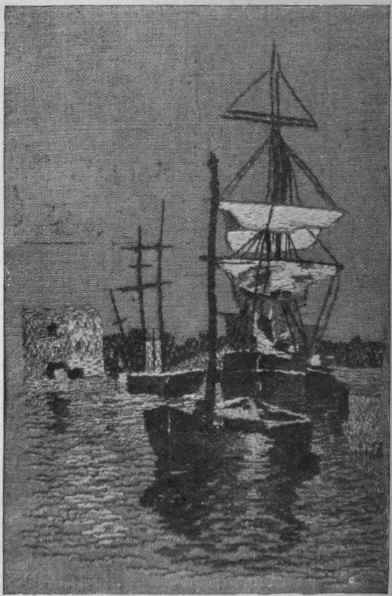
No. 3. A sea study in monochrome on brownish canvas
But there are many less arduous ways of making needlework pictures than that of setting in thousands of stitches on canvas and obtaining a tapestry effect. Perhaps the quickest method of all is the darning of various materials in wool or silk after a slight colour-wash has been laid on to serve as a background, and also as a guide to the worker with the needle.
Either a brownish linen is used, or a matlasse of dull-surface wool or silk thread is then darned into the fabric, so that landscape, foliage, figures, and sky can all be depicted in softly toned hues; and varying results, from the most impressionist to the realistic, can be obtained at the will of the worker, guided by a colour scheme laid on as a pattern.
The mingling of brushwork and needlework in one example is perfectly sound, and strictly in accordance with old precedent in the thirteenth and fourteenth centuries, when English church needlework Was famous throughout Europe. The Pope himself sent for opus Anglicanum - pictures of saints being treated in this way.
The very beautiful example of the Virgin and Child illustrated is worked on satin. The flesh is painted in water-colour; the halos, in pale blue silk, show up well against the olive-green rayed background. The blue of the mother's mantle is of the lovely bright shade beloved of Leonardo da Vinci. One line of gold thread outlines each halo. Such a picture could be Worked by a careful needlewoman without special tuition, the design being painted from a photograph of one of the pictures of the old masters.
Continue to:


My Books

