


2. Jiu-Jitsu For Women
Description
This section is from "Every Woman's Encyclopaedia". Also available from Amazon: Every Woman's Encyclopaedia.
2. Jiu-Jitsu For Women
Author of "Wrestling" and "Jiu-jitsu," Official Referee, Olympic Games, 1908.
Speed and Accuracy Necessary to Success in Jiu jitsu - Some Valuable Combat Tricks - The Superiority of the Defensive Over the Offensive Attitude - How to Vanquish the Most Powerful Assailant
Without any question, the most interesting part of jiu-jitsu is that dealing with the several holds, twists, locks, and throws used for the purpose of self-defence - the combat tricks, as they are termed by the Japanese. There is a fascination in these tricks which is irresistible. Their simplicity and deadly effectiveness, the ease and sureness with which an expert will bring them into play, and the decisiveness with which it is possible to demonstrate the superiority of the person to whom they are familiar over the individual who relies upon untutored strength, cause one to be filled with the desire to obtain familiarity with the tricks and the manner in which they are performed.
Few of the tricks are complicated, but the manner of performance is all-important. The knack of successfully executing a trick may be appreciated in five minutes, but to learn to execute it thus successfully will take very much longer.
The performance of any trick as described is simple enough, but between that and the ability to use the same trick in actual contention there is a wide gulf. Accuracy is essential; but with accuracy, if jiu-jitsu really is to be useful, there must be joined speed. The required combination of speed and accuracy can be the outcome only of much practice.
Merely knowing how to perform a trick is not enough. The trick must be practised until its performance becomes almost mechanical.
The practising of these combat tricks is in itself a very entertaining sport. There is not the slightest need tor it to be carried to too great lengths; the defender should be quick to give notice that the attack has been carried sufficiently far. But it is only by practising the tricks as they would be performed when actually used in self-defence that the required familiarity with them can be gained.
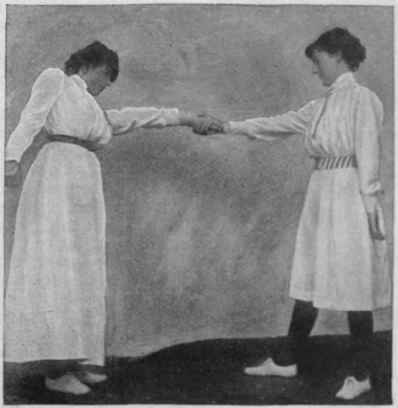
Fig. 1. By means of this grip and twist, the elbow-joint is locked, and the victim is unable to release herself
Continue to:


My Books

