


The Stereoscope
Description
This section is from the book "Warne's Model Housekeeper", by Ross Murray. See also: Larousse Gastronomique.
The Stereoscope
"This most valuable and instructive instrument, and now not only a 'household word,' but a piece of domestic apparatus without which no drawing-room is thought complete, was invented by Professor Wheatstone, and subsequently modified by Sir D. Brewster. It demonstrates that man must have two eyes in order to enjoy the appreciation of distance, or, like the fabled Polyphemus, we might only have had one eye. Mr. Woodward gives the following excellent and familiar explanation of the phenomena produced by the stereoscope.
'A Familiar Explanation of the Phenomena produced by the Stereoscope "'The name is derived from two Greek words, signifying to view solid things, and the instrument is so constructed that two flat pictures, taken under certain conditions, shall appear to form a single solid or projecting body.
"'A picture of any object is formed on the retina of each eye; but although there may be but one object presented to the two eyes, the pictures formed on the two retinas are not precisely alike, because the object is not observed from the same point of view.
So The Stercoscope.
"' If the right hand be held at right angles to, and a few inches from, the face, the back of the hand will be seen when viewed by the right eye only, and the palm of the hand when viewed by the left eye only; hence the images formed on the retinae of the two eyes must differ, the one including more of the right side and the other more of the left side of the same solid or projecting object. Again, if we bend a card so as to represent a triangular roof, place it on the table with the gable end towards the eyes, and look at it, first with one eye and then with the other, quickly and alternately opening and closing one of the eyes, the card will appear to move from side to side, because it will be seen by each eye under a different angle of vision. If we look at the card with the left eye only, the whole of the left side of the card will be plainly seen, while the right side will be thrown into shadow. If we next look at the same card with the right eye only, the whole of the right side of the card will be distinctly visible, while the left side will be thrown into the shadow; and thus two images of the same object, with differences of outline; light and shade, will be formed - the one on the retina of the right eye, and the other on the retina of the left.
These images falling on corresponding parts of the retinae convey to the mind the impression of a single object;* while experience having taught us, however unconscious the mind may be of the existence of two different images, that the effect observed is always produced by a body which really stands out or projects, the judgment naturally determines the object to be a projecting body.
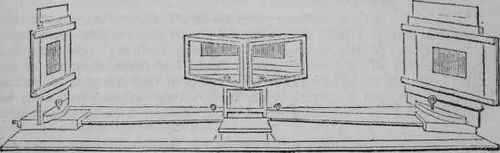
Professor Wheatstone's Reflecting Stereoscope.
"' It is experience also that teaches us to judge of distances by the different angles of vision under which an object is observed by the two eyes; for the inclination of the optic axes, when so adjusted that the images may fall on corresponding parts of the retinae, and thus convey to the mind the impression of a single object, must be greater or less, according to the distance of the object from the eyes.
"' Perfect vision cannot then be obtained without two eyes, as it is by the combined effect of the image produced on the retina of each eye, and the different angles under which objects are observed, that a judgment is formed respecting their solidity and distances.
* " That this is the correct theory of single vision with the two eyes is evident. For if, while looking at a single object with both eyes, we make a slight pressure with the finger on one of the eyeballs, we shall immediately perceive two objects; but, on removing the pressure, only one will be again seen".
"' A man restored to sight by couching cannot tell the form of a body without touching it, until his judgment has been matured by experience, although a perfect image may be formed on the retina of each eye. A man with only one eye cannot readily distinguish the form of a body which he had never previously seen, but quickly and unwittingly moves his head from side to side, so that his one eye may alternately occupy the different positions of a right and a left eye; and, if we approach a candle with one eye shut, and then attempt to snuff it, we shall experience more difficulty than we might have expected, because the usual mode of determining the correct distance is wanting.
"' In order, then, to deceive the judgment, so that flat surfaces may represent solid or projecting figures, we must cause the different images of a body, as observed by the two eyes, to be depicted on the respective retinae, and yet to appear to have emanated from one and the same object. Two pictures are therefore taken from the really projecting or solid body, the one as observed by the right eye only, and the other as seen by the left. These pictures are then placed in the box of the stereoscope, which is furnished with two eye-pieces, containing lenses so constructed that the rays proceeding from the respective pictures to the corresponding eyepieces shall be refracted or bent outwards, at such an angle as each set of rays would have formed had they proceeded from a single picture in the centre of the box to the respective eyes, without the intervention of the lenses; and as it is an axiom in optics that the mind always refers the situation of an object to the direction from which the rays appear to have proceeded when they enter the eyes, both pictures will appear to have emanated from one central object; but as one picture represents the real or projecting object as seen by the right eye, and the other as observed by the left, though appearing by refraction to have proceeded from one and the same object, the effects conveyed to the mind, and the judgment formed thereon, will be precisely the same as if the images were both derived from one solid or projecting body, instead of from two pictures, because all the usual conditions are fulfilled; and consequently the two pictures will appear to be converted into one solid body.
"' The necessary pictures for producing these effects, excepting those of geometrical figures, which may be laid down by certain rules, cannot, however, be drawn by the hands of man; for, as Professor Wheatstone has observed, 'It is evidently impossible for the most accurate and accomplished artist to delineate, by the sole aid of his eye, the two projections necessary to form the stereoscopic relief of objects as they exist in nature, with their delicate differences of outline, light, and shade. But what the hand of the artist was unable to accomplish, the chemical action of light,directcd by the camera, has enabled us to effect.
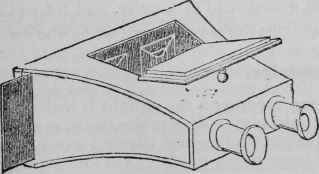
Brewster's Refracting Stereoscope.
"' Daguerreotype portraits and Talbotype pictures are therefore taken usually by two cameras placed towards the object, with a difference of angle equal to the difference of the angle of vision of the two eyes, which is about 18° when the object is eight inches from the eyes; hence, if these be carefully examined and compared with the original projecting objects, they will be found to be faithful representations of the object as seen by each eye respectively".
Directions For Using The Stereoscope
"'The objects must be so adjusted in the box, that only one picture may be seen in the centre, care being taken that the pictures are not reversed so as to be seen by the right eye instead of the left, and vice versa.
"' The proper position of portraits, buildings, and similar objects cannot be mistaken; but where this is not readily perceived, it should be ascertained, when the object can be marked so as at once to be properly placed.
"' The eye-pieces, if allowed to turn, are marked with arrows, to indicate their proper position, these must be placed inwards, and in a right line with each other.
"' The eye-pieces in some instances are made to draw out to suit the foci of different persons. But those who use spectacles will generally see best with them on, bringing them forward so as to lie flat on the eye-pieces, which in such cases should not be drawn out.
"' Persons, however, with a defective sight in either eye will not be able to perceive the astonishing effects of the arrangement, as two different images will not be perfectly formed on the retinae of the respective eyes.'"
Continue to:


My Books

