


The Pea Fowl
Description
This section is from the book "Warne's Model Housekeeper", by Ross Murray. See also: Larousse Gastronomique.
The Pea Fowl
Though last in our list of poultry, is by no means the least. It is not in every establishment that this bird can be kept, as, being of a very rambling disposition, it requires space. It loves to roam in shrubberies and extensive pleasure grounds, and to such places it is a most appropriate ornament. Who can fail to be struck with admiration at the surprising beauty of the plumage of the peacock, strutting along in majestic grandeur, the tail as it is generally, but erroneously, called, spread? Those splendidly-marked feathers we see expanded are not the tail proper, but the feathers that cover the tail; it is nearly, or completely, covered by them. The tail proper consists of about eighteen feathers, of a brown, rusty hue, which serve as a support for the beautifully-marked feathers which we generally call the tail.
The hen is not so splendid as the cock, but has an aigrette on its head the same as the cock. Peacocks are very shy birds. The hen generally selects some very sheltered retired spot for her nest. This is not so much to protect her eggs from human enemies as it is to hide them from the peacock, who will destroy every egg that he might see. The same also would be the fate of the pea chicks. He would kill every one he might meet by pecking them on the crown of the head before the protecting feathers sprout. They will not leave the nest for some days after they are hatched; when they do, on no account attempt to chase or catch them, as the hen will lead them away through dangerous places, and, in her hurry to protect them, trample upon and kill them.
The peahen sits from six-and-twenty to thirty days. The eggs are greyish-white, and she seldom sits upon more than five eggs. The chicks should be fed the same as turkey's chicks; and when full-grown, corn of different kinds, insects, small reptiles, and fruits, are their general and favourite food. As a dish for the table, the roast peacock must be seen and tasted by those who would enjoy a repast worthy of ancient Rome and of our more modern times.
The peacock is a native of India, Thibet, and the islands of the Indian Seas, This bird is said to have been introduced into Europe by Alexander the Great. The date of its introduction into this country is unknown. Peacocks formed a favourite dish at the tables of the ancient Romans and at the feasts of the Middle Ages.
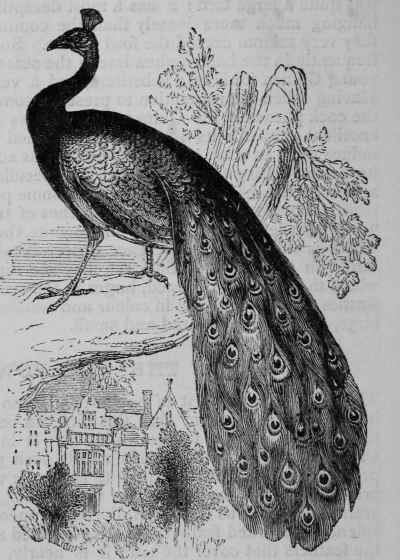
The Common Peacock.
A vow taken in the presence of the peacock was considered especially sacred, probably from its social and public nature.
The Peahen forms a most excellent dish, but. it requires larding to make the flesh tender and succulent. When the peacock is served he is adorned with some of his tail feathers. For dressing the peahen, see "Model Cookery;" for the Swan, see Christmas Recipes in the article on "Social Duties".
Continue to:


My Books

