


The Common Mushroom. Agaricus Campestris (True Meadow Mushroom)
Description
This section is from the book "Warne's Model Housekeeper", by Ross Murray. See also: Larousse Gastronomique.
The Common Mushroom. Agaricus Campestris (True Meadow Mushroom)
The common meadow mushroom varies considerably, but "common to all are a fleshy pileus, which is sometimes smooth, sometimes scaly, in colour white, or of different shades of tawny, fuliginous, or brown; gills free, at first pallid, then flesh-coloured, then pink, next purple, at length tawny-black; the stem white, full, firm, varying in shape, furnished with a white persistent ring; the spores brown-black, and a volva which is very fugacious." - Badham's Esculeni Funguses of England.
There is scarcely any one in England who does not feel himself competent to decide on the genuineness of a mushroom; its pink gills easily distinguish it from a kindred fungus, Ag. arvensis, the gills of which are of a flesh-coloured grey, and out of the pickings of ten thousand hands a mistake is of rare occurrence; and yet no fungus presents itself under such a variety of forms, or such singular diversities of aspect. The inference is plain; less discrimination than that employed to distinguish this would enable anyone who should take the trouble to recognise at a glance many of those esculent species, which every spring and autumn fill our plantations and pastures with plenteousness. Neither is this left to be a mere matter of inference; it is corroborated in a singular manner by what takes place at Rome; there, whilst many hundred baskets of what we call toadstools are carried home for the table, almost the only one condemned to be thrown into the Tiber, by the inspector of the fungus market, is our own mushroom; indeed, in such dread is this held in the Papal States, that no one knowingly would touch it. "It is reckoned one of the fiercest imprecations," writes Professor Sanguinetti, "amongst our lower orders, infamous for the horrible nature of their oaths, to pray that one may die of a Pratiolo; " and although it has been some years registered among the esculent funguses of Milan and Pavia (on the authority of Vittadini), it has not yet found its way into those markets.
Mr. Worthington G. Smith, in his "Mushrooms and Toad-stools," qualifies this statement of Dr. Badham.
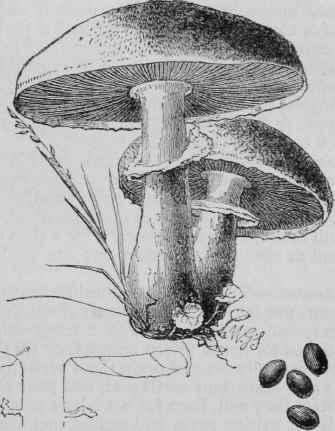
Agancus campesiris (the True Meadow Mushroom). Pastures, autumn; colour, white or pale brown; gills, salmon, at length black; diameter, 3 to 6 inches. The spores are magnified 700 diameters.
Agaricus campesiris is not generally appreciated in Italy, and indeed is seldom eaten, and never appears in the markets, for the simple reason that there would be no sale for it. There is an edict in existence ordering certain fungi to be thrown into the Tiber, but it is now and has long been altogether effete; and whilst there is an abundance of A. Caesareus (avowedly the most delicious of all fungi) for the markets of Italy, it is not to be expected the consumption will be given up for another and little known species.
The Modes Of Cooking This Species
"The mushroom, having the same proximate principles as meat, requires like meat to be cooked before these become changed. The Ag. campestris may be prepared in a great variety of ways: they give a fine flavour to soup, and greatly improve beef-tea; where arrowroot and weak broths are distasteful to the patient, the simple seasoning of a little ketchup will frequently form an agreeable change. Some roast them, basting with melted butter and white (French) wine sauce. In patties and vols-au-vent they are equally excellent; in fricassees, as everybody knows, they are the important element of the dish.
Mushrooms A La Creme
Trim and rub half a pint of button mushrooms, dissolve two ounces of butter rolled in flour in a stewpan; then put in the mushrooms, a bunch of parsley, a teaspoonful of salt, half a tea-spoonful each of white pepper and of powdered sugar, shake the pan round for ten minutes, then beat up the yolks of two eggs, with two table-spoonfuls of cream, and add by degrees to the mushrooms; in two or three minutes you can serve them in the sauce.
Mushrooms On Toast
Put a pint of mushrooms into a stewpan, with two ounces of butter rolled in flour; add a teaspoonful of salt, half a tea-spoonful of white pepper, a blade of mace powdered, and half a teaspoonful of grated lemon; stew till the butter is all absorbed, then add as much white roux as will moisten the mushrooms; fry a slice of bread in butter, to fit the dish, and as soon as the mushrooms are tender serve them on the toast.
How To Pot Mushrooms
The small open mushrooms suit best for potting. Trim and rub them; put into a stewpan a quart of mushrooms, three ounces of butter, two teaspoonfuls of salt, and half a teaspoonful of Cayenne and mace mixed, and stew for ten or fifteen minutes, or till the mushrooms are tender; take them carefully out and drain them perfectly on a sloping dish, and when cold press them into small pots, and pour clarified butter over them, in which state they will keep for a week or two. If required to be longer preserved, put writing paper and melted suet over the butter.
Continue to:


My Books

