


Magnetism
Description
This section is from the book "Warne's Model Housekeeper", by Ross Murray. See also: Larousse Gastronomique.
Magnetism
The magnetic or black oxide of iron, sometimes called the lead-stone or loadstone, is estimated as one of the most valuable ores of iron, because it enjoys the property, when freely suspended, of pointing to the north; and it does this by virtue of an inherent property which belongs to it, called magnetism.
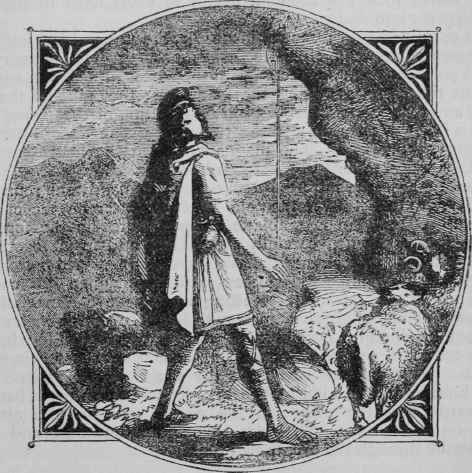
The Shepherd discovering the Magnetic Stone on Mount Ida with the Iron or his Crook.
The loadstone occurs native, and crystallizes in cubes, and is said to have been discovered by a shepherd on Mount Ida, who first noticed that the iron of his crook was attracted by it.
The magnet was not only called magnes, but "lapis Heracleus," from Heraclea, a city of Magnesia, a part of ancient Lydia, in Greece. It is also called lapis nauticus, because of its use in navigation ; and siderites, because the mineral attracts iron, which the Greeks called .
.
"The earliest mention in English records of the primitive mariner's compass is that by Alexander Neckham, who describes the same in his ' Treatise on Things pertaining to Ships.' Neckham was born at St. Alban's in 1157. A translation of his works from the Latin, was published in 1866. In the reign of Edward III., the magnet was known by the name of the sail-stone or adamant, and the compass was called the sailing-needle or dial; it is long after this period before we find the word compass. A ship called the Plenty sailed from Hull in 1388, and we find that she was steered by the sailing-stone. In 1345, another entry occurs of one of the king's ships, called the George, bringing over sixteen horologes from Sluys, and that money had been paid at the same place for twelve stones, called adamants or sail-stones, for repairing divers instruments pertaining to a ship".
Fine large pieces of loadstone are usually mounted in handsome brass or silver boxes, and were highly prized in the reign of King Charles II., when the Royal Society of England began to exert itself in the acquisition of scientific knowledge.
When examined with a magnetic needle, the mineral is found to have two points where the magnetic virtue exists in the greatest intensity : these are called poles, and are connected with the pieces of soft iron which protrude from the case containing the loadstone ; they take off the friction and wear and tear of the mineral, whilst all cutting of the stone, in order to obtain a hollow space between the two poles, as in an ordinary horseshoe magnet, is avoided. The magnetism from the loadstone is easily conferred upon and retained by hardened steel.
It is only necessary to rub the steel or drag the loadstone round in one direction, taking care to put the pole N of the latter on the end of the steel bar marked S. An assemblage of steel plates in the form of an elongated horseshoe, when carefully magnetized and fixed together, constitutes a kind of magnetic battery having greatly increased powers.
Every housemother should possess a small magnet. In case of a morsel of needle or any steel dust getting into the eye, a magnet held to it will draw the offending substance out. A niece of the writer broke a large carpet needle into her foot. A surgeon was called in ; he endeavoured to extract it, cut the foot deeply, but could not succeed in reaching the needle. Some days afterwards, at the suggestion of a friend's nurse, she tried holding a strong horse-shoe magnet to it, drawing it backwards and forwards over the place till the needle, obeying the attraction, appeared on the surface. She then squeezed it upwards, and passing another needle through the eye, drew it out.
Continue to:


My Books

