


Light
Description
This section is from the book "Warne's Model Housekeeper", by Ross Murray. See also: Larousse Gastronomique.
Light
Light is supposed to be communicated and produced by the vibratory motion of a subtle and delicate ether, but it is believed that further discoveries may be made on the subject hereafter.
"Starting with the proposition," says Professor Pepper, "that all sources of light and luminous bodies, like musical instruments, must first vibrate, it is not difficult to understand by analogy, how these vibrations may travel at the rate of 182,000 miles per second, in straight lines called rays.
"A tuning-fork emitting sound might by analogy represent a source of light like the sun, whilst a long rod communicating with it would stand in the place of the theoretical ether, propagating the undulations from the sun through a space of 92 1/2 millions of miles, and if the other end of the rod communicates with the sounding-board of a guitar, the audible sound obtained might compare with the light falling on the earth, and becoming apparent by radiation.
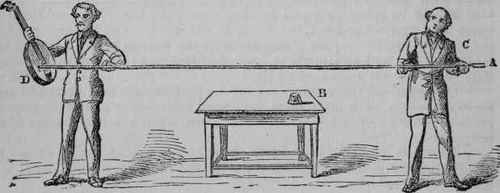
A, tuning-fork struck on the leaden cone B, capped with leather, and applied to the end of the rod c, whilst the other end is held against the sounding-board D.
"The conversion of a continued series of mechanical impulses into waves is beautifully shown by taking hold of the end of a long vulcanized india-rubber tube filled with sand, and having attached one end to the ceiling or other convenient place, it is easy by a jerk to produce the appearance of a wave, which travels distinctly from the hand to the ceiling; at the same time it demonstrates the progressive nature of the wave or undulation, and as the portion held by the operator cannot move from his hand to the ceiling, it shows how the eye is deceived whilst looking at the motion of waves of water. Every wave in water is propagated by the rising and falling of that which has preceded it, and not because the volume of water representing the wave travels bodily from the spot where it is first noticed to the shore where it breaks.
"Dr. Tyndall has shown, by a modification of Dr. Young's experiments with vibrating strings upon which light is thrown, a number of very beautiful effects. A silvered cord attached to the iron arm of a curved spring band, one end of which is made to vibrate by an electro-magnet, displays the divisions of the cords into wave-like figures most perfectly when the cord is illuminated by the lime or, better still, the electric light.
"Using the brilliant light as before, a still more perfect and admirable experiment may be conducted by attaching one end of a bright silvered chain to a hook screwed into a vertical whirling table, and the other to a proper stand. The chain being horizontal and the wheel vertical, it may be swung into one longwave, or by a still more rapid rotation, can be divided into three, four, or more. The links of the chain flash in the light, and produce the most pleasing effects.
"It must be remembered that if cords, chains, water, air, etc, can assume a wave-like motion, the wonderful tension and elasticity of the hypothetical ether would permit the latter to adapt itself to the most complicated movements almost with the rapidity of thought. The very spiral, spindle-like, or corkscrew motion observable in the chain and cord affords a good idea of the mechanism of the propagation of light, as the movement of each molecule of ether is always perpendicular to the path of the ray or wave of light.
"The astonishing rapidity of the periodic movements of the non-gravitating molecules of ether becomes apparent, when it is stated that to produce white light five hundred millions of millions of vibrations of the ether, 1,000.000,000,000 x 500 must occur in every second of time.
"Or, taking the coloured rays at the extremities of the solar spectrum, viz., the red ray and the violet, the former demands the recurrence of four hundred and fifty-eight millions of millions, 1,000,000,000.000 X 458; and the latter, the violet, a still larger number, and greater rapidity of vibration, six hundred and ninety-nine millions of millions, 1,000.000,000,000 X 699 per second.
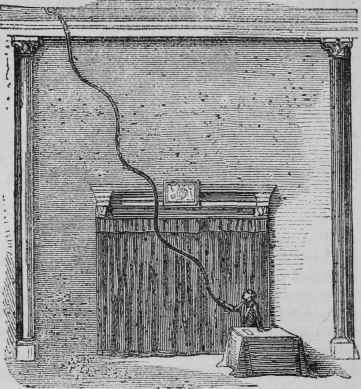
The Vulcanized Tube attached to the ceiling, and thrown into protuberances or waves by the hand of the operator.
" The coloured rays of light are supposed, according to the undulatory theory, to be distinguished from each other by the breadths of the different waves, just as the sound of a stringed instrument may vary according to the diameter and thickness of the strings. A tightly-stretched thin cord vibrating would be the parallel to violet light. It is an axiom that, "The rapidity of vibration is inversely proportional to the length and diameter of the string, and proportional to the square root of the tension. A thicker cord not so tightly stretched, would be the parallel to red light.
Heat A Source Of Light
"When iron is heated to a temperature of 6350 Fahrenheit, it emits a dull red light, visible only in a darkened room. If the heat is further increased to 9030 Fahrenheit, a bright red light is apparent, visible in a chamber fairly illuminated. The light attains a greater intensity at the moment the iron is heated to 10000 Fahrenheit. Thus, by the progressive increase of the heat of the iron, what is call a dull red, a pale red, and a white heat is obtained. By increasing the heat of a solid body a development of light or incandescence is obtainable.
Light The Frequent Attendant Of Electrical Phenomena
"The intense and dazzling brightness of lightning has been known to cause temporary and permanent blindness. The immense electric spark, the result of the discharge of thousands of acres of charged clouds, will probably be more closely imitated than ever by an enormous induction coil, now being constructed by Mr. Apps for the Royal Polytechnic, which is calculated to give a spark 5 ft. in length, the usual length being from 5 to 18 in., or, in very rare cases, 2 ft. At the moment of discharge the electricity may develop light, heat, magnetical, mechanical, and chemical effects. Here is a correlation of forces that might well excuse Oersted in proposing a theory of light in which he regards light as the result of electric sparks".
Light moves with extraordinary swiftness. It travels at the rate of 182,000 miles in a second, and will go eight times round the earth while a person could count " one." It acts on the nerve of the eye and causes us to see. The pupil contracts when the light falls on it full and brilliantly, as from the sun, etc., and dilates when the rays of light are few. The sudden light is therefore painful because it falls on a dilated pupil, which has not had time to contract. By dilating and contracting to catch more or keep back the rays, the pupil of the eye accommodates itself to light or darkness.
The broad pupil of a cat's eye is fatigued by light, therefore she closes her eyes, blinks at fire-light, and sleeps much by day; - seeing best in the • dark, because she has the power, as tigers and owls also have, of dilating ,the pupil of the eye to collect scattered rays in a manner impossible to us.
Continue to:


My Books

