


Domestic Pets. Mice
Description
This section is from the book "Warne's Model Housekeeper", by Ross Murray. See also: Larousse Gastronomique.
Domestic Pets. Mice
The dormouse is very like the squirrel in many of its habits: it lives upon much the same food, and is a hybernating animal too, laying up a store of eatables for the winter, and passing the greater part of the cold months in sleep. In a cage it is not seen to advantage: throughout the day it is generally rolled up into a little soft ball of fur, fast asleep, and its architectural talents are quite thrown away. It is in its wild state a very clever nest-builder, and Mr. Wood gives a most fascinating description of a dormouse's nest, which he found in a hedge 4 feet from the ground, in the forking of a hazel branch, the smaller twigs of which formed a palisade round it. The nest itself was 6 inches long and 3 wide, and constructed of grass blades and leaves of trees. The blades of the sword-grass were chiefly used, and these were twisted round and between the twigs so as to form a hollow oval nest. Finer sorts of grass and the slender stems (not bigger than thread) of delicate climbing weeds, interwoven with the leaves of hazel and maple trees, were used for the bottom of the nest; the entrance to which was most ingeniously concealed by long blades of grass placed across it in such a manner as to spring back to their places, after havingbeen pushed aside to admit the dormouse into the nest.
This was never used as a storehouse; the little creature had its winter provisions carefully hidden under a thick branch in the neighbourhood of the nest. While hyber-nating, the dormouse does not seem to require food: but it wakes up occasionally during the winter, perhaps when a warm sunny day calls it into life for the time, and then it takes food before it rolls itself up and sleeps again. It requires a good deal of warmth, and must have soft hay, moss, and wool given it to form its bed, and it does its best with these, but cannot construct anything very beautiful out of them.
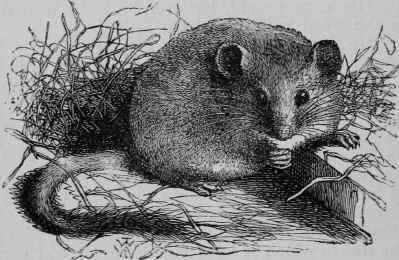
Dormouse.
If we had a tame dormouse, we think we should try to provide it with materials which it might be induced to use for the construction of a nest like that described by Mr. Wood. The dormice our brothers had were kept in a cage made for dormice, wired at one end, with a little compartment at the other boarded in, the door of which was pulled up and pushed down at pleasure, so that the little creatures could be shut into their bedroom when the outer room was cleaned out. Even with this precaution they were continually getting out of the cage, they were such nimble little animals, and the whole house was often searched in vain for the truants. At last, perhaps, they would be found in the .fold of a curtain or underneath the cushion of a sofa. Sometimes a worse fate befell them, and they would creep under the cushion of an arm-chair, and get crushed to death, or be trodden under loot, or be squeezed under a door in trying to escape. They sleep during the day and come out in the evening, so that they must be provided with food as soon as it grows dusk; and if they have a large cage with sticks placed across it, they will gambol about very merrily in the open part of it as soon as night approaches.
Their food should be varied as much as possible: they will eat nuts and almonds, peas and beans, canary seed, and various other grains; and they are very fond of the milky juice of a dandelion or sow-thistle. We used always to put a little tin pan of milk into the cage every night, and they would often drink it all, especially when they had young ones. It is said that rabbits will be hindered from devouring their young by providing them with water, and that they would not eat them unless maddened by thirst or suffering from extreme hunger. Some dormice have the same propensity to cannibalism; and if this theory about the rabbits be correct, ft may apply also to the mother dormouse which devours her young. We thought she did so when alarmed for their safety, not being able to conceal them elsewhere; but it would be well to provide her with a constant supply of water or milk when nursing. The milk is useful too in furnishing the dormouse with animal food; out of doors it eats insects. There are generally four or five young ones in a litter, born blind, but able to see in a few days, and they are soon capable of taking care of themselves.
The cage must, of course, be kept perfectly clean, and the floor of the open part should be sanded like a bird-cage.
White, Grey-and-White, and Brown and White mice are sometimes kept in cages like those of the dormouse, and they must be treated in the same manner. The common Brown mouse is said to be a more tractable and intelligent pet, and to be easily tamed by patient kindness. I never heard a mouse sing, but several instances are recorded of mice who have learned to imitate the chirp and even the song of a canary kept in the room in which they were; so that it might be worth while to try to give such pets the benefit of a musical education for the chance of their acquiring so curious an accomplishment. The little Harvest mouse, the tiniest of British quadrupeds, has sometimes been kept in a cage, and will grow tame enough to take its favourite food, flies and other insects, from the hand. It is a most beautiful little creature, very active and agile' climbing about by means of its long tail and flexible toes, and leaping like a little Jerboa. It should have grains of wheat and maize, and canary seed, and plenty of water always in the cage; and wool or flannel and grass for its nest, which in its wild state is the most beautiful and elaborate construction of leaves and grass woven together into a round ball and suspended from strong grass-stems, wheat-stalks, or thistle-heads. In the winter it takes refuge in corn ricks, or burrows deeply in the earth, and makes a warm bed of grass.
Even in confinement the harvest mouse will show its instinctive propensity to store up food for the winter, and if a number of grains of wheat or seed are given to it, will carry them off and hide them in its nest.
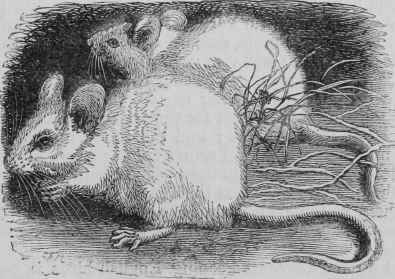
White Mice.
Continue to:


My Books

