


Cabbage And Its Nutritional Value
Description
This section is from the book "Warne's Model Housekeeper", by Ross Murray. See also: Larousse Gastronomique.
Cabbage And Its Nutritional Value
In season: Summer - June to August. Winter - October and November.
Red - July to September.
Our cabbage-plants of all kinds - broccoli, cauliflowers, cabbages, Scotch and German greens, Brussels sprouts, kohl rabis, etc. in all their varieties - spring from one or more species of Brassica Oleracea which, in their wild uncultivated state, have miserable woody and bitter stems and leaves, and useless spindle-shaped roots.
The word cabbage, in its original signification, means a firm head, or ball of leaves folded closely over each other; hence a cabbage-lettuce, a cabbage-rose. Cabbages require a soil enriched with animal manure. When a cabbage is cut in the garden, the stalk left should have two cuts nude across each other so as to divide it into four; sprouts will again Spring from it.
1 lb. of cabbage contains -
Oz. | Grs. | |
Water ..... | 14 | 414 |
Albumen .... | 0 | 126 |
Starch... | 0 | 42 |
Oz. | Grs. | |
Dextrin or gum. | 0 | 203 |
Woody fibre. . . | 0 | 35 |
Mineral ashes . . | 0 | 56 |
The cabbage, when decaying, has a peculiarly strong smell of putrid meat, from the large quantity of azote it contains; therefore the water in which it has been boiled should not be poured down the sink, but out of doors, if possible.
The cabbage is the most nutritious of vegetables, except the mushroom and the dried cauliflower. Its flavour is improved by boiling, but it requires to be eaten with fat, in which it is deficient; therefore fat bacon or pork is quite the proper accompaniment of greens.
A dish in Ireland, known as kolcannon, is the best and most nutritious mode of eating the cabbage.
Kolcannon
Equal quantities of potatoes and cabbage - peel the potatoes when boiled enough; chop up the cabbage, beat both together well, and put in a little pork fat, or dripping, or lard - one ounce to a pound of vegetables; Season with pepper and salt, and an onion or two if you like them. The potato's want of gluten is supplied by the cabbage, which is rich in it, and a most nourishing dish is thus made.
Cabbage is eaten by the Dutch, Germans, and Americans as sourkraut.
We give this receipt (American) for it: -
Have ready a vinegar or white wine cask. About four inches from the bottom have a vent-peg; take a number of the best white cabbages, strip off all the outside leaves, and slice the heads transversely, or across, as thin as possible, until you have as much as you require, then lay over the bottom of the cask vine-twigs, to the height of the peg; on these put a layer of sliced cabbage three inches deep, strew it plentifully with fine salt; use one pound of salt to fifty of the cabbage; then put another layer of cabbage, and salt and cabbage alternately until the cask is two-thirds full; let the last layer be of salt; put cabbage-leaves all over; cover them with a cloth and a piece of wood which will fit the inside of the cask, and place a heavy stone upon it. After four or five days draw out the peg and let the brine run off, rinse the cloth, wash the board and stone, add more salt over the top, and replace cloth, board, and weight.
Repeat this operation at intervals of not more than a month, till that which flows from the cask is clear and free from smell. Keep the cask in a moderate temperature during the whole year. Take it from the cask with a wooden spoon or fork.
How To Serve Sourkraut
Take out as much sourkraut as you wish from the cask, and soak it for at least two hours in cold water, then put it into a colander to drain; put it into a large stewpan or dinner-pot; put on it a piece of corned pork or bacon, and put hot water over nearly to cover it; cover the pot and set it over a moderate fire for an hour or more, until the pork is done; serve with the meat on it; or cut the bacon or pork in slices, strew pepper over them, lay the sourkraut on, put hot water nearly to cover it, cover the pot close, and set it over a moderate fire for an hour and a half. Or it may be boiled with water, and fried sausages put over it and served; or the sausages may be boiled with it and the skins taken off before serving.
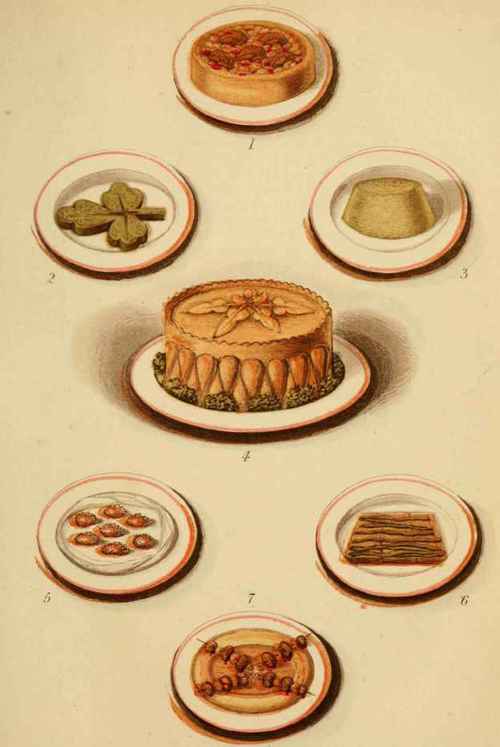
1. Macedoine of Larks.
2. Nettles.
3. Broad Beans mashed.
4. Game Pie.
5. Fried Cauliflowers.
6. Hop Tops.
7. Indian Kebobs.
Continue to:


My Books

