


Breeding Pheasants
Description
This section is from the book "Warne's Model Housekeeper", by Ross Murray. See also: Larousse Gastronomique.
Breeding Pheasants
The pheasant breeds generally in April, making a very rough nest on the ground; but in these days of battue shooting, it would not do to depend entirely on the hap-hazard chance of wet or dry hatching seasons, so, to insure a plentiful supply of game, many hundred eggs are placed under common fowls and reared and fed as poultry until they are large enough to turn out into the woods, when they are dignified with the name of game.
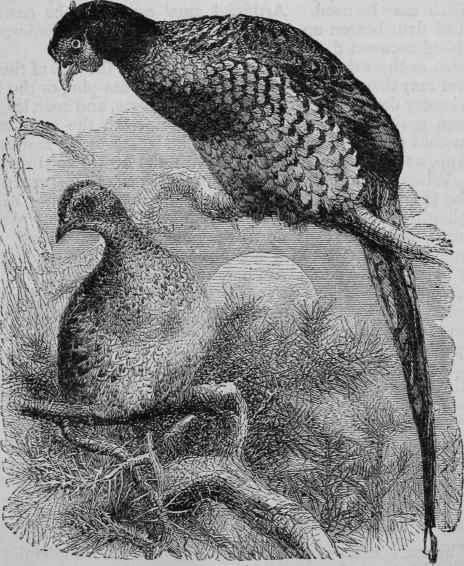
The Common Pheasant.
The following directions for rearing them under hens have been, we know, adopted with success: - A sufficient number of eggs being provided, put them under a hen that has kept her nest for three or four days; and if two or three hens happen to sit on the same day, an opportunity will be afforded of shifting the good eggs. At the end of ten or twelve days, examine, and throw away those that are bad, and set the same hen or hens again. The hens having set their full time, such of the young pheasants as are already hatched must be put into a basket, with a piece of flannel, till the hen has done hatching, then place the whole brood under a frame, with a net over it, and a covered place for the hen, so as to confine her; but leave the young pheasants at liberty to go or return to her at pleasure. Their food must consist of boiled eggs cut small, boiled milk and bread, alum curd, and ants' eggs, a little of each and often. Rice may also be given, softened by boiling; and, instead of ants' eggs, which in some places are not easily procured, or in addition to them, maggots from decayed flesh may be used.
Artificial ants' eggs may be easily made, composed of flour beaten up with an egg and the shell together, and the pellets rubbed between the fingers to a proper size.
After two or three days, the pheasants will know the call of their foster-mother, and may then be allowed to run upon a grass-plot, or the edge of a corn-field is very desirable, as they like the tall stems, and soon learn to pick up the green grains. Take care to shift them with the sun, and guard them from cold winds. They ought not to be let out in the morning before the sun is up, and they must be shut in with the hen in good time in the evening. When they are old enough those that are to be turned out wild ought to be taught to perch. This is done by tying a string to a hen's leg, and obliging her to sit in a tree all night. She should be placed there before sunset, and if she falls down she must be perseveringly replaced, till she becomes contented with her position. Next the young birds will follow her example and perch with her, and in a few days they will be able to take care of themselves.
If regularly fed, they will remain near any particular spot, and frequent a lawn or pleasure ground as familiarly and almost as fearlessly as common poultry.
Instances have been known of the pheasant breeding with the common fowl. Other crosses also have occurred - viz., with the pheasant and turkey, as also with the Guinea fowl. We have mention also of a cross between the pheasant and grey hen, the female of the blackcock.
Pheasants are bred in vast numbers now in this country, and at a great expense to those that preserve them. It is generally supposed that by the time the pheasants are fit to shoot, each bird has cost in its rearing from 2s. 6d. to 3s.
Continue to:


My Books

