


Beef And Its Nutritional Value
Description
This section is from the book "Warne's Model Housekeeper", by Ross Murray. See also: Larousse Gastronomique.
Beef And Its Nutritional Value
Beef is the flesh of the ox, and is considered the staple animal food of England. Beef contains fibrin, which resembles the gluten of plants in composition and properties. The amount of water in beef is as great as it is in the potato or plantain. It does not contain a particle of starch; but its fibrin is three times as great as that in ordinary wheaten bread; therefore, as far as this matter goes, one pound of beef is equal to three of wheaten bread. The fat in beef makes up for the lacking starch, as it yields a great amount of heat to the system. Fat, in fact, gives more heat during its combustion than any other form of food. Fat meat is therefore the best to purchase.
The heavier the meat is the more water it contains, and this has to be paid for in the meat: it evaporates in roasting. The juice of beef, when extracted, contains a small proportion of a substance called Kreatin, which is rich in nitrogen, and has a certain likeness to the peculiar principle of tea and coffee (theine). This substance has an exhilarating effect on the human system, as a species of tonic; and is the cause of beef-tea being so supporting to invalids.
Constituent parts in 1 lb.:
Oz. | Grs. | |
Water... | 8 | 0 |
Gelatine .... | 1 | 62 |
Fibrin & Albumen | 1 | 122 |
Oz. | Grs. | |
Fat.... | 4 | 340 |
Mineral matter . . | 0 | 350 |
Beef should be marbled with fat through the red lean, and should possess a good amount of separate fat (suet). The animal should have a third of its whole dead weight of fat.
Beef, in cooking, loses on an average 1 lb. in four when boiled; lib. 3 oz. when baked; 1 lb. 5 oz. when roasted. This is caused by the evaporation of the water and the melting of the fat into dripping.
In boiling there is less waste if the meat be plunged into boiling water - not boiled in cold water, when a greater loss will take place, by the unconfined juices slowly passing into the water, which thus becomes stock or pot liquor. The reason is, that the heat contracts the outer surfaces, and coagulates the albumen in the meat juice; thus preventing the escape of the juices into the water.
Meat contains in a liquid form in its juices, ALBUMEN - the white of egg - exactly as it is in an egg before it is boiled. This albumen surrounds the fibres; its use in preparing meat for food is to preserve the fibres from contracting and hardening. This it does by coagulating, or thickening, as soon as sufficiently heated, as white of egg does, and thus covering and preserving the fibres from hardening under the heat. The more albumen there is in meat, therefore, the tenderer it is. Now all young animals have more albumen in the juices than old ones, therefore their flesh is more tender; but, in consequence, they give less gravy, and from the quantity of coagulated albumen in their meat it is white.
Beef and mutton are brown and juicy, because they have less albumen than veal and lamb.
Gelatine is the glutinous matter in the bones of animals; it exists also in a small degree in the flesh. But two ounces of bone contain as much gelatine as there is in one pound of meat. Powdered bone can be dissolved completely into gelatine.
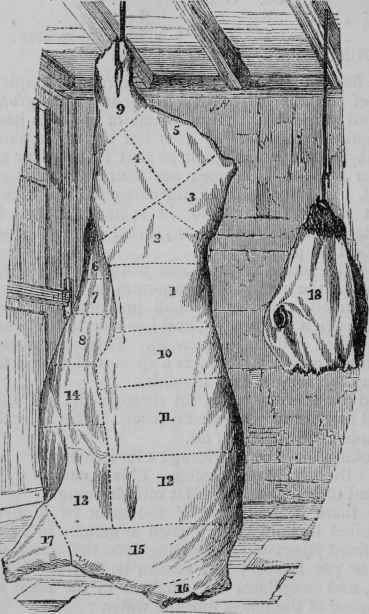
An Ox is divided by the butcher into the following joints: - London style.
1. Sirloin.
2. Top, or aitch-bone.
3. Rump.
4. Buttock, or round.
5. Mouse buttock.
6. Veiny piece.
7. Thick flank.
8. Thin flank.
9. Leg.
10. Fore-rib (5 ribs).
11. Middle rib (4 ribs).
12. Chuck rib (3 ribs).
13. Shoulder, or leg-of-mutton piece.
14. Brisket. 15. Clod.
16. Sticking.
17. Shin.
18. Cheeks or Head.
Osmazome is the flavouring matter of meat. The flesh of old animals has most of it. Under the influence of dry heat osmazome acquires higher properties and gives a finer flavour.
Meat is under-dressed when it has only been sufficiently heated to coagulate the albumen, but not to coagulate the colouring matter of the blood. It is perfectly dressed when it has been heated throughout to a temperature sufficient to coagulate the colouring matter of the blood.
It is too much or over-dressed when the heat has lasted long enough to harden the fibre.
A quick heat in roasting causes the fibres of the meat to contract and close up the pores; it coagulates the albumen (as boiling water will) which at once stops up the pores and retains the whole internal juice. Then the cooking is carried on by the agency of the natural moisture of the flesh. Converted into vapour by heat, a kind of steaming takes place within the piece of meat, so that, whether in the oven, on the spit, or in the midst of boiling water, it is in reality, when skilfully done, cooked by its own steam.
Meat should therefore be cooked by a quick strong fire, and brought near it early, if it is liked with the gravy in it; slower cooking makes it less full of red gravy, but, if well managed, the juices can be retained fully as well.
An ox should be five or six years old before it is killed; it is then in its prime; the fat should be white (yellow fat is not good), and the suet firm and white; the lean, as we have said before, should be marbled with fat - otherwise, in cooking, when the water evaporates there will remain a dry tough piece of meat. Heifer beef is paler than ox beef and closer grained, the fat whiter, and bones smaller. Bull beef is of a dark purply red colour, coarse-grained; has little fat, and a strong meaty smell.
Continue to:


My Books

