


Quercus L. (Fagaceae)
Description
This section is from the book "Woody Plants In Winter", by Earl L. Core, Nelle P. Ammons. Also available from Amazon: Woody Plants in Winter.
Quercus L. (Fagaceae)
Mostly deciduous trees or shrubs, the dried leaves often somewhat persistent through the winter (marcescent). Twigs moderate or slender, grooved; pith moderate, continuous, star-shaped in cross section. Buds solitary, sessile, clustered toward the tips of the branches, with numerous scales. Leaf-scars alternate, half-round; bundle-traces numerous, scattered; stipule-scars small. Fruit an acorn (a nut surrounded at its base by a cup-like involucre). The species hybridize freely and are sometimes difficult to distinguish. In addition to bud and twig characters, the key makes use of leaves and fruits, some of which are often present in winter.
a. | Leaves deciduous | ||
b. Largest terminal buds mostly 6-9 mm. long, usually acute | |||
c. Buds distinctly angled in cross section | |||
d. Buds mostly glabrous, dull straw-colored | 13. | Q. shumardii | |
d. Buds pubescent, dark red or gray | |||
e. Buds whitish-pubescent near the apex, sometimes obtuse | 12. | Q. coccinea | |
e. Buds gray-or rusty-tomen-tose, long (often 10 mm. long), acute | |||
f. Buds gray-tomentose;twigs often shiny | 14. | Q. velutina | |
f. Buds rusty-tomentose ;twigs usually dull, often scurfy-pubescent | 17. | Q. marilandica |
c. Buds circular or only slightly angled in cross section. | |||
d. Buds and twigs orange-brown; buds about 6 mm. long, slender, acute | 8. | Q.prinus | |
d. Twigs reddish-brown; buds reddish-brown or nearly black; plump, obtuse or acute | |||
e. Buds reddish-brown;scales near the apex, silky, or puberulous, mostly on the margins | |||
f. Leaves oblong, lobed | 10. | Q. rubra | |
f. Leaves obovate, crenate-dentate | 6. | Q. michauxii | |
e. Buds reddish-brown to nearly black; scales near the apex whitish-pubescent | 12. | Q. coccinea | |
b. | Largest terminal buds mostly less than 6 mm. long, acute or obtuse | ||
c. Buds mostly acute | |||
d. Twigs gray-tomentose, becoming glabrate | |||
e. Straggling shrub, mostly in the mountains | 16. | Q. ilicifolia | |
e. Large timber tree, not in the mountains | 15. | Q. falcata | |
d. Twigs mostly glabrous | |||
e. Buds and twigs brown or orange-brown | 7. | Q. muehlenbergii | |
e. Buds and twigs red or reddish-brown | |||
f. Bud-scales glabrous; leaves lobed | 11. | Q. palustris | |
f. Bud-scales pubescent; leaves entire | 18. | Q. imbricaria | |
c. Buds obtuse, often nearly globose | |||
d. Twigs shiny, red or reddish-brown |
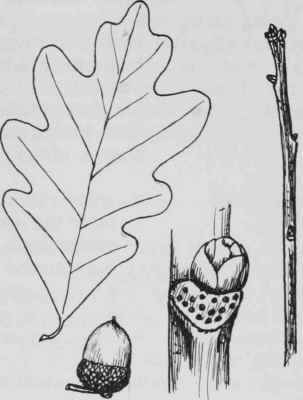
Fig. 64. Quercus alba.
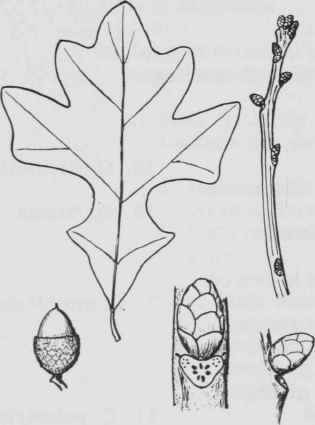
Fig. 65. Quercus stellata.

Fig. 66. Quercus lyrata.
e. Buds globose or nearly so; bud-scales glabrous;twigs reddish | 1. | Q. alba | |
e. Buds obtuse to somewhat acute, often angled, whitish-pubescent near the apex; twigs reddish-brown | 12. | Q. coccinea | |
d. Twigs dull, yellowish-brown | |||
e. Buds and twigs glabrous | 5. | Q. bicolor | |
e. Buds and twigs more or less tomentose | |||
f. Buds about 1. 5 mm. long; twigs slender | 16 | . Q. ilicifolia | |
f. Buds about 3 mm. long; twigs moderate | |||
g. Acorn 2. 5-3. 5 cm. long | |||
h. Cup of the acorn prominently fringed on the margin | 4. | Q. macrocarpa | |
h. Cup of the acorn not fringed | 3. | Q.lyrata | |
g. Acorn about 12 mm. long | 2. | Q. stellata | |
a. | Leaves evergreen | 9. | Q. virginiana |
1. Q. alba L. White Oak. A tree-25-35 m. high, 1-2 m. in diameter; bark gray, rough; twigs gray or purple, often glaucous; buds deep-brown, medium-sized, subglobose or ellipsoid, nearly or quite glabrous, about 5 mm. long; stipules glaucous; acorn ovoid or ellipsoid, 2-3 cm. long, the cup hemispherical, warty, much shorter than the nut. Rich woods, Maine to Minnesota, south to Florida and Texas (Fig. 64).
2. Q. stellata Wang. Post Oak. A tree 15-25 m. high, 6-9 dm. in diameter, with rough gray bark; buds ovoid or conical-ovoid, dull, silky, 3 mm. long; twigs yellow-scurfy; acorn 1-2 cm. long. Sterile soil, Massachusetts to Illinois and Kansas, south to Florida and Texas (Fig. 65).

Fig. 67. Quercus macrocarpa.

Fig. 68. Quercus bicolor.
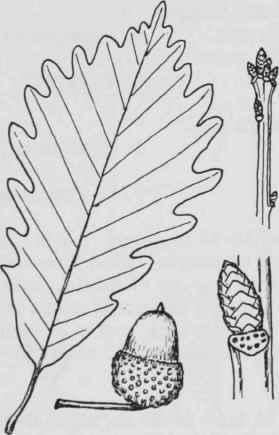
Fig. 69. Quercus michauxii.

Fig. 70. Quercus muehlenbergii.
3. Q lyrata Walt. Overcup Oak. A tree up to 35 m. high, with a trunk diameter of 9-12 dm.;bark gray; twigs buff, pubescent, becoming glabrate; buds 3 mm. long, ovoid-globose, the scales light chestnut-brown, somewhat tomentose; acorn 1. 2-2. 5 cm. long, the cup subglobose, pubescent, nearly covering the depressed nut. Bottomlands, mostly in the coastal plain, Texas and Florida to New Jersey, up the Mississippi Valley to Indiana and Missouri (Fig. 66).
4. Q. macrocarpa Michx. Bur Oak. A tree 15-40 m. high, 1-2 m. in diameter, with gray flaky bark;buds ovoid or conical-ovoid; twigs and buds gray-pubescent; acorn 1. 5-3. 5 cm. high, the nut half-covered or rarely nearly covered by the fringed bur-like cup. Bottomlands, New Brunswick to Manitoba, south to North Carolina, Tennessee, and Texas; not in the coastal plain (Fig. 67).
5. Q. bicolor Willd. Swamp White Oak. A tree 15-25 m. high, 6-9 dm. in diameter, with flaky gray bark, exfoliating from the branches; twigs straw-brown; buds 2-3 mm. long, subglobose or ellipsoid, nearly or quite glabrous; stipule-scars lacking or inconspicuous; acorn 2-3 cm. long, the cup one-third to one-half as long as the nut. Bottomlands, Maine to Minnesota and Nebraska, south to Georgia, Kentucky, and Oklahoma (Fig. 68).
6. Q. michauxii Nutt. Basket Oak. Cow Oak. Swamp Chestnut Oak. (Q. prinus of authors, not L.). Tree 20-30 m. high, with a trunk diameter of 6-9 dm.;bark silvery-whitish; twigs olive or brown; buds 6 mm. long, the scales red, puberulous; acorn ovoid-cylindric, about 3 cm. long. Bottomlands and swamps, mostly in the coastal plain, Texas to Florida and New Jersey, north in the Mississippi Valley to Indiana and Missouri (Fig. 69).
7. Q. muehlenbergii Engelm. Yellow Oak. Muhlenberg Oak. Chinquapin Oak. A tree 15-25 m.high, 6-9 dm. in diameter, with close thin gray bark, flaky when old; twigs orange-brown; buds 3 mm. long, ovoid or conical-ovoid, brown-puberulent or glabrous, the scales often pale-margined; acorn globose or obovoid, 1. 2-2 cm. long, sessile or nearly so, the cup thin, enclosing half the nut. Dry limestone slopes, Vermont and Minnesota, south to Florida and Texas (Fig. 70).
8. Q. prinus L. Chestnut Oak. Rock Oak (Q. montana Willd.) A tree 20-30 m. high, 1-2 m. in diameter, with thick and deeply grooved bark; twigs brown; buds distinctly conical, 5-6 mm. long, deep brown, dull, outer scales pale-margined; acorn 2. 5-3. 5cm. long; ovoid, the cup thick. Dry woods, mostly on sandstone, Maine to Indiana, south to Georgia and Mississippi; not in the coastal plain (Fig. 71).

Fig. 71. Quercus prinus.
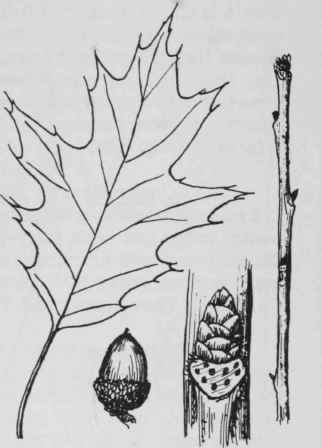
Fig. 72. Quercus rubra.

Fig. 73. Quercus palustris.

Fig. 74. Quercus coccinea.
9. Q. virginiana Mill. Live Oak. A broadly-crowned tree 15-25 m. high, with a trunk diameter of 6-9 dm; bark thick, dark, furrowed, finally flaky; buds small, 3 mm. long, ovoid, acute, remotely angled, the scales light brown, somewhat pubescent; acorn 1-2 cm. long, ovoid or subglobose, often striate; cups canescent, turbinate, about 1. 5 cm. broad. Sandy soil, near the coast, Texas and Louisiana to Florida-, and Virginia; also in Cuba, Mexico, and Central America.
Continue to:


My Books

