


Juniperus L. (Cupressaceae)
Description
This section is from the book "Woody Plants In Winter", by Earl L. Core, Nelle P. Ammons. Also available from Amazon: Woody Plants in Winter.
Juniperus L. (Cupressaceae)
Evergreen trees or shrubs with opposite or whorled scalelike sessile leaves, commonly of 2 sorts, those of the young branches linear, often spreading, on the older branches scale-like, closely appressed and overlapping. Cones of 3-6 fleshy coalescent scales, when mature forming a sort of berry, light blue and glaucous.
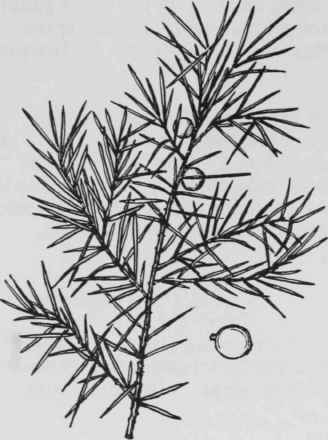
Fig. 21. Juniperus communis.

Fig. 22. Juniperus horizontalis.

Fig. 23. Juniperus virginiana.
a. | Leaves in whorls of 3 | 1. | J. communis |
a. | Leaves mostly opposite | ||
b. Prostrate shrub; cones 6-10 mm. in diameter | 2. | J. horizontalis | |
b. Upright shrub or tree; cones 5-6 mm. in diameter | 3. | J. virginiana |
1. J. communis L. Common Juniper. A low decumbent shrub (in the var. depressa Pursh) or small tree, 2-10 m. high, with pyramidal or columnar form; bark dark reddish-brown, scaly; leaves thin, straight, 12-21 mm. long, widely spreading, grayish above, sharp-pointed; cones subglobose, 5-10 mm. in diameter. Dry soil, pastures, etc., Greenland to Alaska, south to California, Wyoming, Ohio, and the mountains of Georgia (Fig. 21).
2. J. horizontalis Moench. Creeping Savin. Creeping Juniper. A procumbent, prostrate or creeping shrub; leaves scale-like, sharp-pointed; cones 6-10 mm. in diameter, on a short peduncle. Rocky or sandy banks and bogs, Newfoundland to Alaska, south to Wyoming, Illinois, and New York (Fig. 22).
3. J. virginiana L. Red Cedar. A tree 15-25 m. high (or sometimes only a small tree or shrub), pyramidal in form; bark thin, peeling off in long strips, reddish-brown; leaves mostly opposite, those on the young twigs subulate, spiny-tipped, 4-8 mm. long, those of the older branches scale-like, acute or subacute, closely appressed and overlapping, 4-ranked, causing the twigs to appear quadrangular; cones ("berries") maturing in autumn, light blue, glaucous, about 6 mm. in diameter. Dry woods and barrens, often on limestone outcrops, Florida to Texas, north to New England and Missouri (Fig. 23).
Continue to:


My Books

