


White Flowers
Description
This section is from the book "Wild Flowers", by Macgregor Skene. Also available from Amazon: Wild Flowers.
White Flowers
I. | Flowers grouped in Composite Heads | . 1-5 |
II. | Flowers grouped in Umbels . | . 6-15 |
III. | Flowers grouped otherwise, or occurring singly | 16-50 |
A. Leaves compound, deeply cut, or lobed | 16-25 | |
B. Leaves quite simple, at most toothed | 26-50 | |
a. Stamens absent . | . 50 | |
b. Stamens 2-4 in number | 26-32 | |
c. Stamens 5-7 in number | 33-42,44, 45,48 | |
d. Stamens 8 or more in number | 43-50 |
1. Daisy, Bellis perennis, Daisy family. The short horizontal underground stem bears rosettes of leaves, which are oval in shape, tapering to the base, and irregularly toothed: from among these arise several flower-stalks, each a few inches high and with a single flower-head: the disc is yellow, the ray white with pink tips: perhaps the commonest of our wild flowers, to be seen during the greater part of the year in grassy places: the flower-heads are very sensitive, closing in darkness and wet weather.
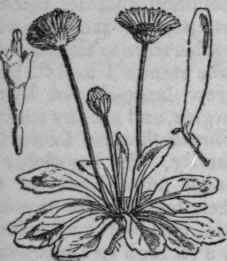
1. Common Daisy.
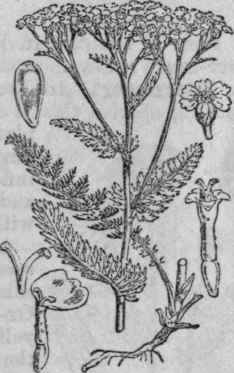
2. Millefoil.
2. Millefoil, Yarrow, Achillea Millefolium, Daisy family. A common and very pretty plant of meadows and pastures:
15 the leaves are 3 to 4 ins. long and lance-shaped in outline, but they are deeply lobed, and the lobes are cut into fine segments, so that the leaf has a dainty feather-like appearance: the stem is about 1 ft. high, and bears a flat head of small flower-heads: flowers in summer.
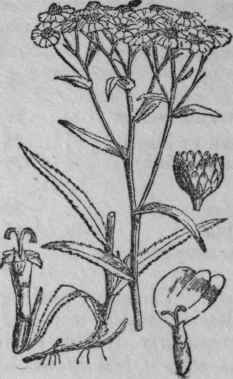
3. Sneeze wort.
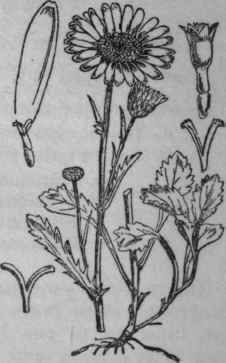
4. Ox-eye.
3. Sneeze wort, Achillea Ptarmica, Daisy family. Like the preceding species, this is one of our common summer meadow plants: the flower-heads are somewhat larger but are gathered into the same flat inflorescence: the stem is 1 to 2 ft. high, and bears narrow lance-shaped leaves, with serrate margins, and a shiny surface.
4. Ox-eye, Chrysanthemum Leucanthe-mum, Daisy family. In hay-fields in summer the large flower-heads of the Ox-eye, with their broad white rays and yellow discs, are frequently abundant: the stem is 1 to 2 ft. high and bears only a few flower-heads: the leaves are dark green, glossy, serrate, and narrow towards the base. The Feverfew, a related species with numerous smaller heads, and compound leaves having lobed ovate leaflets, is found on waste ground.
5. Mayweed, Matricaria inodora,Daisy family. A common weed in fields and waste places, flowering in late summer and autumn: the stem is about 1 ft. high and may be branched: the leaves are twice cut and the segments are very narrow, almost hair-like: the flower-heads are few in number, fairly large, with white ray and yellow disc: the plant has a scent resembling, but not so strong as, that of the related Chamomile.
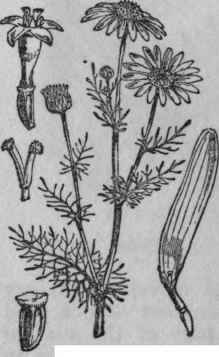
5. Mayweed.
6. Hemlock, Conium maculatum, Hemlock family. A plant of hedgerows and waste places: it is easily recognised by the fact that the stem (3 to 5 ft. high) is spotted with dull purple, and by its mouse-like smell: the whole plant is smooth, with a slight bloom: the leaves are large and doubly feather-compound: the secondary leaflets are deeply notched: the large white umbels are to be seen in summer: the plant is highly poisonous.
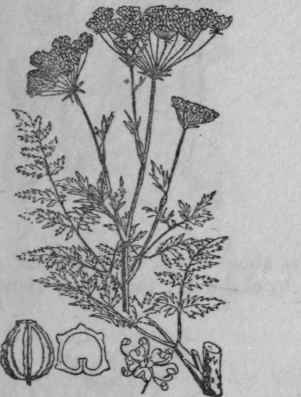
6. Hemlock.
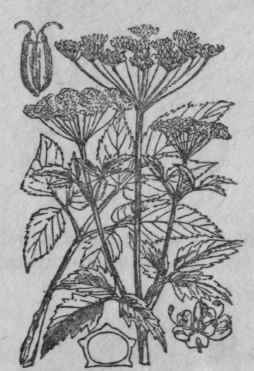
7. Gout-weed.
7. Gout-weed, Bishop's-weed, Ægopodium podagraria, Hemlock family. The leaves of this plant often cover considerable areas in damp shady places, and it is frequently an annoying garden weed: the leaves are large and divided into three leaflets, each of which is again divided into three leaflets, these being ovate, serrate, and glossy-green: from among the leaves rises the flower stem, about 1 to 2 ft. high, with several smallish umbels of yellowish-white flowers: flowers in summer.
8. Burnet-Saxifrage, Pmqrinella Saxifraga, Hemlock family. A common plant of pasture-land, flowering in autumn: from the base of the stem spring a few feather-compound leaves, with ovate, notched leaflets: the stem (1 to 2 ft, high) looks bare, as its few leaves are divided into narrow, notched segments; the stem bears several small umbels, which are white or tinged with red.
9. Pig-nut, Conopodium denudatum, Hemlock family. The root is a single tuber which lies about 6 ins. underground, and is frequently dug up and eaten by children: the stem is slender, especially below, and about 1 ft. high, with a few rather small umbels: the leaves are doubly feather-compound, and the leaflets deeply notched, giving the plant a very graceful appearance: flowers in early summer.
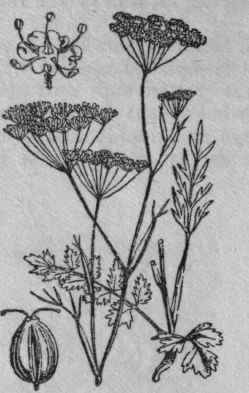
8. Burnet-Saxifrage.
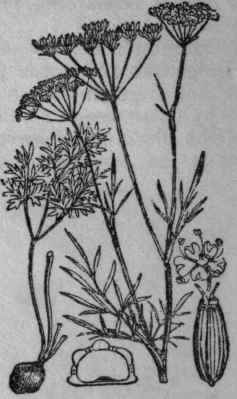
9. Pig-nut.
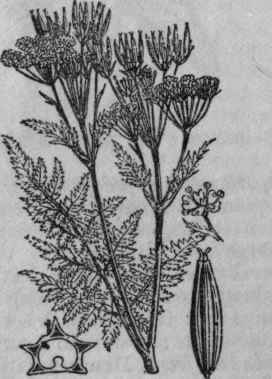
10. Sweet Cicely.
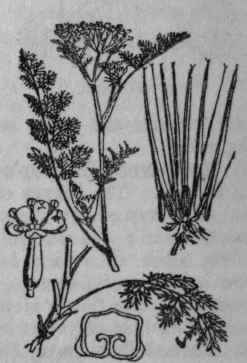
11. Shepherd's Needle.
10. Sweet Cicely, Myrrhis Odorata, Hemlock family. The Myrrh of country children is fairly common on pastures and damp waste ground: it is a tall (3 ft.) handsome plant with large doubly or triply feather-compound leaves: the whole plant is soft with fine hairs: the umbels are large and cream-coloured: the fruits, as well as the leaves and stem, are aromatic and are eaten by children because of their pleasant flavour: flowers in early summer.
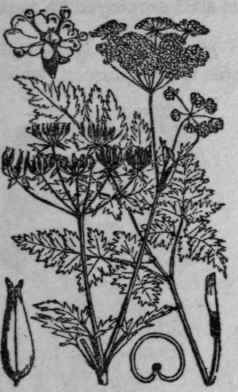
12. Wild Chervil.
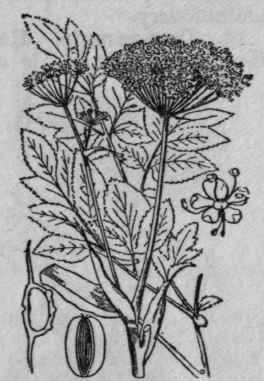
13. Angelica.
11. Shepherd's Needle, Scandix Peden-Veneris, Hemlock family. The English name of this plant of the fields refers to the long (2 ins.) slender needle-like fruits, which are very striking after the flower has fallen: the stem is about 1 ft. high with long triply feather-compound, light green leaves, the segments of which are very narrow: the small umbels occur one or two together: flowers summer.
Continue to:


My Books

