


Fly-Honeysuckle. Lonicera ciliata
Description
This section is from the book "A Guide To The Wild Flowers", by Alice Lounsberry. Also available from Amazon: A Guide to the Wild Flowers.
Fly-Honeysuckle. Lonicera ciliata
Family
Honeysuckle.
Colour
Greenish yellow.
Odour
Scentless.
Range
North and westward to Minnesota.
Time Of Bloom
May.
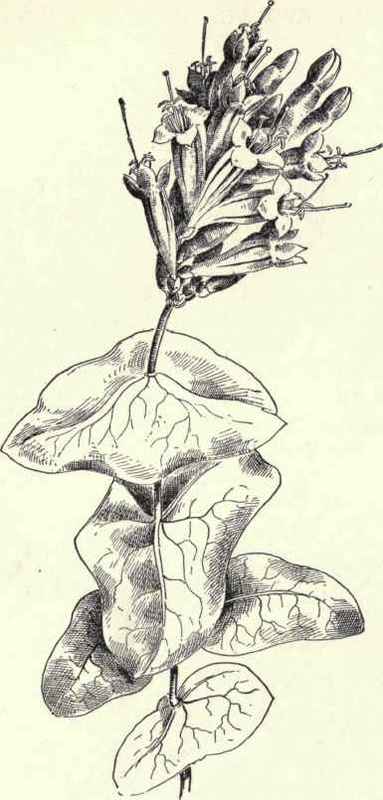
Flowers: growing in pairs on slender peduncles from the axils of the leaves. Calyx: of five short teeth. Corolla: funnel-form; five-lobed; spurred at the base. Stamens: five. Pistil: one. Fruit: a red, egg-shaped berry. Leaves: on petioles; ovate; sometimes heart-shaped at the base, the margins slightly fringed with hairs. A shrub; branching, with bark of a dull grey colour.
Evidently the fly-honeysuckle has not been brought up on the old adage that blood is thicker than water; as it has recklessly cast off its family resemblance. The regularity of the corolla and its wide mouth are quite different from the slender, tubular, two-lipped forms of the cultivated species to which it is nearly allied. It has, moreover, a very pert and saucy look and flourishes best in the rocky woods of the north.
Continue to:


My Books

