


Polygonaceae - Buckwheat Family. Field-Sorrel. Red Sorrel. Sheep-Sorrel
Description
This section is from the book "Our Early Wild Flowers", by Harriet Louise Keeler. See also: Newcomb's Wildflower Guide.
Polygonaceae - Buckwheat Family. Field-Sorrel. Red Sorrel. Sheep-Sorrel
Rumex acetosella Rumex, the ancient Latin name, of unknown etymology.
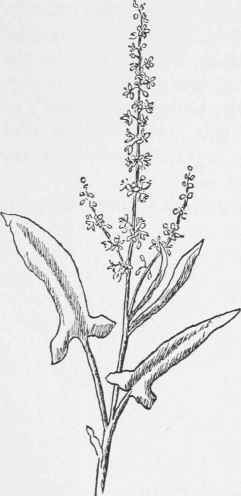
Field-Sorrel. Rumex acetosella
Perennial by running root-stock. Naturalized from Europe. Easily recognized by its arrow-shaped leaves. Abundant everywhere. May, June.
Stems
Six to twelve inches high, slender and branched above, angular and furrowed, tufted.
Leaves
Basal leaves lanceolate-hastate, one to two inches long, on long petioles, agreeably acid. Upper stem-leaves greatly reduced, nearly linear and without ears.
Flowers
Dioecious, that is, of two kinds, staminate and pistillate; small, crowded in paniculate racemes; yellowish red and reddish purple, borne in whorls along the flowering stems.
Calyx
Of six sepals; three outer spreading, three inner larger and continuing to grow after flowering and so protecting the akene.
Corolla
Wanting.
Stamens
Six, borne at the base of the calyx, exserted.
Pistil
One, with three styles.
Fruit
Akene, granular, surrounded by the calyx.
Pollinated by bumblebees, honey-bees, and small butterflies.
This weed can be found in fence corners or hugging close to the walls of a building and sometimes taking entire possession of a neglected field. Its basal, arrow-headed leaves, pleasantly acid to the taste, mark it unmistakably.
This is the plant whose blossoms often cover large areas with a reddish yellow, misty cloud about the last of May, only to disappear after ripening thousands of seeds to come up the following spring. Each tiny spire is small and inconspicuous, but sorrel stands by sorrel until the total makes myriads and the field glows in red or reddish gold with almost a metallic reflection. The plant is not long-lived, will easily die out, and cultivation drives it away.
Continue to:


My Books

