


Boraginaceae - Borage Family. Virginia Cowslip. Bluebells. Lungwort. Mertensia Virginica
Description
This section is from the book "Our Early Wild Flowers", by Harriet Louise Keeler. See also: Newcomb's Wildflower Guide.
Boraginaceae - Borage Family. Virginia Cowslip. Bluebells. Lungwort. Mertensia Virginica
Named in honor of Mertens, a German botanist.
Perennial. In low meadows and along streams, often cultivated. Ontario to Minnesota, south to New Jersey, South Carolina, Nebraska, and Kansas. Frequent in northern Ohio. April, May.
Stem
Smooth, pale, erect, one to two feet high.
Leaves
Oblong or obovate, veiny, entire; the lower four to six inches long and narrowed into margined petioles.
Flowers
Showy, clustered, pinkish purple when opening, changing later to blue.
Calyx
Five-lobed; lobes oblong-lanceolate.
Corolla
Cylindric, trumpet-shaped, pendent, obscurely five-lobed, throat open, often with five ridges between the stamens.
Stamens
Five, inserted on the tube.
Pistil
Ovary four-divided; style threadlike.
Fruit
Four seed-like little nuts, wrinkled.
Pollinated by bees and butterflies. Nectar-bearing.
The brilliant blue blossoms of the Virginia Cowslip are very striking among their paler neighbors. The most interesting thing about these blossoms is their marked change in color; each little bell beginning life Mertensia Virginica a lovely pink-purple but becoming bright blue before ending it.
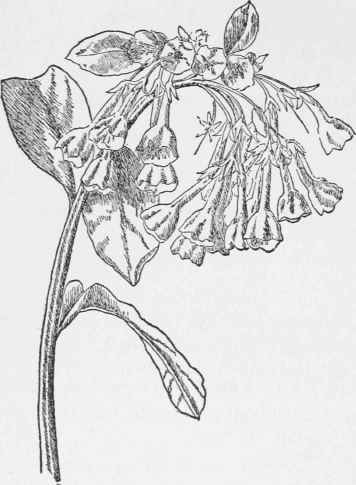
Bluebells.
Virginia Cowslip has also the distinction of being the one smooth species in a family noted for the harsh, rough, hairy, and forbidding character of stem and leaves.
Continue to:


My Books

