


4. Ipomoea L. Sp. Pl. 159. 1753. Continued
Description
This section is from the book "An Illustrated Flora Of The Northern United States, Canada And The British Possessions Vol3", by Nathaniel Lord Britton, Addison Brown. Also available from Amazon: An Illustrated Flora of the Northern United States, Canada and the British Possessions. 3 Volume Set..
4. Ipomoea L. Sp. Pl. 159. 1753. Continued
3. Ipomoea Trichocarpa Ell. Small-Flowered Pink Morning-Glory
Fig. 3432
Convolvulus carolinus L. Sp. Pl. 154. 1753.
Ipomoea trichocarpa Ell. Bot. S. C. & Ga. 1: 258. 1817.
Ipomoea commutata R. & S. Syst. 4: 228. 1819.
Ipomoea Carolina Pursh, Fl. Am. Sept. 145. 1814. Not L. 1753- Similar in habit to the preceding species, but the leaves usually more lobed; peduncles often longer than the leaves, 1-3-flowered; sepals lanceolate or oblong-lanceolate, acuminate, pubescent or ciliate; corolla 1'-1 1/2' long, pink or purple; capsule glabrous or pubescent.
Kansas to Texas, east to South Carolina and Florida.

4. Ipomoea Leptophylla Torr. Bush Morning-Glory
Fig. 3433
Ipomoea leptophylla Torr. in Frem. Rep. 95. 1845.
Perennial from an enormous root, which sometimes weighs 25 lbs., glabrous throughout; stems erect, ascending or reclining, rather stout, 2°-4° long, much branched. Leaves narrowly linear, entire, acute, 2'-5' long, 1"-3" wide; petioles very short; peduncles stout, nearly erect, usually shorter than the leaves, 1-4-flowercd; pedicels shorter than the peduncles; sepals broadly ovate, obtuse, 3"-4" long, or the outer shorter; corolla funnelform, purple or pink, about 3' long, the limb scarcely lobed; capsule ovoid, acute, 8"-12" long, 2-celled, much longer than the sepals; seeds pubescent.
In dry soil, South Dakota to Nebraska, Wyoming, Texas and New Mexico. Man-root. May-July.
5. Ipomoea Purpurea (L.) Lam. Morning-Glory
Fig. 3434
Convolvulus purpureus L. Sp. Pl. Ed. 2, 219. 1762. Ipomoea purpurea Lam. Tabl. Encycl. 1: 466. 1791. Pharbitis purpurea Voigt. Hort. Sub. Calcutta 354. 1845.
Annual, pubescent; stem retrorsely hairy, twining or trailing, 4°-10° long. Leaves broadly ovate, deeply cordate, acute or acuminate, 2'-4' wide, slender-petioled; peduncles slender, 1-5-flowered, often longer than the petioles; sepals lanceolate or oblong, acute, pubescent or hirsute near the base, 6"- 8" long; corolla funnel form, blue, purple, pink, variegated or white, 2'-2 1/2' long; ovary 3-celled (rarely 2-celled); stigmas 3 (rarely 2); capsule depressed-globose, about 5" in diameter, shorter than the sepals.
In waste places, commonly escaped from gardens, Nova Scotia to Florida, west to Ontario, Nebraska and Texas. There is a double-flowered form in cultivation. Adventive or naturalized from tropical America. Ropewind. July-Oct.


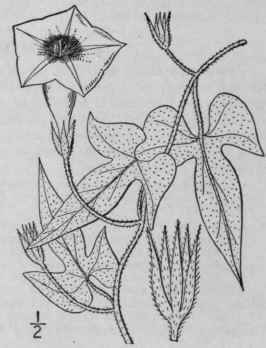
6. Ipomoea Hederacea Jacq. Ivy-Leaved Morning-Glory
Fig. 3435
Ipomoea hederacea Jacq. Icon. Rar. pl. 36. 1781. Pharbitis hederacea Choisy, Mem. Soc. Gen. 6: 440.
1833.
Annual, pubescent; stem twining or climbing to a height of 2°-5°, slender, retrorsely hairy. Leaves ovate-orbicular in outline, long-petioled, deeply 3-lobed, cordate at the base, 2'-5' long, the lobes ovate, acuminate, entire, or the lateral ones sometimes repand or dentate; peduncles 1-3-flowered, much shorter than the petioles; flowers opening in early morning, soon closing; sepals lanceolate with long linear often recurved tips, densely hirsute below, sparingly so above, 8"-12" long; corolla funnel-form, the tube usually nearly white, the limb light blue or purple, l'- 1 1/2" long; ovary 3-celled; stigmas 3; capsule depressed-globose, 3-valved, about as long as the lanceolate portion of the sepals.
In fields and waste places, Maine to Florida, Pennsylvania, Nebraska and Mexico. Naturalized or adventive from tropical America. July-Oct.
Continue to:


My Books

