


15. Paspalum L. Syst. Ed. 10, 2: 855. 1759. Part 4
Description
This section is from the book "An Illustrated Flora Of The Northern United States, Canada And The British Possessions Vol1", by Nathaniel Lord Britton, Addison Brown. Also available from Amazon: An Illustrated Flora of the Northern United States, Canada and the British Possessions. 3 Volume Set..
15. Paspalum L. Syst. Ed. 10, 2: 855. 1759. Part 4
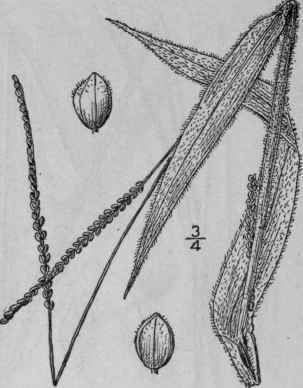
9. Paspalum Setaceum Michx. Slender Paspalum
Fig. 296
Paspalum setaceum Michx. Fl. Bor. Am. 1: 43. 1803.
Stems 8'-21/2° tall, slender. Sheaths and blades very pubescent, the latter 3'-8' long, 1"-3" wide, erect or ascending; racemes 1 1/2'-3 1/2' long, more or less curved, generally solitary, occasionally 2, on a long-exserted slender peduncle, with 1 or 2 additional shorter peduncles from the same upper sheath; spikelets about 3/4" long, broadly obovate; the first scale 3-nerved, pubescent, with glandular hairs, the second scale 2-nerved, the midnerve rarely if ever present, glabrous or nearly so.
In dry fields, New Hampshire to Nebraska. Florida and Texas. Ascends to 2200 ft. in Virginia. Aug.-Sept. Beard-grass. Pitchfork-grass.
10. Paspalum Muhlenbergii Nash. Muhlenberg's Paspalum
Fig. 297
Paspalum Muhlenbergii Nash, in Britton, Man. 75. 1901.
A tufted branching perennial, with pubescent narrow leaf-blades, and glabrous spikelets. Culms at first erect, finally reclining, 1 1/4°-2 1/2° long; sheaths commonly pubescent all over with long hairs, or sometimes only on the margins; blades flat, of medium texture, more or less pubescent on both surfaces with long hairs, linear to linear-lanceolate, 8' long or less, 3 1/2"-6" wide; racemes single or in pairs, 2'-4' long, the rachis less than i" wide; spikelets in pairs, about 1" long and less than 1" wide, oval or broadly obovate, the 2 outer scales 3-nerved, or the second one rarely 2-nerved by the suppression of the midnerve.
In fields or in sandy or stony ground, New Hampshire to Florida and Texas. Aug.-Oct.

II. Paspalum Debile Michx. Yellow-Haired Paspalum
Fig. 298
Paspalum debile Michx. Fl. Bor. Am. 1: 44.
1803. Paspalum supinum Bosc; Poir. in Lam. Encycl.
5: 29. 1804. Paspalum dasyphyllum Ell. Bot. S. C. & Ga. I:
105. 1817.
A tufted branching yellowish green perennial, with flat leaf-blades which are pubescent with long yellowish hairs, and pubescent spike-lets. Culms 8-2° tall, stout; leaves densely pubescent with long yellowish spreading hairs; blades flat, thick, lanceolate, 8' long or less, usually 5"-10" broad; racemes usually but little exserted, in 2's or 3's on the main culm, single on the branches, 1 1/2-4' long, rather stout, the rachis about 1/2" wide; spikelets in pairs, about 1" long and a little less than 1" wide, broadly obovate, the first scale usually more or less pubescent with glandular-tipped hairs, 3-nerved, the second scale glabrous, commonly 2-nerved.
In dry sandy places, South Carolina to Missouri, south to Florida and Texas. June-Sept.
12. Paspalum Laeve Michx. Field Paspalum
Fig. 299
Paspalum laeve Michx. Fl. Bor. Am. 1: 44. 1803. Paspalum angustifolium Le Conte, Journ. de Phys. 91:
285. 1820. Paspalum australe Nash, in Britton, Man. 1039. 1901.
A nearly glabrous perennial, with flat leaf-blades and glabrous spikelets. Culms 1°-3° tall; leaf-sheaths glabrous, or hirsute on the margins, compressed; blades up to 16' long, 2 1/2"-4" wide, erect or nearly so, often drooping at the apex, glabrous, or the upper surface more or less hairy; racemes 2-6, 1 1/4'-4' long, the rachis less than 1/2" wide; spikelets singly disposed, 1 1/4"- 1 1/2" long and 1"-1 1/4" wide, oval, the outer 2 scales firm, 5-nerved, the lateral nerves approximate.
In fields and sandy, places, Maryland to Florida and Texas.


Continue to:


My Books

