


1. Lycopodium L. Sp. Pi. 1100. 1753. Part 4
Description
This section is from the book "An Illustrated Flora Of The Northern United States, Canada And The British Possessions Vol1", by Nathaniel Lord Britton, Addison Brown. Also available from Amazon: An Illustrated Flora of the Northern United States, Canada and the British Possessions. 3 Volume Set..
1. Lycopodium L. Sp. Pi. 1100. 1753. Part 4
8. Lycopodium Annotinum L. Stiff Club-Moss
Fig. 107
Lycopodium annotinum L. Sp. PI. 1103. 1753.
Stems prostrate, creeping, 1°-3° or more long, stiff, rarely pinnately branching, leafy, with numerous aerial branches, these 5-10' high, simple or 1-3 times forked, the divisions mostly fertile; leaves uniform, 8-ranked, spreading horizontally or somewhat re-flexed, with upward curved apices, lanceolate to linear-lanceolate, broadest at the middle or above, serrulate, pungent; spikes 1 or several, oblong-cylindric, 1/2-1 1/4 long, the sporophyls broadly ovate-subulate, with erose margins.
In woods and thickets, commonly in dry soil, Labrador to Alaska, south to Pennsylvania, Michigan, Colorado and Washington. Also in Europe and Asia. Mountain forms with more rigid pointed leaves have been separated as var. pungens. Autumn. Called also Interrupted club-moss.
9. Lycopodium Alpinum L. Alpine Club-Moss
Fig. 108
Lycopodium alpinum L. Sp. PI. 1104. 1753-
Main stem prostrate, creeping (9'-1 1/2° long) at or near the surface, with numerous ascending freely branched aerial stems 1 1/2'-4' high; branches crowded, glaucous, the fertile ones terete and longer than the others, with subulate leaves, the foliar ones strongly dorsiventral with leaves of 3 kinds in 4 rows, those of the upper row narrowly ovate, acute, those of the lateral rows thick, asymmetrical, falcate, the tips decurved, those of the under row trowel-shaped; spikes sessile, 3/8'-3/4' long; sporophyls ovate, erose, acute.
In woods, Quebec and Labrador to Washington and Alaska. Also in Europe and Asia. Cypress-moss. Heath-cypress, Savin-leaved club-moss.
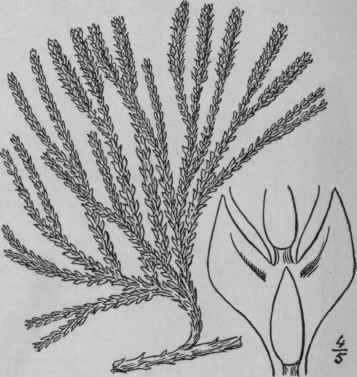

10. Lycopodium Sitchense Rupr. Alaskan Club-Moss
Fig. 109
Lycopodium sitchense Rupr. Beitr. Pfl. Russ. Reich. 3: 30. 1845.
Stems prostrate, 8'-15' long, nearly superficial, sending up numerous aerial stems, these several times dichotomous, the branches terete, vertical, forming compact tufts 2'-3' high, with few or numerous stronger projecting fertile branches; leaves of the branchlets 5-ranked, appressed or spreading and curved upwards, linear, thick, entire, acute; spikes sessile or upon short (up to 1' long) minutely bracteate peduncles, solitary, cylindric; sporophyls ovate, acuminate or long-subulate, the margins erose.
In cold woods, Labrador and Quebec to Alaska, south to Washington, New York and northern New England.
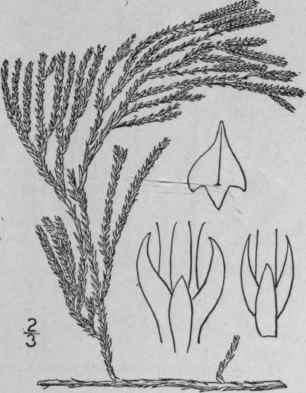
II. Lycopodium Sabinaefolium Willd. Cedar-Like Club-Moss
Fig. No
Lycopodium sabinaefolium Willd. Sp. PI. 5: 20. 1810.
Horizontal stems extensively creeping at or near the surface of the ground and occasionally branching, with numerous freely branched assurgent aerial stems, the branches of these 2'-4' long, loosely clustered, dorsiventrally flattened; leaves ascending, slender, subulate, nearly equal, in 4 rows upon the terminal and subterminal branchlets, those of the lateral rows slightly larger, thicker and more widely spreading than the usually subappressed leaves of the upper and lower rows; peduncles 3/4'-2' long, slender, bracteate, terminal upon the main terete branches; spikes mostly solitary (casually 3), 1/2'-1 1/4' long, the sporophyls broadly ovate, acuminate, greenish, with scarious erose margins.
In cold mountain woods, Prince Edward Island, Quebec, northern New England and Ontario.

Continue to:


My Books

