


1. Juncus L. Sp. Pi. 325 (1753). Part 14
Description
This section is from the book "An Illustrated Flora Of The Northern United States, Canada And The British Possessions Vol1", by Nathaniel Lord Britton, Addison Brown. Also available from Amazon: An Illustrated Flora of the Northern United States, Canada and the British Possessions. 3 Volume Set..
1. Juncus L. Sp. Pi. 325 (1753). Part 14
39. Juncus Polycephalus Michx. Many-Headed Rush
Fig. 1204
Juncus polycephalus Michx. Fl. Bor. Am. 1: 192. 1803. Juncus Engelmanni Buch. Krit. Verz. June. 67. 1880.
Stem stout, about 30 high, compressed, 2-4-leaved. Leaves 20' in length or less, the upper shorter; blades vertically flattened, 1 1/2-4" broad, the septa incomplete, or the blades rarely narrower, merely compressed, and with complete septa; inflorescence 3 1/2'-12' high, its leaves with nearly obsolete blades; heads globose, 3 1/2"-5" in diameter; perianth 1 1/2"-2" long, its parts subulate; stamens 3, one-half to three-fourths as long as the perianth; anthers shorter than the filaments; capsule subulate, 1-celled, exceeding the perianth, the valves remaining united by the slender beak, their margins finally involute; seed narrowly oblong, about i" long, acute at each end, witli nearly straight tips, reticulate in about 12 rows, the areolae smooth.
In swamps, Virginia to Missouri, Florida and Texas.
Juncus validus Coville, which has beakless capsules and leaves with complete septa, is recorded from Missouri; Arkansas, Oklahoma, Mississippi and Texas.

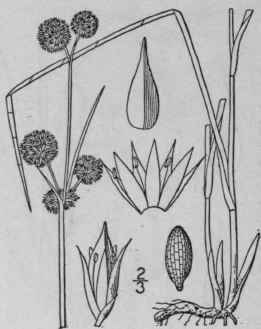
40. Juncus Scirpoides Lam. Scirpus-Like Rush
Fig. 1205
Juncus scirpoides Lam. Encycl. Meth. Bot. 3: 267. 1789.
Stems 8-3° high, erect, terete, in clusters from short, horizontal rootstocks. Stem leaves 1-3; blades terete, 1" thick or less, usually less than 4' long, the septa perfect; basal leaves similar, but with longer blades; inflorescence strict or slightly spreading, sometimes 6' in length; heads 2-30, either simple, globose, 3"-4" in diameter in flower, and 4"-5 1/2" in fruit, or lobed, and of slightly greater diameter; perianth 1 1/4"-1 3/4" long, its parts subulate, the inner somewhat shorter; stamens equalling the inner perianth-parts; capsule subulate, i-celled, its long beak exceeding the perianth; seed oblong, abruptly apiculate at either end, 1/5"-1/4" long, reticulate in 14-20 longitudinal rows, the areolae smooth.
New York to Florida, Missouri and Texas.
Juncus megacephalus M. A. Curtis, doubtfully admitted into our first edition from Virginia, is not definitely known to grow north of North Carolina.
41. Juncus Brachycephalus (Engelm.) Buch. Small-Headed Rush
Fig. 1206
Juncus brachycephalus Buch. in Engler, Bot. Jahrb. 12:
268. 1890. Juncus canadensis var. brachycephalus Engelm. Trans. St.
Louis Acad. 2: 474. 1868.
Stems 1°-2 1/2° high, tufted from a branching root-stock, erect or occasionally reclining and rooting at the nodes, 2-4-leaved; leaves all with well developed blades, the lower commonly 4'-8' long; inflorescence commonly 2 1/2'-6' high, with spreading branches, its lowest bract foliose; heads top-shaped, 2-5-flowered; perianth 1"-1 1/4" long, its parts green, or reddish brown above, with hyaline margins, lanceolate, obtuse or sometimes acute, the outer shorter than the inner; stamens 3; anthers much shorter than the filaments; capsule reddish brown, about one-half longer than the perianth, ovoid-oblong, acute to obtuse, tipped, 3-sided, 1-celled; seed 1/3"-1/2" long, with narrowly oblong body, short-tailed at either end, 20-30 ribbed somewhat cross-barred the intervening spaces finely cross-lined.
Maine to Pennsylvania, Missouri and Wisconsin.

Continue to:


My Books

