


Voluntary Arbitration
Description
This section is from the book "Elementary Economics", by Charles Manfred Thompson. Also available from Amazon: Elementary Economics.
Voluntary Arbitration
As soon as the employer and his striking employees are agreed to try to settle their differences peacefully they are ready for arbitration. The usual practice in this country has been for each side to select an equal number of arbitrators, the arbitrators themselves selecting another so as to avoid the possibility of a tie vote. Each side then presents its case. The strikers explain their grievances, and submit as much proof as possible in an effort to prove that the employer ought to remove their cause. If the question of wages is the cause of the strike, the men are likely to argue not only that they are entitled to a raise because business conditions will permit it, but also that their present wage is inadequate to support their families properly. The usual contention of the employer is that any increase in wages will ruin his business. The arbitrators soon learn, if indeed they do not know already, that the claim of each party is likely to be greater than its expectation. This is but natural since arbitration means compromise. It is their business then to sift all the evidence offered and even to make investigations of their own. Finally, they render a decision, which ordinarily both sides accept in good faith. Occasionally, however, one or the other party to the agreement, becoming dissatisfied with the award, finds a pretext for undoing all that the arbitrators have done.
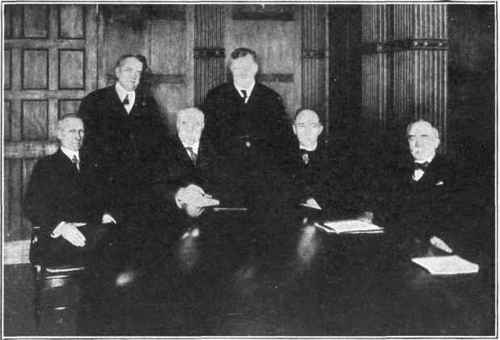
Copyright Underwood & Underwood, New York
An Arbitration Board.
Continue to:


My Books

