


Methods Employed To Force The Demands Of Labor
Description
This section is from the book "Elementary Economics", by Charles Manfred Thompson. Also available from Amazon: Elementary Economics.
Methods Employed To Force The Demands Of Labor
The chief weapon employed by organized labor to get higher wages, shorter working hours, and better surroundings has been, and is now, the strike. To strike means to quit work in a body. No other method has been found to be so effective, since the employer as well as his striking employees feels the evil effects of idleness. Usually strikers have the moral support of the general public, which may be secured and retained by advancing moderate demands and by abstaining from violence. Often in spite of the exercise of due care, individual strikers, and even groups, breaking away from restraint, hurt the cause by committing acts of lawlessness. Especially is this likely to happen when the employer attempts to continue his business operation by employing nonunion laborers, known in union circles as "scabs." Sometimes these nonunion men are bona fide workers; sometimes they are strike-breakers, who follow the dangerous calling of filling temporarily the place of men on a strike, irrespective of the nature of the work. They run great risks and are paid high wages. When unemployed they usually loaf in low-class saloons, ready at a moment's notice to assist in breaking a strike if the employer is willing to pay their price.
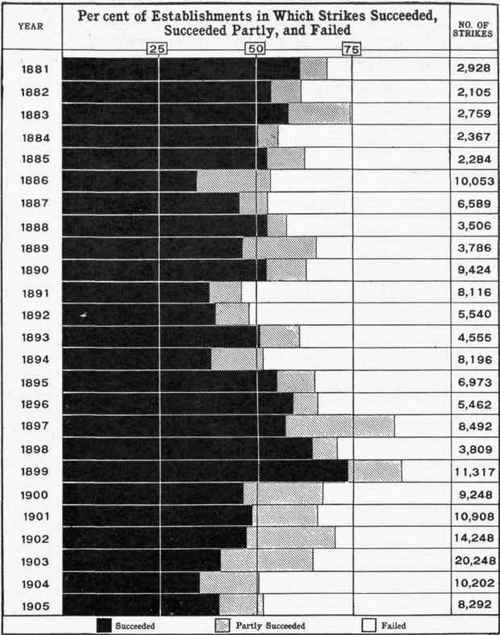
The claim is frequently made that the loss of wages caused by strikes is greater than the increases gained by the strikers that win. This claim, while it has some foundation, is exaggerated. From the best available data on strikes and their cost, we are justified in concluding that the per capita annual cost of strikes in this country during the past generation, if spread over all employees, is small; also that if the cost be confined to organized labor it is not prohibitive or even excessive. To say that strikers have lost a billion dollars in wages since 1880, is estimating the cost in one way; to say that the per capita annual cost to all employees is one dollar, is estimating it in another way. The leading authority on English labor history asserts that the annual strike loss sustained by English employees is not greater than the loss caused by an extra half-holiday each year; that is, that the loss sustained by each English laborer is equal to a half day's wages. Dissatisfied employees may also resort to the boycott, which simply means that they, assisted by their friends and sympathizers, refuse to buy goods of the employers against whom they have a grievance.
Continue to:


My Books

