


Fixing The Current Interest Rate
Description
This section is from the book "Elementary Economics", by Charles Manfred Thompson. Also available from Amazon: Elementary Economics.
Fixing The Current Interest Rate
We may now inquire how the current rate of interest is fixed. Since the borrowers are really buyers of capital and the lenders sellers of capital we can apply the principle developed in the chapter on determining the market price of goods. Like buyers of goods, borrowers have a maximum price (interest rate) in mind; and lenders, like sellers, consider only a minimum price (interest rate). Borrower A, to revert to Fig. 11, is willing to go as high as 12 per cent but no higher. Borrower B will go no higher than 8 per cent, while borrowers C and D have in mind a maximum rate of 5 and 4 per cent, respectively. Lender H must have at least 12 per cent; lender G, 8 per cent; lender F, 5 per cent; and lender
E, 4 per cent. Obviously, any one of the lenders would be willing to supply, to the extent of his lending capital, the wants of borrower A. But A, eager to pursue his own economic advantage, quickly sees, since he does not desire all the capital available, that some of the lenders have a minimum rate far below his maximum. Also those with lower minimum rates will not permit any one of their number to secure A's maximum rate at the expense of leaving their savings uninvested. Thus from the opposing forces there emerges an interest rate which will permit the largest amount of money to be loaned. This we call the current rate, and its location may be illustrated as follows:
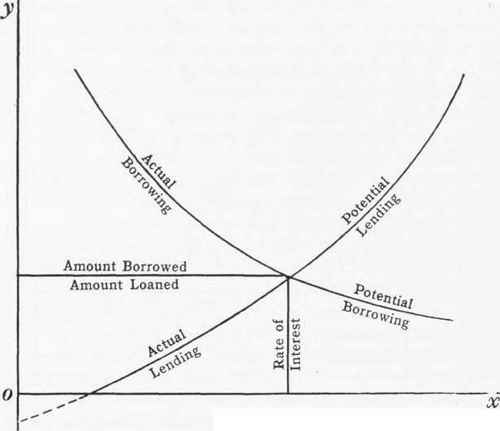
Fig. 13.
Continue to:


My Books

