


Competitive Profits Resemble Rent
Description
This section is from the book "Elementary Economics", by Charles Manfred Thompson. Also available from Amazon: Elementary Economics.
Competitive Profits Resemble Rent
There is one striking similarity between profits and rent. Rent, as we have seen, is a differential; that is, it arises from differences in fertility or location. Profits likewise owe their existence to differences. The best enterpriser, like the best farm land, produces abundantly; and like the best farm land he cannot produce enough for all. Consequently, society is compelled to resort to poorer enterprisers just as it is to poorer lands. But the costs of production of poorer enterprisers are higher than for better enterprisers in the same industry, and they must get a return equal to what they have paid for the use of land, labor, and capital, in addition to their own wages. In other words, the poorest enterpriser in any industry tends to set the price of its product, while all other enterprisers in the same industry enjoy a reward, called profits, for their superior skill. As a result, profits, like rent, do not enter into price. Price fixes profits; profits do not fix price. Figure 14 illustrates this point. Society demands the services of four enterprisers, A, B, C, and D, in a certain industry. A's cost of producing one unit of the product is AL; B's cost is BM; C's cost is CN; and D's cost is DR. Clearly, the market price cannot be less than DR. Consequently, on each unit A will enjoy a profit of LS; B, of MT; and C, of NO. If A's profit were WS instead of LS the price of the product would not be materially affected, for the price DR is still necessary to keep D in business.
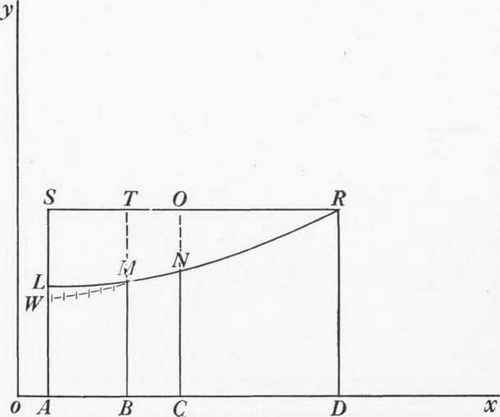
Fig. 14.
Continue to:


My Books

