


40. Indirect Methods Of Marketing. The Primitive Market Place
Description
This section is from the book "Elementary Economics", by Charles Manfred Thompson. Also available from Amazon: Elementary Economics.
40. Indirect Methods Of Marketing. The Primitive Market Place
The first bartering, as we have already noticed, was characterized by the higgling of two individuals alone, uninfluenced by other traders. The next step was the primitive market place, which owed its origin to the accessibility of its location to various tribes; or perhaps to the influence of some neighboring church or monastery which undertook to keep peace among the traders. Here at stated periods, the people assembled, bringing with them the products which they desired to exchange for other goods. Very soon, we may imagine, it was discovered that certain goods, such as iron, spices, salt, and woolen cloth, were very generally in demand. Naturally, some more alert than their neighbors saw the advantage of devoting more time to the production of those goods which were generally desired. They saw also that they could supply their own wants for other goods easier by resorting to the market place than by direct production. At the same time another group known as merchants saw the advantage of giving their whole time to the collection of goods for these markets. Gradually there grew up the custom of using money in making exchanges, the merchants buying goods from producers and selling them again to consumers. From such crude beginnings has developed the highly complicated industrial life of the present time with its producing to sell and its buying to consume.
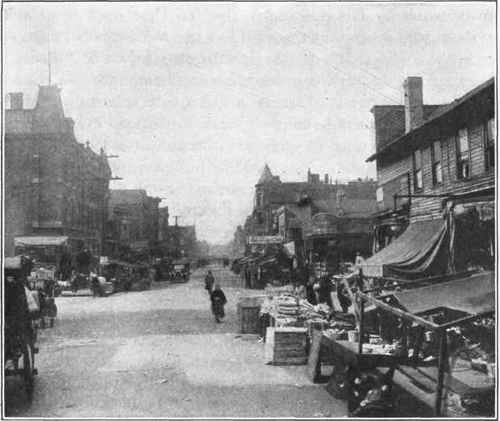
Maxwell Street, Chicago.
Here business is conducted on the street, very much as it is in an ordinary retail store.
Continue to:


My Books

